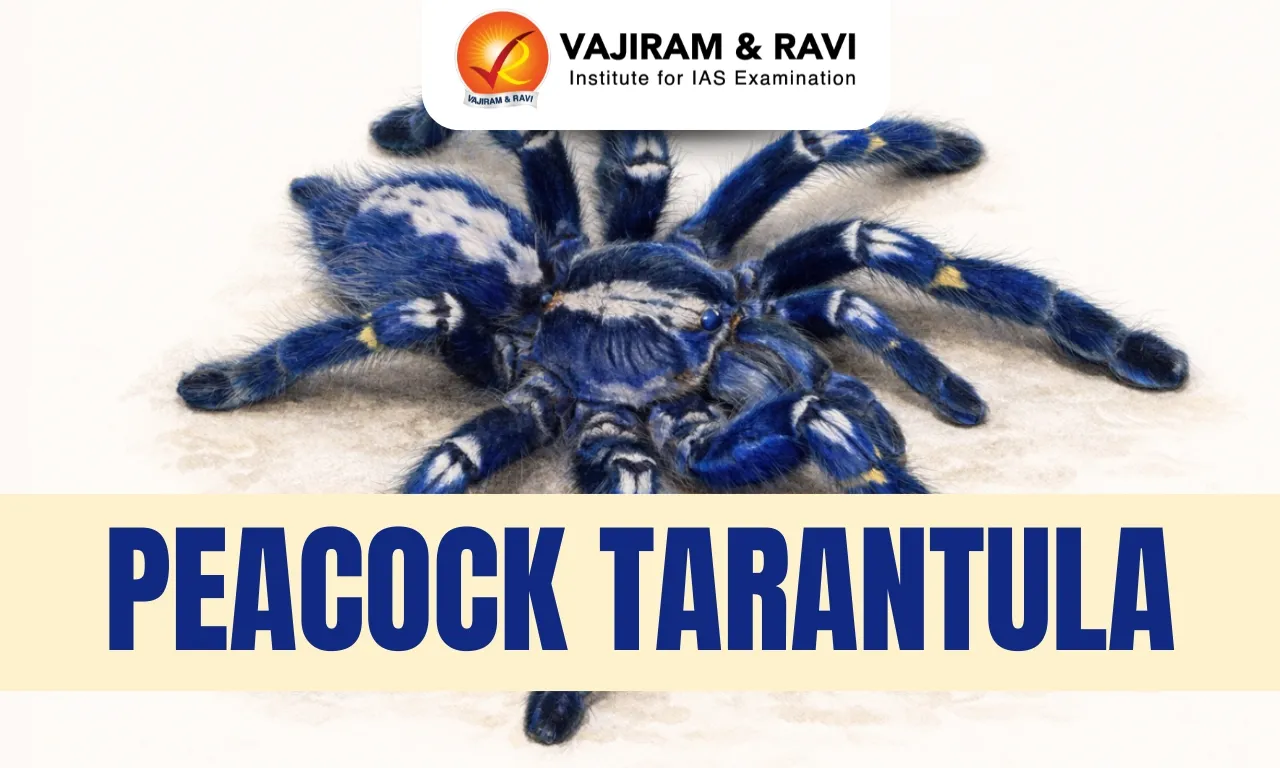
The Peacock Tarantula is one of the most stunning and rare spider species in the world, known for its vibrant metallic blue coloration and unique patterns. Scientifically called Poecilotheria metallica, this species belongs to the arboreal tarantulas found primarily in India. Due to its limited habitat and exotic beauty, it has become highly popular among wildlife enthusiasts and conservationists.
About Peacock Tarantula
- The Peacock Tarantula (Poecilotheria metallica) is one of the rarest and most visually striking spiders in the world, famous for its metallic blue coloration.
- It belongs to the Theraphosidae family and is classified as a tarantula species with unique ornamental patterns.
- This species is endemic to India, primarily found in parts of Andhra Pradesh.
- Its natural habitat in India is only limited to some forest areas, which makes the species highly vulnerable to environmental changes and habitat destruction.
- In its natural habitat, it is an arboreal species, meaning it lives on trees, occupying tree holes, bark crevices, and elevated surfaces.
- It is also known as the Gooty Sapphire Ornamental Tarantula, named after the region where it was first discovered.
- The spider has a distinctive bright blue body with yellow and white markings, forming geometric patterns on its legs and abdomen.
- It can grow up to 6–8 inches in leg span, making it a large and impressive spider.
- The Peacock Tarantula is a nocturnal hunter, remaining hidden during the day and becoming active at night.
- It is an active predator that does not rely on webs but instead uses speed and venom to capture prey such as insects and small animals.
- Known for being fast and agile, it can move quickly and climb vertical surfaces with ease.
- Although it is venomous, its bite is not fatal to humans but can cause pain, swelling, and irritation.
- Females have a long lifespan (up to 15 years), while males have a shorter life cycle.
- During reproduction, females lay egg sacs containing around 50–150 eggs, which they guard until hatching.
- The species is listed as Critically Endangered by the International Union for Conservation of Nature (IUCN) due to its declining population.
- Major threats include deforestation, habitat loss, and illegal collection for the pet trade.
- It plays an important ecological role by controlling insect populations and supporting biodiversity.
- Its blue coloration is due to structural coloration, where microscopic structures reflect light rather than pigments producing the color.
UPSC CSE Prelims PYQ
Regarding Peacock tarantula (Gooty tarantula), consider the following statements:
- It is an omnivorous crustacean.
- Its natural habitat in India is only limited to some forest areas.
- III. In its natural habitat, it is an arboreal species.
Which of the statements given above is/are correct?
- I only
- I and III
- II only
- II and III


 Last updated on Oct, 2026
→ UPSC 2027 Notification will be released on 13 January 2027 at upsconline.nic.in.
→ Check Nobel Prize 2026 Winners List here.
→ Download PIB PRiSM Monthly Magazine 2026 here.
→ Check UPSC Monthly Current Affairs Magazine The Recitals here.
→ Check out the latest UPSC Syllabus here.
→ Download UPSC Model Answers for Mains 2026
→ UPSC Mains Question Paper 2026 is out now for Essay & GS Paper 1, 2, 3 & 4.
→ UPSC Calendar 2027 has been released.
→ Enroll in Vajiram & Ravi’s UPSC Mains Test Series 2027 for structured answer writing practice, expert evaluation, and exam-oriented feedback.
→ Join Vajiram & Ravi’s UPSC Mentorship Program 2027 for personalized guidance, strategy planning, and one-to-one support from experienced mentors.
→ Go through the UPSC Mains Previous Year Papers to enhance your preparation.
→ UPSC has released UPSC Toppers List 2025 with the Civil Services final result on its official website.
→ Also check Best UPSC Coaching in India
Peacock Tarantula FAQs
Q1. What is the Peacock Tarantula?+
Q2. Where is the Peacock Tarantula found?+
Q3. Why is the Peacock Tarantula called so?+
Q4. Is the Peacock Tarantula endangered?+
Q5. What type of habitat does it live in?+
Tags: ecology and environment geography geography notes peacock tarantula