About Petra:
- It is a historic and archaeological city located in southern Jordan.
- It was the center of an Arab kingdom in Hellenistic and Roman times.
- Petra was established in 312 AC, which makes it around 2000 years old.
- It became the capital of the Nabateans people, an Arab tribe, who were referred to in the Bible.
- Under Nabataean rule, Petra prospered as a centre of the spice trade that involved such disparate realms as China, Egypt, Greece, and India.
- The Romans conquered Petra in 106 A.C, and they turned the territory into a Roman province of Arabia.
- During the second and third centuries, Petra continued to grow, and in the seventh century, the Romans lost the power of Petra to Islam.
- In the 12th century, Petra was once again taken by different leaders, and for a while, Petra was hidden until it was found by Swiss explorer Johann Ludwig Burckhardt in 1812.
- Features:
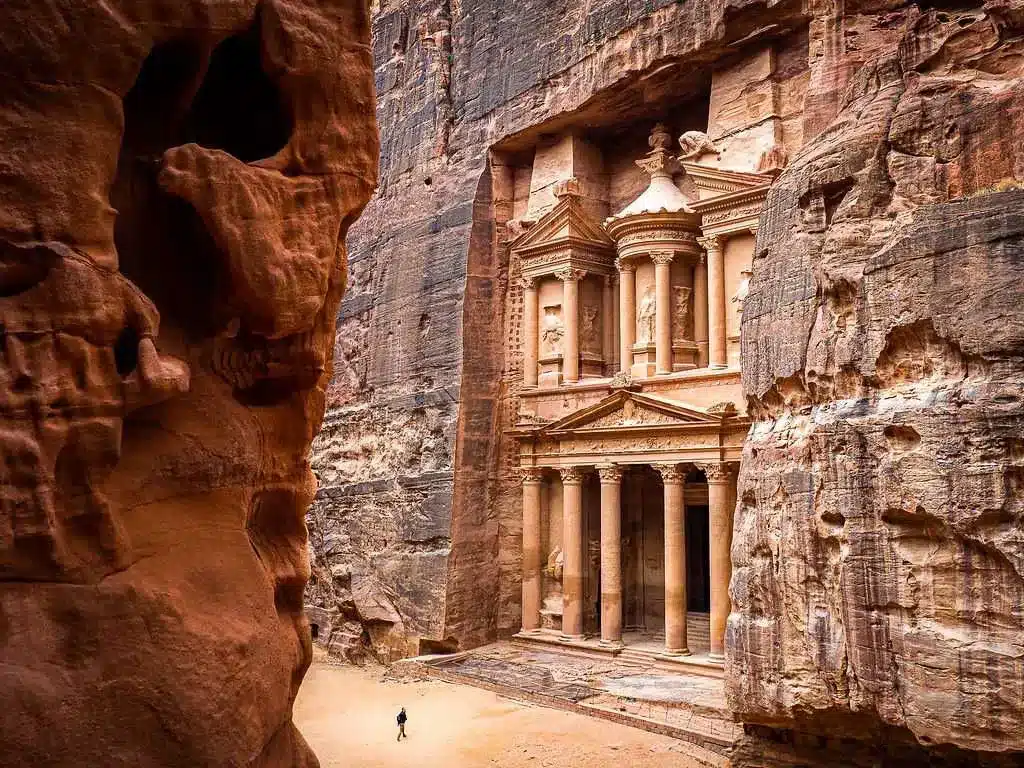
- Many of Petra’s buildings were carved directly into rocky sandstone cliffs.
- The name Petra comes from the Greek word for “rock.”
- The city of Petra was built on a terrace with the Wadi Musa (the Valley of Moses) running through it east to west.
- The valley is enclosed by sandstone cliffs veined with shades of red and purple varying to pale yellow.
- Petra is home to roughly 800 tombs, therefore known as the “Royal Tombs”, with the most renowned being ‘The Treasury’.
- To support the ancient city’s large population, its inhabitants maintained an extensive hydrological system, including dams, cisterns, rock-carved water channels, and ceramic pipes.
- Petra has also been referred to as the “Rose City” because of the color of the stones used in its buildings.
- Petra has been a UNESCO World Heritage Site since 1985.
Q1: What is a UNESCO World Heritage Site?
A World Heritage site is a landmark or area with legal protection by an international convention administered by the United Nations Educational, Scientific and Cultural Organisation (UNESCO). World Heritage sites are designated by UNESCO for having cultural, historical, scientific or other forms of significance. The sites are judged to contain “cultural and natural heritage around the world considered to be of outstanding value to humanity (OUV)”.
Source: 2,000-year-old skeletons and ‘Holy Grail’ cup unearthed in secret Petra tomb


 Last updated on Oct, 2026
→ UPSC 2027 Notification will be released on 13 January 2027 at upsconline.nic.in.
→ Check Nobel Prize 2026 Winners List here.
→ Download PIB PRiSM Monthly Magazine 2026 here.
→ Check UPSC Monthly Current Affairs Magazine The Recitals here.
→ Check out the latest UPSC Syllabus here.
→ Download UPSC Model Answers for Mains 2026
→ UPSC Mains Question Paper 2026 is out now for Essay & GS Paper 1, 2, 3 & 4.
→ UPSC Calendar 2027 has been released.
→ Enroll in Vajiram & Ravi’s UPSC Mains Test Series 2027 for structured answer writing practice, expert evaluation, and exam-oriented feedback.
→ Join Vajiram & Ravi’s UPSC Mentorship Program 2027 for personalized guidance, strategy planning, and one-to-one support from experienced mentors.
→ Go through the UPSC Mains Previous Year Papers to enhance your preparation.
→ UPSC has released UPSC Toppers List 2025 with the Civil Services final result on its official website.
→ Also check Best UPSC Coaching in India