Phulkari Latest News
Several years after Punjab’s traditional embroidery, Phulkari, secured the coveted Geographical Indication (GI) tag, the craftspersons who keep the centuries-old practice alive continue to struggle for recognition and a sustainable livelihood.
About Phulkari
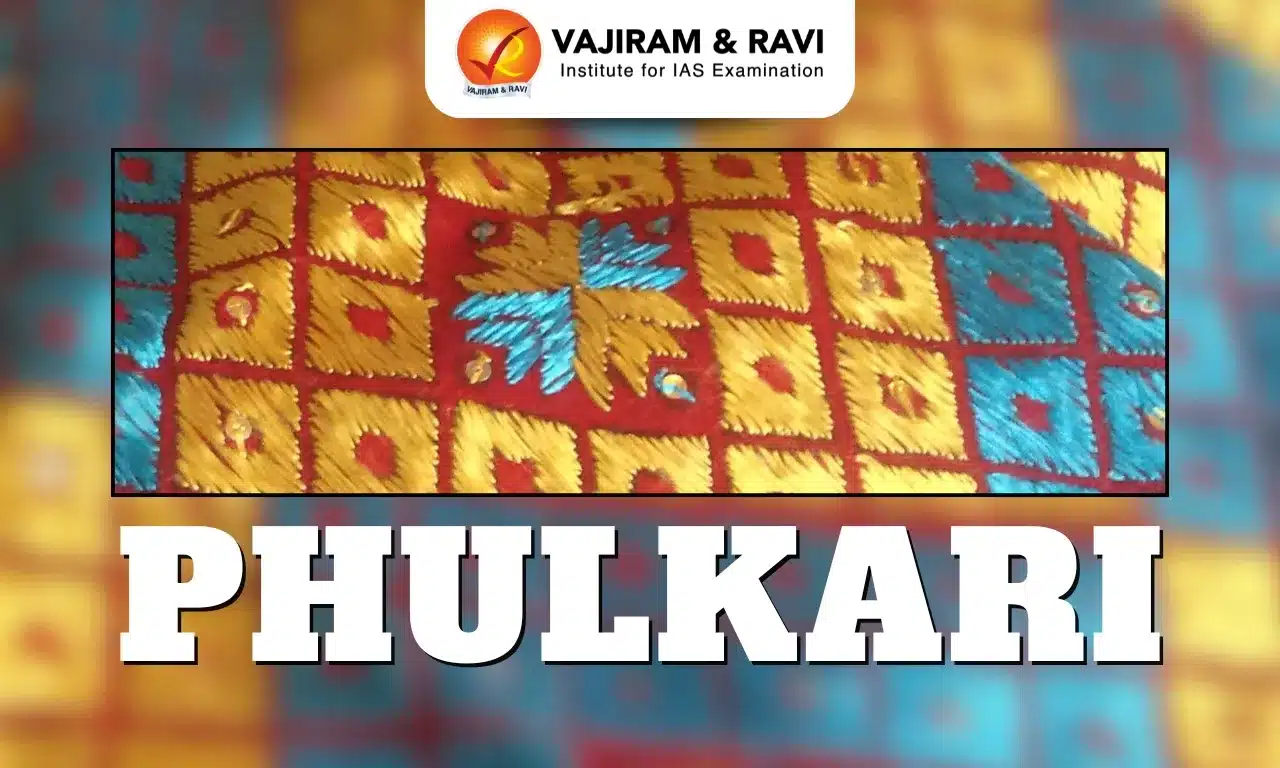
- Phulkari, meaning “flower work,” is a traditional embroidery art of Punjab.
- There are various theories about the origin of phulkari.
- Some believe this embroidery dates back to the 7th century CE, while others suggest it originated from Iran, where it was known as Gulkari.
- However, distinct styles of phulkari have been identified, making it uniquely Punjabi.
- References to phulkari can be found in ancient texts, folk legends, and literature, with the earliest mention in the 18th-century Punjabi literature.
- It symbolizes life and is intricately linked to the birth of a girl child in Punjabi families, where mothers and grandmothers start embroidering Phulkari dupattas upon her birth.
- Girls learned to embroider early, with the number of phulkaris reflecting the family’s status and marking cultural milestones.
- It received a Geographical Indication (GI) tag in 2010.


Phulkari Features
- It’s an amalgam of cotton and silk.
- The cloth used is usually hand-woven thick cotton, called ‘ khadder’. While the threads are thin, lustrous, and breakable silk, called ‘pat’.
- The cloth is usually dyed red, but can be white, grey, or black also.
- And the treads are a myriad of colors, ranging from the rich dark pink to soothing off-whites.
- The stitch is intricate, small, and completely fills the cloth. The stitch can be vertical, horizontal, or diagonal to create the shadow effect.
- Phulkari embroidery makes use of the least complicated patterns to create extremely intriguing designs.
- The designs and patterns can vary from geometrical figures to flowers to local fauna. Peacocks, elephants, birds, and camels appear frequently.
- Phulkari’s product range includes embroidered chaddars, dupattas, and stoles, traditionally worn by brides or for ceremonies.
News: TI

 Last updated on Oct, 2026
→ UPSC 2027 Notification will be released on 13 January 2027 at upsconline.nic.in.
→ Check Nobel Prize 2026 Winners List here.
→ Download PIB PRiSM Monthly Magazine 2026 here.
→ Check UPSC Monthly Current Affairs Magazine The Recitals here.
→ Check out the latest UPSC Syllabus here.
→ Download UPSC Model Answers for Mains 2026
→ UPSC Mains Question Paper 2026 is out now for Essay & GS Paper 1, 2, 3 & 4.
→ UPSC Calendar 2027 has been released.
→ Enroll in Vajiram & Ravi’s UPSC Mains Test Series 2027 for structured answer writing practice, expert evaluation, and exam-oriented feedback.
→ Join Vajiram & Ravi’s UPSC Mentorship Program 2027 for personalized guidance, strategy planning, and one-to-one support from experienced mentors.
→ Go through the UPSC Mains Previous Year Papers to enhance your preparation.
→ UPSC has released UPSC Toppers List 2025 with the Civil Services final result on its official website.
→ Also check Best UPSC Coaching in India
Phulkari FAQs
Q1. What is Phulkari?+
Q2. What does the word “Phulkari” mean?+
Q3. When did Phulkari receive a Geographical Indication (GI) tag?+
Q4. What materials are traditionally used in Phulkari?+
Tags: phulkari prelims pointers upsc current affairs upsc prelims current affairs