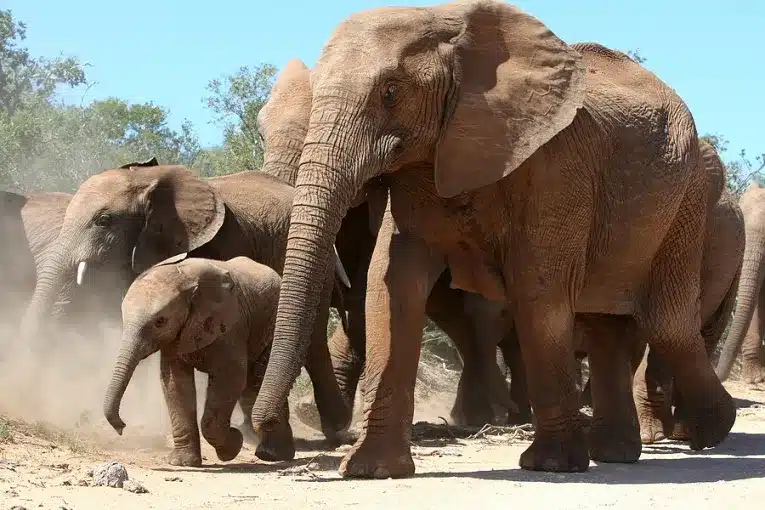
About Placental Mammals:
- A placental mammal is an animal that has a placenta.
o The placenta is a vascular organ formed during gestation of female mammals (except for monotremes and marsupials), built up of maternal and fetal tissues jointly, and which serves for the transport of nutrient substances from the mother to the fetus and to eliminate fetal waste products.
- Placental mammals carry their fetus in the uterus until they are born at an advanced stage.
- The young get their nourishment through a placenta before birth. The placenta delivers nutrients and oxygen to the fetus in the uterus.
- The placenta permits a long period of fetal growth in the uterus. As a result, the fetus can become large and mature before birth.
- Classified under the subclass Eutheria, placental mammals have 4,000 identified species.
- Fossil evidence shows that the first placental mammals evolved between about 163 million and 157 million years ago during the Jurassic Period (201.3 million to about 145 million years ago).
- The placentals include all living mammals except marsupials and monotremes (egg-laying mammals).
- Marsupials and monotremes have a less-developed, less-efficient type of placenta that limits the gestation period.
What are Marsupials?
- Marsupials are a group of mammals that are known for giving birth to relatively undeveloped young, which then continue to grow and develop outside the womb, typically in a pouch.
- Marsupials have a short-lived placenta that nourishes their young for just a few days before they’re born, the rest of their nutrition coming from the mother’s teats inside the pouch.
- Marsupials have an extra pubic bone, the epipubic bone, to support their pouch.
- There are over 330 species of marsupials. Around two-thirds of them live in Australia. The other third live mostly in South America.
- Examples: Kangaroos, Koalas, Opossums, etc.
Q1: What is brown fat?
Brown fat, also called brown adipose tissue, helps maintain your body temperature when you get too cold. It’s the same fat that bears use to stay warm when they hibernate. Babies are born with a lot of brown fat behind their shoulder blades. Newborns can’t shiver, which is one of the ways the body creates heat. Brown fat acts as a built-in heater.
Source: Marsupials key to discovering the origin of heater organs in mammals


 Last updated on Oct, 2026
→ UPSC 2027 Notification will be released on 13 January 2027 at upsconline.nic.in.
→ Asian Games 2026 are being held in Aichi-Nagoya, Japan, from 19 September to 4 October.
→ Check Nobel Prize 2026 Winners List here.
→ Download PIB PRiSM Monthly Magazine 2026 here.
→ Check UPSC Monthly Current Affairs Magazine The Recitals here.
→ Check out the latest UPSC Syllabus here.
→ Download UPSC Model Answers for Mains 2026
→ UPSC Mains Question Paper 2026 is out now for Essay & GS Paper 1, 2, 3 & 4.
→ UPSC Calendar 2027 has been released.
→ Enroll in Vajiram & Ravi’s UPSC Mains Test Series 2027 for structured answer writing practice, expert evaluation, and exam-oriented feedback.
→ Join Vajiram & Ravi’s UPSC Mentorship Program 2027 for personalized guidance, strategy planning, and one-to-one support from experienced mentors.
→ Go through the UPSC Mains Previous Year Papers to enhance your preparation.
→ UPSC has released UPSC Toppers List 2025 with the Civil Services final result on its official website.
→ Also check Best UPSC Coaching in India