MCC Violation Debate Latest News
- The Model Code of Conduct (MCC), a set of guidelines for political parties during elections, originated in Kerala in 1960 and was later formalised by the Election Commission in 1968, with revisions in 1974 and provisions for the “party in power” added in 1979.
- Its strict enforcement began under T. N. Seshan in 1991.
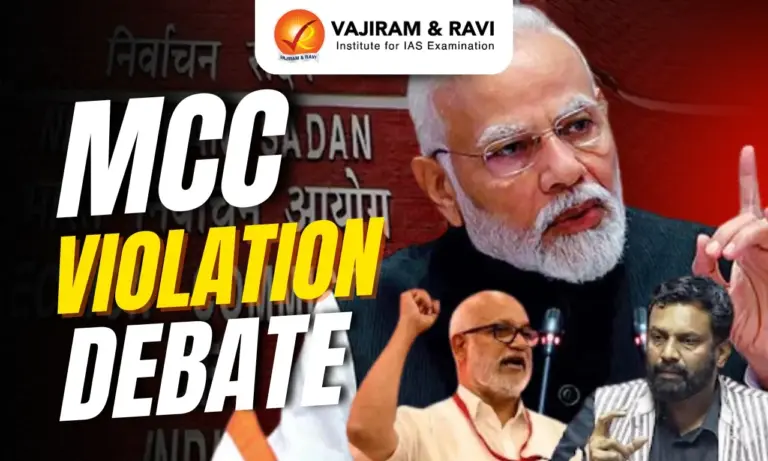
- Recently, PM Modi’s April 18 address has sparked debate over a possible violation of the MCC.
Evolution of the Model Code of Conduct and Recent Controversy
- The Model Code of Conduct (MCC) has evolved through judicial interpretation and electoral practice.
- In the Mohinder Singh Gill v. Chief Election Commissioner, the Supreme Court described Article 324 as a “reservoir of power,” enabling the Election Commission to act where laws are absent.
- Later, the Harbans Singh Jalal v. Union of India clarified that the MCC comes into force from the announcement of the election schedule.
- The Code allows for sanctions ranging from censure to suspension of party recognition.
- Recently, Prime Minister Narendra Modi’s televised address, where he criticised Opposition parties and appealed to voters, has raised concerns about potential violations of the MCC.


PM’s Broadcast and MCC: Legal and Ethical Questions
- The Model Code of Conduct restricts the party in power from using official resources for electoral advantage.
- Clauses 1(a), 1(b), and 4 of Part VII prohibit combining official duties with campaigning, misusing government machinery, and exploiting publicly funded media for partisan purposes.
Concerns Raised by the Broadcast
- The Prime Minister’s April 18 address, broadcast on state-run platforms, has raised concerns as it appears to fall within the scope of these restrictions.
- The issue centres on whether public resources were used for political messaging, making it a potential violation under Part VII of the MCC.
- However, the Election Commission has not yet taken action on related complaints.
Legal Dimension: Representation of the People Act, 1951
- Unlike the MCC, the law under the Representation of the People Act, 1951, is more specific.
- Section 123(3) defines a “corrupt practice” as appealing to voters based on religion, caste, community, race, or language.
- In the Abhiram Singh v. C.D. Commachen judgment, the Supreme Court clarified that such appeals apply to both candidates and voters.
- While the MCC provides flexible guidelines to ensure fairness, the legal provisions impose stricter boundaries.
- The controversy over the broadcast lies at the intersection of these frameworks, raising questions about both ethical conduct and statutory compliance during elections.
PM’s Broadcast and Electoral Law: What Courts and Statutes Say
- Judicial interpretation, especially in Abhiram Singh v. C.D. Commachen, clarified that Section 123(3) of the RPA focuses on appeals based on religion, caste, community, race, or language.
- However, it does not cover broader political messaging such as gender-based appeals or party-targeted campaigning, leaving gaps in its applicability to the April 18 broadcast.
A New Legal Route: Section 123(7)
- A pending petition in the court invokes Section 123(7), which prohibits using government officials or machinery to advance electoral prospects.
- The petition argues that the use of public broadcasters like Doordarshan and Sansad TV, along with PMO resources, may fall under this provision.
Statute vs Code: Different Scopes
- While the law narrowly defines “corrupt practices,” focusing on specific grounds or misuse of official assistance, the Model Code of Conduct (MCC) is broader and examines the use of public resources by the party in power.
- Thus, the broadcast may escape strict statutory violation but still raise concerns under the MCC.
Regulatory Dilemma and Enforcement Challenge
- The Election Commission’s inaction highlights a larger issue: the gap between rigid statutory provisions and the MCC’s flexible framework.
- If the Supreme Court admits the petition, it could test the boundaries of electoral law and redefine how such cases are addressed in the future.

 Last updated on Oct, 2026
→ UPSC 2027 Notification will be released on 13 January 2027 at upsconline.nic.in.
→ Check Nobel Prize 2026 Winners List here.
→ Download PIB PRiSM Monthly Magazine 2026 here.
→ Check UPSC Monthly Current Affairs Magazine The Recitals here.
→ Check out the latest UPSC Syllabus here.
→ Download UPSC Model Answers for Mains 2026
→ UPSC Mains Question Paper 2026 is out now for Essay & GS Paper 1, 2, 3 & 4.
→ UPSC Calendar 2027 has been released.
→ Enroll in Vajiram & Ravi’s UPSC Mains Test Series 2027 for structured answer writing practice, expert evaluation, and exam-oriented feedback.
→ Join Vajiram & Ravi’s UPSC Mentorship Program 2027 for personalized guidance, strategy planning, and one-to-one support from experienced mentors.
→ Go through the UPSC Mains Previous Year Papers to enhance your preparation.
→ UPSC has released UPSC Toppers List 2025 with the Civil Services final result on its official website.
→ Also check Best UPSC Coaching in India
MCC Violation Debate FAQs
Q1. What is PM broadcast MCC violation debate?+
Q2. Why is PM broadcast MCC violation debate important?+
Q3. What laws are involved in PM broadcast MCC violation debate?+
Q4. How do courts view PM broadcast MCC violation debate?+
Q5. What is the Election Commission’s role in PM broadcast MCC violation debate?+
Tags: mains articles MCC violation debate upsc current affairs upsc mains current affairs