NITI Aayog Latest News
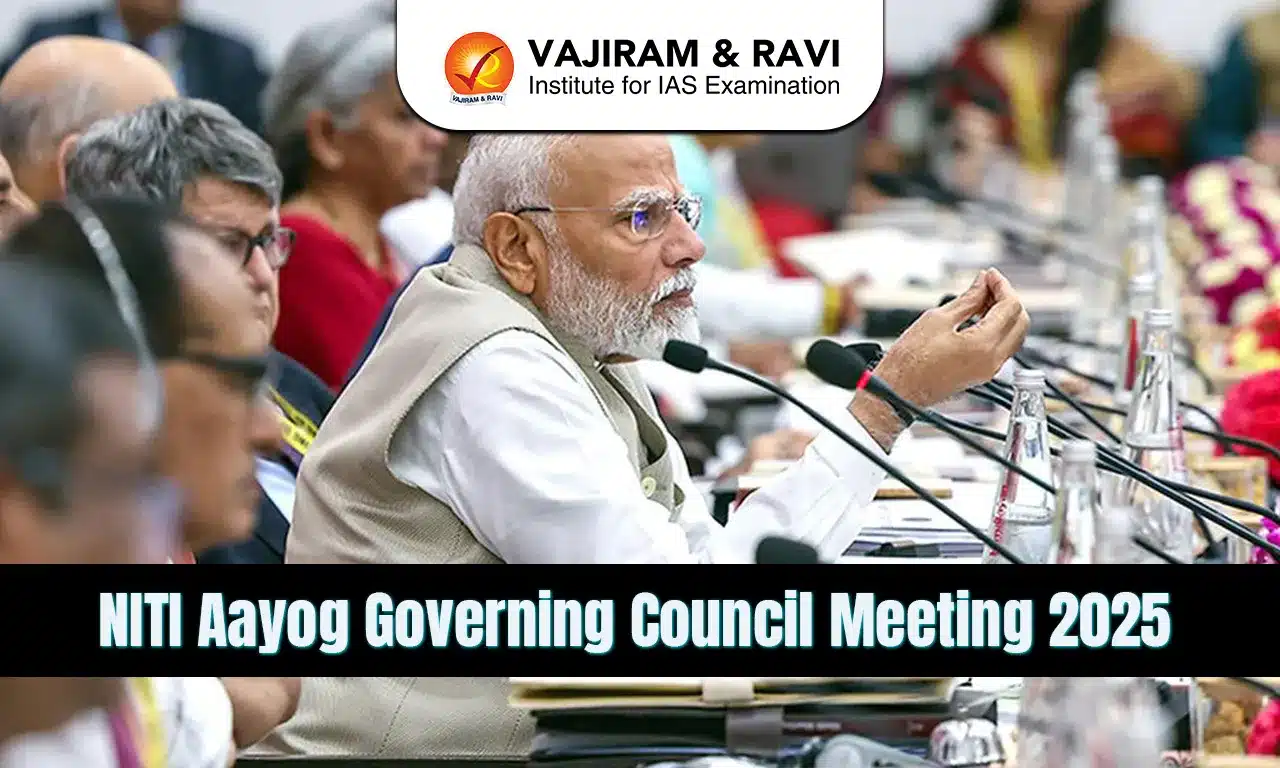
- The 10th meeting of the Governing Council of NITI Aayog, chaired by Prime Minister Narendra Modi, was recently held in New Delhi.
About NITI Aayog
- The NITI Aayog (National Institution for Transforming India) is the premier policy think tank of the Government of India, established in 2015 to replace the Planning Commission.
- Its primary mandate is to promote cooperative federalism, facilitate evidence-based policymaking, and guide India’s long-term developmental strategy toward achieving Viksit Bharat @2047.
- Functions of NITI Aayog
- Formulating strategic and long-term policy frameworks.
- Coordinating between the Centre and states.
- Encouraging innovation, technology-driven governance, and sustainable development.
- Monitoring implementation of key national programmes.
- Functions of NITI Aayog


Governing Council of NITI Aayog
- The Governing Council is the apex decision-making body of NITI Aayog. It is chaired by the Prime Minister of India and comprises:
- Chief Ministers of all states and Union Territories with legislatures.
- Lieutenant Governors of other UTs.
- Union Ministers for key portfolios.
- Vice-Chairperson and senior officials of NITI Aayog.
- This council meets annually to discuss key policy issues, align Centre-state priorities, and foster a collaborative approach to India’s growth and development.
- It plays a crucial role in strengthening “Team India” spirit across different levels of government.
Highlights of PM Narendra Modi’s Address
- Focus on Viksit Bharat @2047
- PM Modi began by emphasizing the shared goal of making India a “Viksit Bharat” (developed nation) by 2047.
- He encouraged each state to align its developmental agenda accordingly, ensuring that every state, city, municipal body, and village transforms into a ‘Viksit’ unit.
- Team India Approach
- The Prime Minister underscored the importance of Centre-state collaboration. “If the Centre and states work together like Team India, no goal is impossible,” he stated.
- He advocated for coordinated planning across sectors such as infrastructure, services, governance, and innovation.
- Modernising Civil Preparedness
- Reflecting on Operation Sindoor and national security concerns, PM Modi emphasized that such efforts should not be one-time responses.
- He urged states to institutionalize civil defence mechanisms and enhance disaster resilience capabilities.
Strategic Recommendations by the PM
- Leverage Free Trade Agreements (FTAs)
- PM Modi advised states to strategically use India’s new FTAs to boost local manufacturing and exports. He called for an investor-friendly regulatory environment and proposed removing outdated laws to attract global investments.
- Tourism Development
- PM Modi proposed the “One State, One Global Destination” initiative. Each state should develop at least one world-class tourist hub with comprehensive infrastructure. This would catalyse both direct tourism revenue and the development of nearby cities.
- Urban and Workforce Reforms
- In response to rapid urbanisation, the Prime Minister stressed the need for future-ready cities built on principles of sustainability, innovation, and resilience. He also called for reforms to integrate more women into the workforce, urging states to craft gender-sensitive laws and policies.
Key State-Level Inputs and Demands
- Tamil Nadu’s Tax Revenue Demand
- Chief Minister M.K. Stalin demanded that states receive a 50% share in central taxes, up from the current 33.16%. He also urged for:
- A dedicated urban transformation mission like AMRUT 2.0.
- A Clean-Ganga-style river rejuvenation mission for Tamil Nadu rivers such as Cauvery and Vaigai.
- Chief Minister M.K. Stalin demanded that states receive a 50% share in central taxes, up from the current 33.16%. He also urged for:
- Andhra Pradesh’s Sub-Group Proposal
- CM N. Chandrababu Naidu proposed forming three sub-groups of states to work with the Centre:
- GDP Growth and Investments
- Population Management
- Technology-Driven Governance (using AI, drones, digital platforms)
- CM N. Chandrababu Naidu proposed forming three sub-groups of states to work with the Centre:
- Chhattisgarh’s 3T Model
- CM Vishnu Deo Sai proposed a 3T (Technology, Transparency, Transformation) development model under the “Chhattisgarh Anjor Vision Document”. It targets:
- Tenfold increase in per capita income.
- Doubling GSDP in five years.
- Naxal-free Chhattisgarh by March 2026.
- CM Vishnu Deo Sai proposed a 3T (Technology, Transparency, Transformation) development model under the “Chhattisgarh Anjor Vision Document”. It targets:
- Punjab’s Concerns on Water and Borders
- CM Bhagwant Mann raised Punjab’s claim over Yamuna river waters and demanded:
- Inclusion of border villages in the Vibrant Villages Programme.
- More funds for anti-drug initiatives and border security.
- Reversal of perceived “step-motherly treatment” by the Centre.
- CM Bhagwant Mann raised Punjab’s claim over Yamuna river waters and demanded:
NITI Aayog Meeting FAQs
Q1. What is the Governing Council of NITI Aayog?
Ans. It is NITI Aayog’s top decision-making body comprising the PM, CMs, LGs, and Union Ministers.
Q2. What was the theme of the 10th Governing Council meeting?
Ans. The theme was “Viksit Rajya for Viksit Bharat @2047.”
Q3. What reforms did PM Modi urge states to implement?
Ans. Modi called for leveraging FTAs, removing obsolete laws, boosting tourism, and increasing women’s workforce participation.
Q4. What was Tamil Nadu’s key demand at the meeting?
Ans. Tamil Nadu demanded a 50% share in central taxes and a Clean-Ganga-style mission for its rivers.
Q5. How many state leaders attended the 2025 NITI Aayog meeting?
Ans. 31 out of 36 CMs and LGs attended the meeting, marking record participation.

 Last updated on Oct, 2026
→ UPSC 2027 Notification will be released on 13 January 2027 at upsconline.nic.in.
→ Check Nobel Prize 2026 Winners List here.
→ Download PIB PRiSM Monthly Magazine 2026 here.
→ Check UPSC Monthly Current Affairs Magazine The Recitals here.
→ Check out the latest UPSC Syllabus here.
→ Download UPSC Model Answers for Mains 2026
→ UPSC Mains Question Paper 2026 is out now for Essay & GS Paper 1, 2, 3 & 4.
→ UPSC Calendar 2027 has been released.
→ Enroll in Vajiram & Ravi’s UPSC Mains Test Series 2027 for structured answer writing practice, expert evaluation, and exam-oriented feedback.
→ Join Vajiram & Ravi’s UPSC Mentorship Program 2027 for personalized guidance, strategy planning, and one-to-one support from experienced mentors.
→ Go through the UPSC Mains Previous Year Papers to enhance your preparation.
→ UPSC has released UPSC Toppers List 2025 with the Civil Services final result on its official website.
→ Also check Best UPSC Coaching in India
Tags: mains articles niti aayog upsc current affairs upsc mains current affairs