What’s in today’s article?
- Why in news?
- What is the PM SVANidhi Scheme?
- News Summary: The study
Why in news?
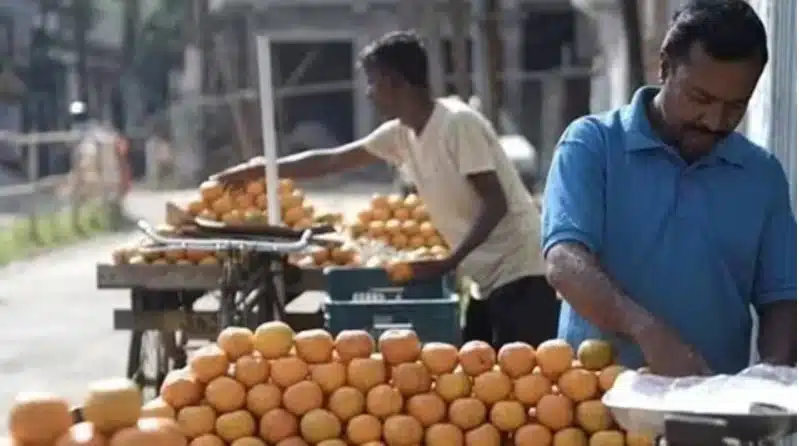
- A study looked at how the PM Street Vendor’s AtmaNirbhar Nidhi (PM SVANidhi), a loan scheme for street vendors, affected their income.
- It found that the first loan of ₹10,000 increased the yearly income of each beneficiary by ₹23,460.


The PM SVANidhi Scheme
- About
- It was launched in 2020 amid the pandemic by the Ministry of Housing and Urban Affairs (MoHUA), Government of India.
- It is a micro-credit facility that provides street vendors a collateral-free loan of Rs 10,000 with low rates of interest (below 12%) for a period of one year, aiding the vendors at getting back on their feet financially.
- In the long term, it aims at –
- Establishing a credit score for the vendors
- Creating a digital record of their socio-economic status
- This will enable street vendors to avail the Central government schemes later, formalise the informal sector of the economy and provide them safety nets and a means of availing loans in the future.
- Need for the Scheme
- Many vendors belong to the informal economy, and often borrow from private lenders which charge them exorbitant rates of interest.
- The COVID-19 pandemic and the nationwide lockdown left daily wage workers and street vendors out of work.
- Eligibility
- All vendors who have been vending from or before (March 24, 2020) and with a certificate of vending can avail the loan.
- As per the Street Vendors Act 2014, the Town Vending Committees (which comprises the local authorities and vendors from an area) issue a certificate of vending after a survey has been conducted of all the vendors.
- Performance of the scheme
- Data on the PM-SVANidhi portal (February 10, 2024) showed that 60.65 lakh first-term loans, 16.95 lakh second-term loans and 2.43 lakh third-term loans have been disbursed so far under the scheme.
News Summary: The study
- About
- The study was commissioned by the Union Ministry of Housing and Urban Affairs.
- It was carried out between January and June 2023 by the Centre for Analytical Finance of the Indian School of Business (ISB).
- The report will be used by the Ministry for its own assessment of PM SVANidhi and is not likely to be made public
- Findings
- 94% of those beneficiaries who had availed the first loan of Rs 10,000 said they used it to make business investments.
- It was 98% in case of those who had availed the second loan.
- The first loan resulted in an additional income of 1,955 per month, or 23,460 in total during the loan’s one-year duration.
- The study found 13.9% of all the loans disbursed had been classified as non-performing assets (NPAs), meaning no payments had been made for three months and more.
- The study discovered that the debt-to-income (DTI) ratio of the beneficiaries was lower than what small businesses typically have.
- This indicates that the vendors are considered highly creditworthy.
- Additionally, the study revealed that even after the PM SVANidhi program started, there was not much improvement in street vendors accessing formal credit from other sources.
- Only 9% of the beneficiaries had loans from other financial institutions.
- 94% of those beneficiaries who had availed the first loan of Rs 10,000 said they used it to make business investments.
Q1) What is debt-to-income (DTI) ratio?
A debt-to-income (DTI) ratio is a percentage that compares your total debt payments to your gross income. Lenders use this ratio to determine your creditworthiness and ability to repay loans.
Q2) What is micro-credit?
Microcredit is a type of microfinance that involves giving small loans to individuals or groups who lack access to formal banking systems. The loans are typically short-term, with a repayment period of 1-2 years.
Source: PM-SVANidhi boosted annual income of street vendors by Rs 23,000: Study | Ministry of Housing and Urban Affairs

 Last updated on Oct, 2026
→ UPSC 2027 Notification will be released on 13 January 2027 at upsconline.nic.in.
→ Check Nobel Prize 2026 Winners List here.
→ Download PIB PRiSM Monthly Magazine 2026 here.
→ Check UPSC Monthly Current Affairs Magazine The Recitals here.
→ Check out the latest UPSC Syllabus here.
→ Download UPSC Model Answers for Mains 2026
→ UPSC Mains Question Paper 2026 is out now for Essay & GS Paper 1, 2, 3 & 4.
→ UPSC Calendar 2027 has been released.
→ Enroll in Vajiram & Ravi’s UPSC Mains Test Series 2027 for structured answer writing practice, expert evaluation, and exam-oriented feedback.
→ Join Vajiram & Ravi’s UPSC Mentorship Program 2027 for personalized guidance, strategy planning, and one-to-one support from experienced mentors.
→ Go through the UPSC Mains Previous Year Papers to enhance your preparation.
→ UPSC has released UPSC Toppers List 2025 with the Civil Services final result on its official website.
→ Also check Best UPSC Coaching in India