PoK Protests Latest News
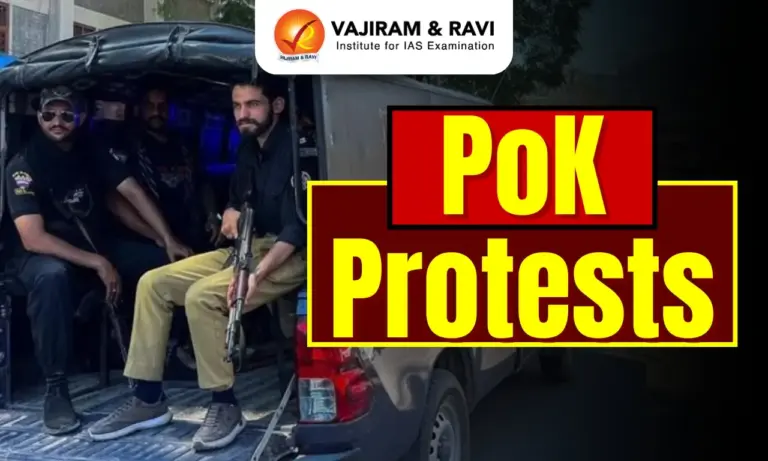
- At least 15 people have been killed in Pakistan-occupied Kashmir (PoK) as violent protests rage just a month before scheduled local elections.
- Pakistani authorities have responded with a crackdown — banning the protest-leading organisation, announcing bounties for leaders’ arrest, and clashing with locals.
- India has condemned the “police brutality” and called on the international community to hold Pakistan accountable.
Background: A Region Long Restless
- PoK protests are not new. Unrest began in 2023 when residents mobilised against rising electricity bills and shortages of subsidised wheat.
- The Mangla Dam — a major hydropower project built on PoK’s rivers — displaced local communities but the region continues to pay high power tariffs, a long-standing grievance.
- Chronic underdevelopment, heavy security deployment due to militancy, and the dominance of Islamabad-appointed bureaucrats over the Legislative Assembly have deepened public anger over the years.
- The protest movement is spearheaded by the Joint Awami Action Committee (JAAC) — a coalition of traders, professionals, and civil society activists.


The Immediate Flashpoint: The 12 Seats Controversy
- The current flash point is a Pakistan Supreme Court verdict upholding 12 seats in the 53-member PoK Assembly reserved for Jammu and Kashmir migrants settled in different parts of Pakistan — some in Punjab, some in Sindh, and so on.
- The polling for these seats is conducted outside PoK, and the local Election Commission has no role in it.
- In effect, out of 53 seats in the PoK Assembly, local voters directly elect only 33 members.
- Besides the 12 refugee seats, there are 5 seats reserved for women, 1 for Ulamas (religious scholars), 1 for overseas Kashmiris, and 1 for technocrats.
Why Do Locals Oppose These Seats
- Local PoK residents argue that these 12 seats are effectively used by the federal government in Islamabad to plant its loyalists in the PoK Assembly — people with no genuine connection to Kashmir.
- They complain that MQM members — representing Urdu-speaking immigrants — end up in their Assembly through these seats.
- There is also a financial grievance: the salaries and expenses of these 20 centrally-controlled representatives (12 refugee + 8 other reserved seats) are funded from PoK’s own budget, even though local voters have no say in electing them.
India’s Parallel: An Important Distinction
- Supporters of this reservation draw a comparison — India too has reserved seats in the J&K Assembly for people displaced from Pakistan-occupied territories.
- However, a crucial difference exists: India keeps those seats vacant, unlike Pakistan which actively fills them.
Pakistan’s Response: Crackdown Over Dialogue
- Rather than addressing core grievances, Pakistan’s response has been repressive.
- JAAC has been banned and its leaders booked under stringent charges including sedition and terror laws.
- The crackdown has drawn international attention — a significant PoK diaspora in the UK has been vocal, and Bradford East MP along with other UK parliamentarians wrote to the British Foreign Secretary demanding restoration of communications and resumption of peaceful talks.
Gilgit-Baltistan: A Parallel Crisis
- Gilgit-Baltistan (GB) — the other part of the former princely state of Jammu and Kashmir under Pakistan’s illegal occupation — shares many of PoK’s problems.
- These include: chronic underdevelopment, dominance by the federal government, and denial of full political rights.
Key Differences
- Unlike PoK, GB has a large Shia Muslim population, which has led to sectarian strife.
- It is also more isolated — even from the Pakistani mainstream — and receives far less media attention.
- Some sections in GB have demanded full integration with Pakistan as a province, a move Islamabad has resisted because granting full provincial status would complicate its demand for a plebiscite over the broader J&K dispute.
India’s Position
- India strongly protested the recent elections held in GB.
- MEA reiterated that the entire Union Territories of J&K and Ladakh, including Gilgit-Baltistan, are integral and inalienable parts of India by virtue of the complete and irrevocable Instrument of Accession signed in 1947.
- India has consistently opposed the China-Pakistan Economic Corridor (CPEC), which passes through GB, on grounds of sovereignty violation.
- After India revoked Article 370 in 2019, there were talks of Pakistan granting GB full provincial status as a reciprocal political move, but those plans were never implemented.
Conclusion
- PoK’s unrest is the inevitable consequence of occupation without representation — a region exploited for its resources, denied its political voice, and governed by a distant power’s interests.
- As protests spread across PoK and Gilgit-Baltistan, the crisis underscores the challenges of managing contested territories through coercion rather than dialogue.
- For India, it also reinforces its longstanding position that these regions remain integral parts of the erstwhile princely state of Jammu and Kashmir.

 Last updated on Oct, 2026
→ UPSC 2027 Notification will be released on 13 January 2027 at upsconline.nic.in.
→ Check Nobel Prize 2026 Winners List here.
→ Download PIB PRiSM Monthly Magazine 2026 here.
→ Check UPSC Monthly Current Affairs Magazine The Recitals here.
→ Check out the latest UPSC Syllabus here.
→ Download UPSC Model Answers for Mains 2026
→ UPSC Mains Question Paper 2026 is out now for Essay & GS Paper 1, 2, 3 & 4.
→ UPSC Calendar 2027 has been released.
→ Enroll in Vajiram & Ravi’s UPSC Mains Test Series 2027 for structured answer writing practice, expert evaluation, and exam-oriented feedback.
→ Join Vajiram & Ravi’s UPSC Mentorship Program 2027 for personalized guidance, strategy planning, and one-to-one support from experienced mentors.
→ Go through the UPSC Mains Previous Year Papers to enhance your preparation.
→ UPSC has released UPSC Toppers List 2025 with the Civil Services final result on its official website.
→ Also check Best UPSC Coaching in India
PoK Protests FAQs
Q1. What triggered the recent PoK Protests?+
Q2. Why do locals oppose the 12 reserved seats in PoK?+
Q3. What role does JAAC play in the PoK Protests?+
Q4. How has Pakistan responded to the PoK Protests?+
Q5. Why is Gilgit-Baltistan linked to the PoK issue?+
Tags: mains articles PoK Protests upsc current affairs upsc mains current affairs