About President’s Colours:
- It is the highest honour that can be awarded to any military unit, military training establishments, or State/UT Police Forces of India.
- It is bestowed upon a military unit in recognition of exceptional service rendered to the nation, both in peace and in war.
- It is also known as “Rashtrapati ka Nishaan” in Hindi.
- History:
- The President’s Colour award has its history way back to ancient Indian traditions.
- In ancient times, whenever any military unit marches, they carried ‘dhwajas‘ or ‘patakas‘ or simply a flag of their respective kings to demonstrate their king’s supremacy. The flag had emblems or messages of their kings to other rulers.
- During British rule in India, the tradition continues. The military unit of the British Armed Forces of that time carried the king’s/queen’s version of the flag whenever they go for a military march.
- On November 23, 1950, the ‘king’s colour’ of the erstwhile British Indian regiments was laid to rest in Chetwode Hall, Dehradun, to make way for the ‘colours’ of the President of the Republic of India.
- The Indian Navy was the first Indian Armed Forces to be awarded the President Colour by Dr. Rajendra Prasad on May 27, 1951.
- Award:
- It is a type of special flag, also known as ‘Nishaan’, which is awarded to a military unit in an organised ceremony.
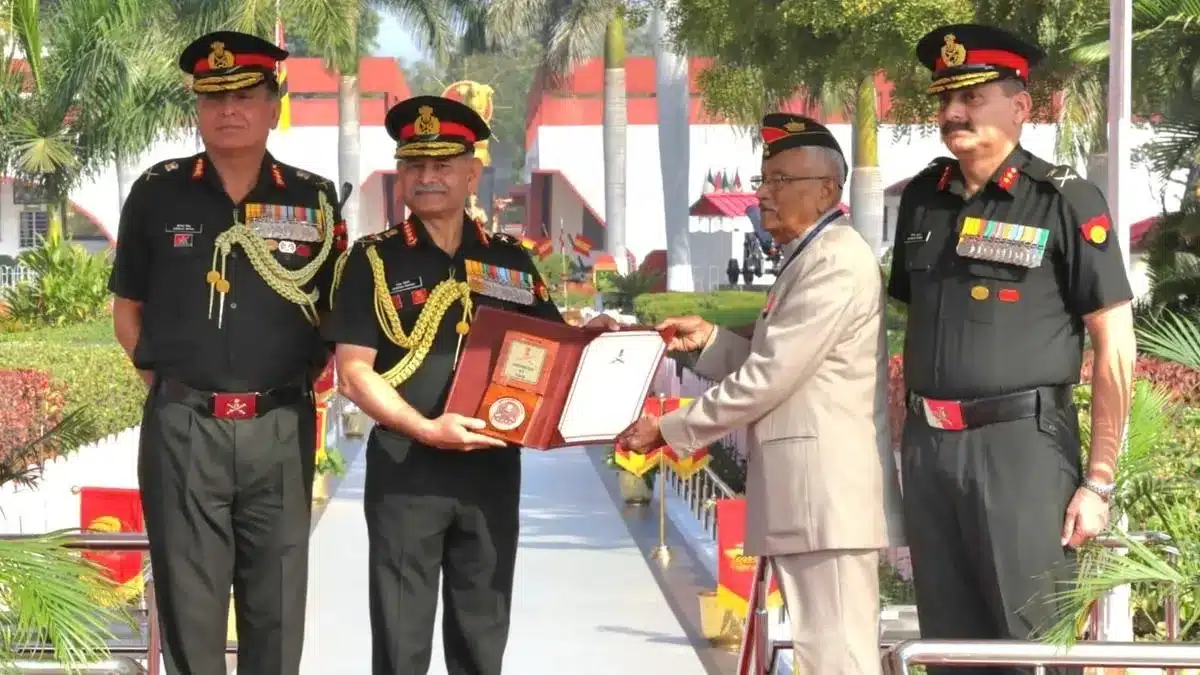
- Colours are generally presented personally by the President, who is the Supreme Commander of the Armed Forces, and in case of the President’s non-availability, by the Service Chief.
- The flag consists of a golden border in the middle and the insignia of a respective military unit, training establishments, and police forces in the centre.
- Sometimes, it may also contain the motto, important achievements, and battle participation of those military units to which the award is bestowed.
- During any ceremonial parade, the President’s Colour, i.e., the special flag of a military unit, is kept in a special position, and soldiers often march with the President’s Colour on important dates, like their establishment anniversary.
Q1: What is an Insignia?
An insignia is a symbol, badge, or emblem that represents a specific organization, rank, or identity. It is often used to denote membership, achievements, or affiliation with a particular group or institution. In the military, for example, an insignia can refer to a badge or emblem worn by soldiers to indicate their rank, unit, or service branch.
News: Army Chief presents President’s Colours to four battalions of Mechanised Infantry


 Last updated on Oct, 2026
→ UPSC 2027 Notification will be released on 13 January 2027 at upsconline.nic.in.
→ Asian Games 2026 are being held in Aichi-Nagoya, Japan, from 19 September to 4 October.
→ Check Nobel Prize 2026 Winners List here.
→ Download PIB PRiSM Monthly Magazine 2026 here.
→ Check UPSC Monthly Current Affairs Magazine The Recitals here.
→ Check out the latest UPSC Syllabus here.
→ Download UPSC Model Answers for Mains 2026
→ UPSC Mains Question Paper 2026 is out now for Essay & GS Paper 1, 2, 3 & 4.
→ UPSC Calendar 2027 has been released.
→ Enroll in Vajiram & Ravi’s UPSC Mains Test Series 2027 for structured answer writing practice, expert evaluation, and exam-oriented feedback.
→ Join Vajiram & Ravi’s UPSC Mentorship Program 2027 for personalized guidance, strategy planning, and one-to-one support from experienced mentors.
→ Go through the UPSC Mains Previous Year Papers to enhance your preparation.
→ UPSC has released UPSC Toppers List 2025 with the Civil Services final result on its official website.
→ Also check Best UPSC Coaching in India