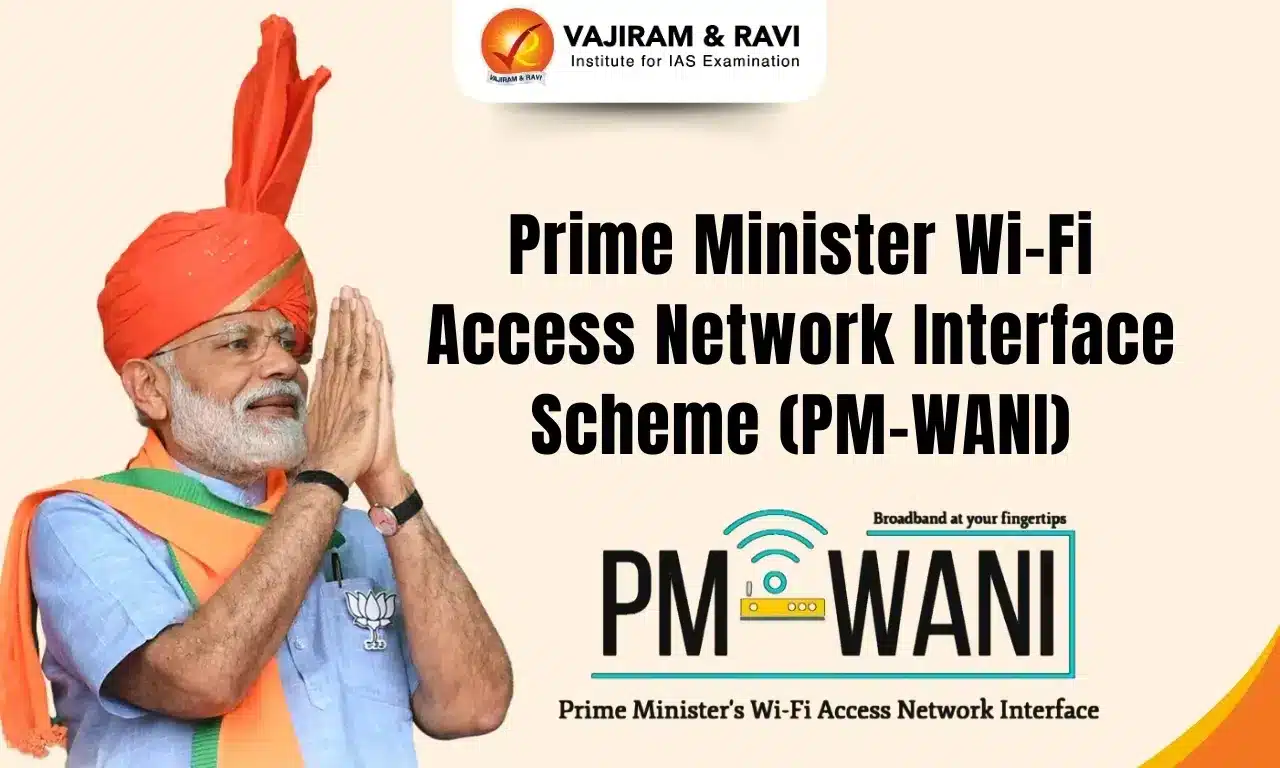
The Prime Minister Wi-Fi Access Network Interface (PM-WANI) scheme is a government initiative launched in December 2020 by the Department of Telecommunications (DoT) which aims to enhance public internet access across India by setting up a large network of Wi-Fi hotspots, particularly in rural areas, to promote digital inclusion, empowerment and promote economic growth as well.
Prime Minister Wi-Fi Access Network Interface Scheme Objectives
- To overcome the digital divide by increasing internet connectivity, especially in remote and rural regions.
- To empower individuals and businesses to participate in the digital economy through affordable internet access.
- To encourage local entrepreneurs by enabling shopkeepers and individuals to become Public Data Office (PDO) operators.
Prime Minister Wi-Fi Access Network Interface Scheme Components
- Public Data Office (PDO): Local entrepreneurs (e.g., kirana stores or shops) who set up Wi-Fi hotspots and sell internet services to users.
- Public Data Office Aggregator (PDOA): Entities that assist PDOs in registration, billing, and network management.
- App Provider: Develops mobile applications for users to locate and access PM-WANI hotspots.
- Central Registry: Maintains records of all stakeholders and ensures smooth ecosystem operation.


Prime Minister Wi-Fi Access Network Interface Scheme Benefits
- Reduces dependence on expensive mobile data plans.
- Provides cost-effective internet access through a pay-per-use model.
- Bridges the urban-rural digital divide.
- Improves access to government services, education, and healthcare.
- Encourages local entrepreneurship by allowing individuals to set up PDOs.
- Facilitates skill development and online education, enhancing employability.
Prime Minister Wi-Fi Access Network Interface Scheme Challenges
- Public Wi-Fi networks are prone to data breaches and cyberattacks due to multiple users at a time.
- High traffic on public networks can lead to bandwidth overuse, reducing internet speed.
- With India offering some of the cheapest mobile data globally, the demand for public Wi-Fi might face challenges.

 Last updated on Oct, 2026
→ UPSC 2027 Notification will be released on 13 January 2027 at upsconline.nic.in.
→ Check Nobel Prize 2026 Winners List here.
→ Download PIB PRiSM Monthly Magazine 2026 here.
→ Check UPSC Monthly Current Affairs Magazine The Recitals here.
→ Check out the latest UPSC Syllabus here.
→ Download UPSC Model Answers for Mains 2026
→ UPSC Mains Question Paper 2026 is out now for Essay & GS Paper 1, 2, 3 & 4.
→ UPSC Calendar 2027 has been released.
→ Enroll in Vajiram & Ravi’s UPSC Mains Test Series 2027 for structured answer writing practice, expert evaluation, and exam-oriented feedback.
→ Join Vajiram & Ravi’s UPSC Mentorship Program 2027 for personalized guidance, strategy planning, and one-to-one support from experienced mentors.
→ Go through the UPSC Mains Previous Year Papers to enhance your preparation.
→ UPSC has released UPSC Toppers List 2025 with the Civil Services final result on its official website.
→ Also check Best UPSC Coaching in India
Prime Minister Wi-Fi Access Network Interface Scheme FAQs
Q1. What is the prime minister's free Wi-Fi scheme?+
Q2. What is the name of PM Modi WIFI network?+
Q3. What is the cost of a PM Wani device?+
Q4. How much is PM wani per day?+
Q5. Does the government give free Wi-Fi?+
Tags: Prime Minister Wi-Fi Access Network Interface Scheme (PM-WANI)