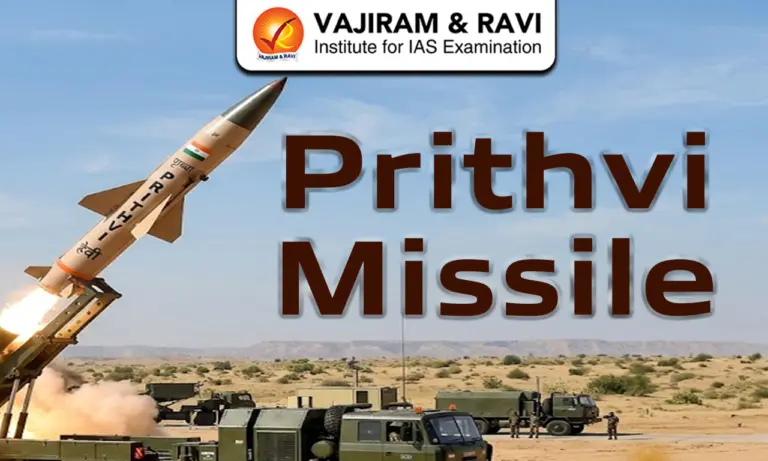
Prithvi missile was one of India’s earliest indigenously developed ballistic missiles, created to strengthen the country’s defence and security system. It was part of India’s efforts to build a strong missile development program and reduce dependence on foreign technology. Designed for short-range use, it focused on delivering payloads with accuracy and reliability. Overall, the Prithvi missile played a crucial role in laying the foundation for India’s modern missile and strategic defence capabilities.
Prithvi Missile
- Prithvi missile is a family of indigenously developed short-range surface-to-surface ballistic missiles (SRBMs) built by Defence Research and Development Organisation (DRDO) under the Integrated Guided Missile Development Programme (IGMDP) started in 1983.
- It was India’s first indigenous ballistic missile, successfully test-fired in 1988 from Sriharikota, marking a major step in India’s defence self-reliance.
- The missile can carry both conventional and nuclear warheads, making it an important part of India’s tactical deterrence system.
- It has a strike range of around 150 to 350 km, and is deployed under the Strategic Forces Command (SFC).
Also Read : Missiles of India
Variants of Prithvi Missile
- The Prithvi missile series includes three main variants, each designed for use by a specific branch of the Indian Armed Forces, ensuring flexibility across land, air, and sea operations.
- Prithvi-I (Surface-to-Surface-150) is used by the Indian Army and has a range of about 150 km. It can carry a payload of up to 1,000 kg and uses a single-stage liquid fuel system. It has been in service since 1994, although newer systems like Prahar are gradually replacing it.
- Prithvi-II (Surface-to-Surface-250) is mainly used by the Indian Air Force and Army. It has a longer range of around 250-350 km and can carry 500-1,000 kg warheads. It also uses liquid fuel propulsion and has been operational since 1996.
- Prithvi-III (Surface-to-Surface-350), also known as Dhanush, is the naval version used by the Indian Navy. It has a range of up to 350 km and uses a two-stage propulsion system (solid fuel in the first stage and liquid fuel in the second). It was successfully tested in 2004.


Prithvi Missile Key Features and Technology
- One of the most important aspects of the Prithvi missile is its advanced inertial navigation and guidance system, which helps it achieve high accuracy and precision while hitting targets. In some tests, accuracy has been reported to be within 10 meters, which is highly reliable for a ballistic missile.
- The missile uses maneuvering trajectories, allowing it to change its path during flight, making it harder for enemy defense systems to intercept it.
- The propulsion technology used in Prithvi is believed to be influenced by the Soviet SA-2 surface-to-air missile, which was one of the earliest effective missile systems developed in the 1950s.
- Prithvi missiles are deployed under India’s Strategic Forces Command (SFC), ensuring centralized control and readiness for strategic operations.
Prithvi Missile Role in India’s Defense System
- The Prithvi missile plays a crucial role in strengthening India’s tactical strike capabilities, especially in short-range combat scenarios. It allows India to respond quickly to threats by targeting key enemy positions.
- Its ability to carry nuclear warheads makes it an important part of India’s deterrence doctrine, helping maintain strategic balance in the region.
- Over time, while newer missile systems are being introduced, the Prithvi series still represents a foundation of India’s missile development journey and continues to hold historical and strategic importance.

 Last updated on Oct, 2026
→ UPSC 2027 Notification will be released on 13 January 2027 at upsconline.nic.in.
→ Check Nobel Prize 2026 Winners List here.
→ Download PIB PRiSM Monthly Magazine 2026 here.
→ Check UPSC Monthly Current Affairs Magazine The Recitals here.
→ Check out the latest UPSC Syllabus here.
→ Download UPSC Model Answers for Mains 2026
→ UPSC Mains Question Paper 2026 is out now for Essay & GS Paper 1, 2, 3 & 4.
→ UPSC Calendar 2027 has been released.
→ Enroll in Vajiram & Ravi’s UPSC Mains Test Series 2027 for structured answer writing practice, expert evaluation, and exam-oriented feedback.
→ Join Vajiram & Ravi’s UPSC Mentorship Program 2027 for personalized guidance, strategy planning, and one-to-one support from experienced mentors.
→ Go through the UPSC Mains Previous Year Papers to enhance your preparation.
→ UPSC has released UPSC Toppers List 2025 with the Civil Services final result on its official website.
→ Also check Best UPSC Coaching in India
Prithvi missile FAQs
Q1. What is the Prithvi missile?+
Q2. Who developed the Prithvi missile?+
Q3. When was the Prithvi missile first tested?+
Q4. What is the range of the Prithvi missile?+
Q5. How many variants of the Prithvi missile are there?+
Tags: defence internal security prithvi missile