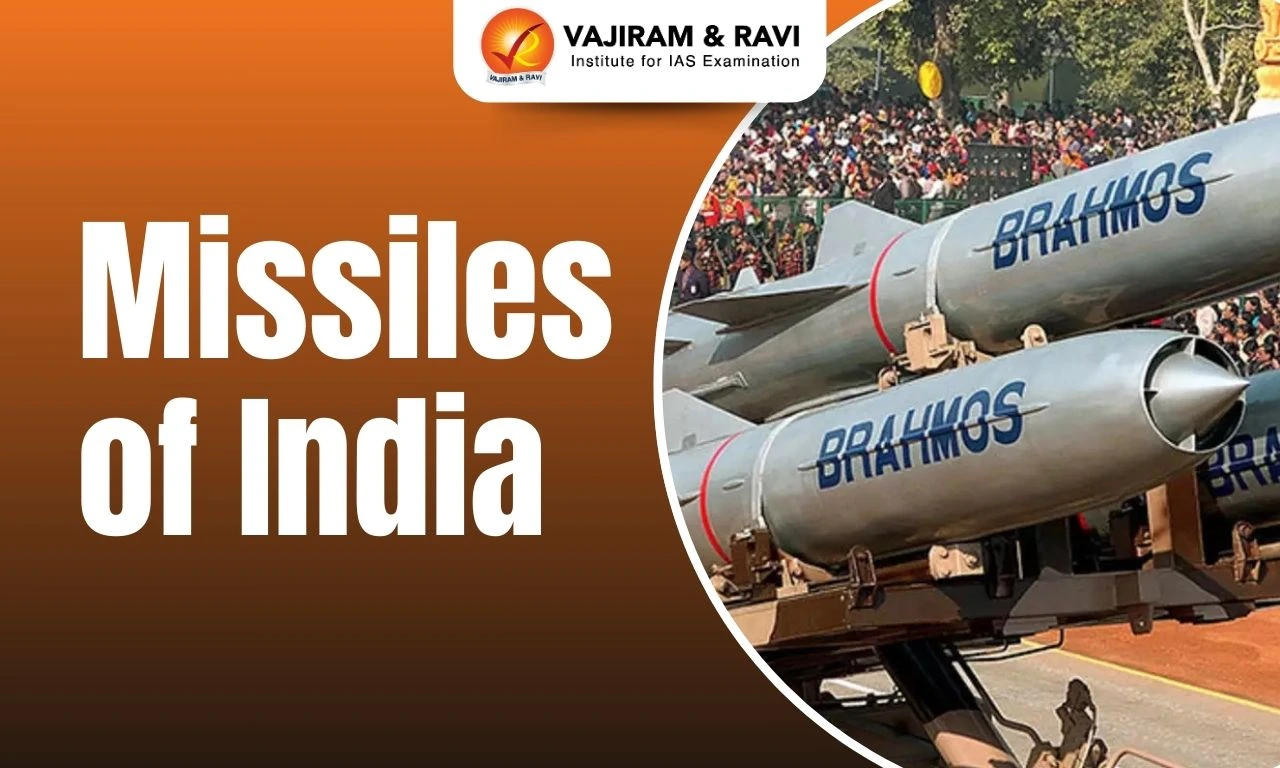
Missiles in India include both ballistic and cruise missile systems with strategic and tactical importance. These missiles have been developed through various missile programs since independence, with the Integrated Guided Missile Development Program (IGMDP) being the most important and successful. The development of these missile systems signifies India’s aim to maintain the balance of power and strategic stability in the Asia-Pacific region and attain great power status.
Prithvi, Akash, Agni, BrahMos, Sagarika, etc., are the missiles that have been developed to counter the geopolitical challenges and potential threats to India. They aim to strengthen both offensive and defensive capacities during any conflict scenario.
Missile Meaning
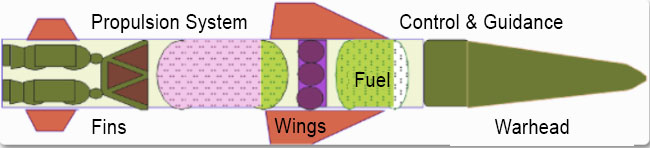
A missile is a guided airborne ranged weapon capable of self-propelled flight, usually by a jet engine or rocket motor. Missiles have five system components:
- Guidance system
- Targeting system
- Flight system
- Engine
- Warhead
Missiles of India Features
Missiles in India include diverse types like ballistic, cruise, and surface-to-air missiles, with advanced guidance systems, varying ranges, and capabilities for both conventional and nuclear payloads.
- Accuracy: India's missiles incorporate advanced guidance technologies like inertial navigation systems, satellite navigation, radar, and optical seekers to achieve pinpoint accuracy. Missiles like Agni-V and BrahMos have consistently hit targets with high bull's-eye precision.
- Quick Deployment: Most of India's missiles use solid fuels, lending them quick reaction capability. Shorter preparation and launch times give flexibility to armed forces for a faster response. Prithvi and Agni missiles in special transport-erector-launcher vehicles can fire in under 15 minutes.
- High Lethality: Powerful indigenous propulsion systems give Indian missiles extended ranges and heavy warheads to inflict major damage. BrahMos Missile, with its supersonic speed, is one of the deadliest cruise missiles globally.


Missile in India Programs
Missile Programs of India began with the formation of the Defence Research and Development Organisation (DRDO) and the initiation of the Integrated Guided Missile Development Program (IGMDP) in 1983. It aimed to develop a range of indigenous missiles for India's defence needs.
|
Missile Programs of India |
Features |
Key products |
|
Integrated Guided Missile Development Program |
Objectives:
|
Prithvi, Akash, Nag, Trishul and Agni (1, 2 and 3) |
|
BrahMos Aerospace-Joint Venture |
- Established in 1998 - Jointly developed by India's DRDO and Russia's NPO Mashinostroyenia |
BrahMos Supersonic Cruise Missile |
|
- Started in 1999 - Two-tiered system: endo- and exo-atmospheric interception |
Prithvi Air Defence (PAD) / Pradyumna Ballistic Missile Interceptor, Advanced Air Defence (AAD) / Ashwin Ballistic Missile Interceptor |
|
|
Independent Projects |
- Since 2008, after the completion of IGMDP. |
Agni series, K-Missiles, Hypersonic Technology Demonstrator Vehicle (in process), etc. |
Missiles in India Types
Types of Missiles in India are categorised based on launch mode, range, propulsion, warhead, and guidance systems, reflecting the country’s diverse and advanced missile development capabilities for both defensive and strategic purposes.

Types of Missiles Based on Speed
Types of Missiles in India Based on speed, refer to the classification of missiles depending on how fast they travel, categorised into subsonic, supersonic, and hypersonic missiles, each serving different strategic purposes.
- Subsonic Missile: Missiles that travel slower than sound are known as "subsonic."
- Supersonic Missile: Missiles that travel faster than the speed of sound (Mach 1) but less than Mach 5 are called "supersonic."
- Examples: Indian BrahMos supersonic cruise missile.
- Hypersonic Missile: The term "hypersonic" means that the speed of missiles should be at least five times faster than the speed of sound (over Mach 5).
- Examples: Shaurya/Sagarika missiles of India (Max speed - 7.5 Mach), etc.
Types of Missiles Based on Trajectory
Types of Missiles Based on Trajectory refer to the classification of missiles depending on their flight path, which includes ballistic missiles that follow a curved trajectory and cruise missiles that fly at low altitudes.
- Ballistic Missiles: Ballistic missiles have a ballistic lofted trajectory and work on the principle of unpowered free-fall flight after the boost phase. Examples are India's Agni and Prithvi series of ballistic missiles.
- Hypersonic Glide Vehicle: Ballistic missiles attaining hypersonic velocities during the re-entry phase are hypersonic ballistic missiles.
- Examples of HGVs: China's DF-17 missile mounts a hypersonic glide vehicle; Russia's Avangard boost-glide system.
- India is in the “Technology demonstration” stage of HGVs.
- Cruise Missiles: It is a guided missile used against terrestrial or naval targets that remains in the atmosphere (unlike ballistic missiles) and flies the major portion of its flight path at an approximately constant speed before hitting the target.
- Subsonic Cruise missiles: These cruise missiles travel at less than Mach 1. Examples: U.S. BGM-109 Tomahawk long-range subsonic cruise missile, Indian Nirbhay subsonic cruise missile.
- Supersonic Cruise missiles: Cruise missiles travelling at supersonic speeds are called supersonic cruise missiles. Joint Indo-Russian BrahMos is the fastest supersonic cruise missile, reaching close to Mach 3 speed.
- Hypersonic Cruise missiles: Cruise missiles powered using scramjet engines to realise speeds greater than Mach 5 are designated as hypersonic cruise missiles. BrahMos Aerospace is working on the BrahMos-II variant to attain hypersonic cruise speeds above Mach 8.
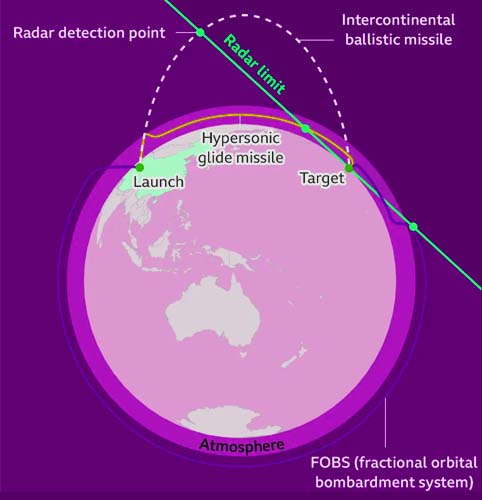
- Fractional Orbital Bombardment System (FOBS): It is a warhead delivery system that uses a low Earth orbit towards its target destination. Just before reaching the target, it deorbits through a retrograde engine burn.
- Instead of ICBMs which follow a probable trajectory, FOBS can avoid early warning systems by approaching from the south polar region without the revelation of targets.
- Example: Russia developed this technology in the 1960s. Recently, China has tested this system too.
Types of Missiles Based on the Launch Mode
Types of Missiles Based on the Launch Mode refer to the classification of missiles according to their point of launch and intended target platform, such as air, surface, or sea-based offensive and defensive operations.
|
Launch Mode |
Description |
Examples |
|
Surface-to-Surface |
Launched from land-based platforms to strike ground targets |
Prithvi, Agni, and BrahMos |
|
Surface-to-Air |
Launched from land to intercept aerial threats like aircraft, helicopters, and drones |
Akash, MRSAM |
|
Air-to-Surface |
Air-launched to attack ground-based targets |
Helina anti-tank missile fired from Rudra helicopter |
|
Air-to-Air |
Launched from aircraft against hostile aerial targets |
Astra BVR air-to-air missile fired from Tejas |
|
Ship-to-Ship |
Naval anti-ship missiles launched from warships/submarines |
BrahMos anti-ship cruise missile fired from ships |
|
Ship-to-Air |
Naval surface-to-air missiles for fleet air defence |
Barak-8 LR-SAM deployed on ships |
|
Submarine-launched |
Fired from submerged submarines |
K-15 submarine-launched ballistic missile |
|
Shoulder-fired |
Man-portable missiles fired from launchers carried by infantry |
FIM-92 Stinger and Igla shoulder-fired SAMs |
Types of Missiles Based on Strategic Importance
Strategic missiles encompass missiles that give a strategic edge over an opponent or provide credible deterrence to a country. In India and other powerful countries, these missiles are part of the nuclear triad.
- Intercontinental Ballistic Missile (ICBM): These missiles are long-range missiles that are capable of delivering nuclear warheads across continents. It is a part of India’s Nuclear Triad.
- Agni-V is India's first Intercontinental Ballistic Missile (ICBM), with a range of around 5000-8000 km. It brings the entire Asia-Pacific region within its reach.
- Mission Divyastra successfully tested the Agni-V missile using MIRV (Multiple Independently Targetable Re-entry Vehicle) technology, capable of striking multiple targets hundreds of kilometres apart with a single missile.
- Sub-surface Ballistic Nuclear (SSBN): A nuclear-powered submarine carrying and launching ballistic missiles armed with nuclear weapons.
- K-15 Sagarika (750 km) and K-4 (3500 km, in development) are the Submarine-launched ballistic Missiles (SLBMs), that complete India's nuclear triad by enabling second-strike capability from underwater locations.
- K-15 Sagarika has been deployed in the Arihant-class SSBN.
Types of Missiles Based on Tactical Importance
Tactical missiles are employed in the battlefield and frontline combat situations to strike and neutralise enemy assets and capabilities. India boasts an array of tactical missiles.
- Prithvi Missiles: The Prithvi series includes short-range surface-to-surface ballistic missiles.
- Prithvi-I (150km) and Prithvi-II (350 km) for battlefield roles and hitting strategic targets close to the border.
- Prithvi-III naval variant (350 km) to boost coastal and seaborne deterrence from warships.
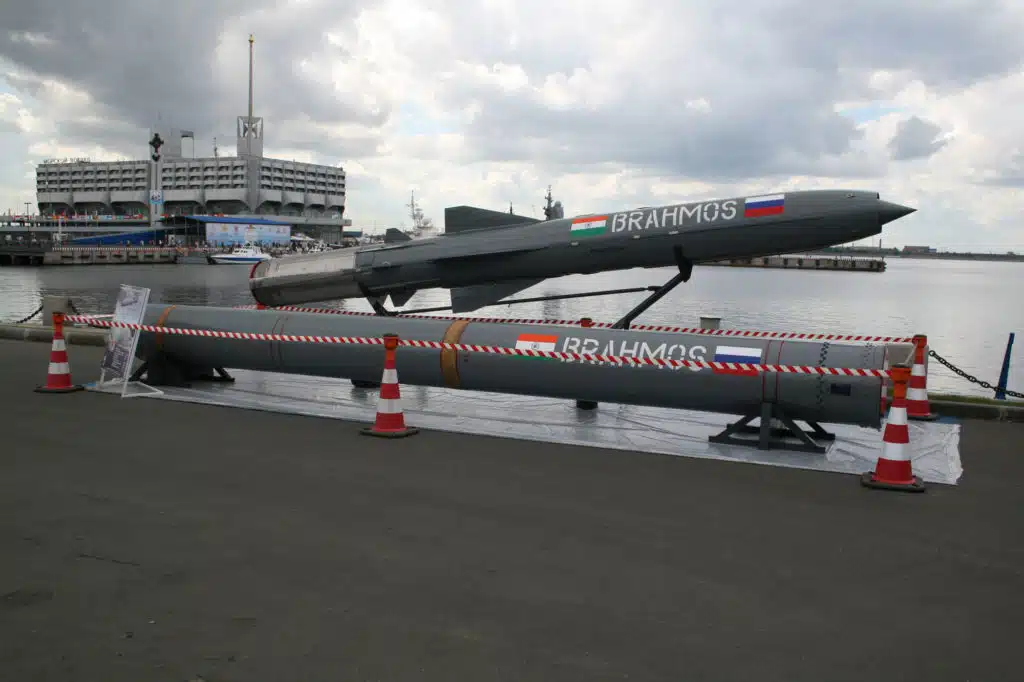
- BrahMos Missile: BrahMos is the fastest supersonic missile in the world. It is a Mach 3 "fire-and-forget" missile, inducted in all three services of the Indian Armed Forces.
- Its variants include land, ship, submarine, and air-launched missiles.
- BrahMos II, the hypersonic cruise missile, is currently in the development phase.
Types of Missiles Based on Propulsion
Missiles utilise different types of propulsion and guidance systems based on their range, launch platform, and targets. Key missile propulsion systems are:
- Solid Propulsion: It uses solid propellants like Hydroxyl-terminated polybutadiene (HTPB) fuel. It is simple, low-cost, and reliable.
- Example: Agni Prime, Parlay Missiles.
- Liquid Propulsion: It employs liquid fuels (Hydrazine - N2H4, liquid hydrogen, etc.) and oxidisers (Nitrogen tetroxide - N2O4, liquid oxygen, etc.). It has higher efficiency and throttle ability.
- Example: Prithvi missiles.
- Ramjet/Scramjet: Air-breathing engines are used for hypersonic ballistic and cruise missiles.
- Example: Under development (India’s HGV and Brahmos-II).
Types of Missiles Based on Guidance Systems
Types of Missiles Based on Guidance Systems refer to how missiles are directed toward their targets, using technologies like wire guidance, inertial systems, laser tracking, command control, GPS, or radio frequency signals.
- Command Guidance: External commands guide missiles through radio/wire links.
- Example: Akash missile system.
- Inertial Guidance: Onboard computers and motion sensors provide autonomous course correction.
- Example: Agni ballistic missiles.
- Terrain Mapping: This compares onboard terrain maps to radar altimeter data for accuracy.
- Example: Prithvi missiles.
- Laser Homing: It guides towards a target illuminated by a laser designator.
- Example: Helina anti-tank missile, Anti-Tank Guided Missile for MBT Arjun, etc.
- Radar/GPS: This updates position using satellite navigation and matches it to targeting data.
- Example: Brahmos cruise missile.
Missiles of india List
India possesses an advanced indigenous missile arsenal developed primarily by the Defence Research and Development Organisation (DRDO).
- Agni Series: Strategic nuclear-capable ballistic missiles.
- Agni-I: Range of 700–800 km (Short-range).
- Agni-II / Agni-Prime: Range of 1,000–3,000 km (Medium-range).
- Agni-III & Agni-IV: Range of 3,000–4,000 km (Intermediate-range).Agni-V: Intercontinental ballistic missile (ICBM) with a range of 5,000+ km.
- Prithvi Series: Tactical surface-to-surface short-range ballistic missiles (150–350 km range).
- K-Series (Submarine-Launched): Includes Sagarika (K-15) (750 km) and K-4 (3,500 km).
- BrahMos: World-class supersonic cruise missile (Mach 2.8 to 3) developed jointly with Russia, with a range around 290–400+ km.
- Nirbhay: Long-range subsonic cruise missile (1,000–1,500 km range).
- Akash: Indigenous medium-range surface-to-air missile system (25–30 km range).
- Barak-8 (MR-SAM / LR-SAM): Jointly developed medium/long-range air defense system for land and naval fleets.
- Prithvi Air Defence (PAD) / Ashwin: Two-tiered ballistic missile interceptor system.
- Astra: Beyond-visual-range (BVR) air-to-air missile (~110 km range).
- Nag & Helina: Fire-and-forget anti-tank guided missiles (ATGMs) for ground and helicopter deployment.
Missiles in India Significance
Missiles in India play a crucial role in national security by providing strategic deterrence, boosting tactical strike capabilities, securing coastal areas, and enhancing air power through advanced air-to-air and air-launched cruise missile systems.
- Strategic deterrence: Long-range ballistic missiles like Agni provide minimum credible deterrence and give India a retaliatory second-strike capability against nuclear attacks.
- Tactical battle capability: Short-range Prithvi and BrahMos missiles allow deep tactical strikes against enemy airbases, logistics, and other targets to gain a battlefield edge.
- Coastal defence: Anti-ship versions of BrahMos and surface-to-air missiles guard India’s vast coastline against hostile warships and aircraft.
- Enhanced air power: Air-to-air missiles like Astra enhance the capability of Indian Air Force (IAF) jets for air combat and strikes. Air-launched cruise missiles turn fighters into potent missile carriers.
Missiles in India Challenges
India faces several challenges in its missile programs, including dependence on imports for critical components, DRDO project delays, technology transfer issues, funding constraints, and the need for enhanced domestic production capabilities and infrastructure development.
- Technological Complexity: India’s missile programs, including ballistic missile defense and tactical systems, face significant technological hurdles such as integrating advanced sensors, guidance systems, and reliable propulsion, often resulting in developmental delays and modest success rates.
- Dependence on Imports: Despite progress in indigenization, India still relies heavily on foreign imports for critical components like RF seekers and propulsion systems, which hampers self-sufficiency and exposes the programs to export control restrictions.
- Funding Constraints: Missile development is capital-intensive, requiring sustained and substantial financial investment; limited resources and the need to balance offensive and defensive priorities often slow down research, production, and modernization efforts.
- Operational and Manufacturing Issues: Programs like Akash and Agni have faced setbacks due to radar, sensor, and manufacturing flaws, with live test failures highlighting persistent quality and reliability concerns.
- Rapidly Evolving Threats: India must continuously upgrade its missile systems to counter fast-advancing adversary technologies and multi-vector threats, demanding constant innovation and adaptation to maintain credible deterrence.
Missiles in India Way Forward
India’s missile capabilities have strengthened strategic deterrence, defence preparedness and technological self-reliance. Going forward, the focus should be on strengthening indigenous research, manufacturing and supporting technologies while maintaining responsible defence policies. DRDO identifies self-reliance in critical defence technologies as a core objective.
- Deepen Indigenisation: Reduce dependence on imported components, especially in propulsion, seekers, sensors, electronics and advanced materials.
- Strengthen Private-Sector Participation: Expand collaboration among DRDO, DPSUs, private firms, MSMEs, start-ups and academia to accelerate development and production. Recent policy measures have increased technology-transfer opportunities for domestic industry.
- Invest in R&D: Increase sustained investment in advanced guidance, propulsion, materials, electronics and testing technologies to maintain technological competitiveness.
- Promote Civil–Military Innovation: Use programmes such as iDEX and the Technology Development Fund to bring innovative solutions from start-ups and academic institutions into defence applications.
- Build Resilient Supply Chains: Develop domestic manufacturing capabilities for critical components to reduce vulnerabilities arising from external supply disruptions.
Missiles in India UPSC PYQs
Q1: Consider the following statements: (UPSC Prelims 2023)
- Ballistic missiles are jet-propelled at subsonic speeds throughout their flights, while cruise missiles are rocket-powered only in the initial phase of flight.
- Agni-V is a medium-range supersonic cruise missile, while BrahmMos is a solid-fuelled intercontinental ballistic missile.
Which of the statements given above is/are correct?
(a) 1 only
(b) 2 only
(c) Both 1 and 2
(d) Neither 1 nor 2
Answer: (d)
Q2: With reference to Agni-IV Missile, which of the following statements is/are correct? (UPSC Prelims 2014)
- It is a surface-to-surface missile.
- It is fuelled by liquid propellant only.
- It can deliver one-tonne nuclear warheads about 7500 km away.
Select the correct answer using the code given below.
(a) 1 only
(b) 2 and 3 only
(c) 1 and 3 only
(d) 1, 2 and 3
Ans: (a)

 Last updated on Oct, 2026
→ UPSC 2027 Notification will be released on 13 January 2027 at upsconline.nic.in.
→ Check Nobel Prize 2026 Winners List here.
→ Download PIB PRiSM Monthly Magazine 2026 here.
→ Check UPSC Monthly Current Affairs Magazine The Recitals here.
→ Check out the latest UPSC Syllabus here.
→ Download UPSC Model Answers for Mains 2026
→ UPSC Mains Question Paper 2026 is out now for Essay & GS Paper 1, 2, 3 & 4.
→ UPSC Calendar 2027 has been released.
→ Enroll in Vajiram & Ravi’s UPSC Mains Test Series 2027 for structured answer writing practice, expert evaluation, and exam-oriented feedback.
→ Join Vajiram & Ravi’s UPSC Mentorship Program 2027 for personalized guidance, strategy planning, and one-to-one support from experienced mentors.
→ Go through the UPSC Mains Previous Year Papers to enhance your preparation.
→ UPSC has released UPSC Toppers List 2025 with the Civil Services final result on its official website.
→ Also check Best UPSC Coaching in India
Missiles in India FAQs
Q1. What are the top 5 missiles of India?+
Q2. What is the latest missile in India?+
Q3. Who is the missile man of India?+
Q4. Can India hit us with missiles?+
Q5. How many S-400 does India have?+
Tags: missiles of india quest UPSC Science and Technology Notes