Jainism is one of the ancient Śramaṇa traditions of India, associated particularly with Vardhamana Mahavira, the 24th Tirthankara. It emphasises Ahimsa (non-violence), truth, non-possession and self-discipline as the means to overcome karma and attain Moksha. Jainism developed a distinctive philosophical tradition based on ideas such as Anekantavada (many-sidedness of reality) and Syadvada (conditional assertion).
Jainism made a lasting contribution to Indian philosophy, ethics, literature, art and architecture, particularly through its strong emphasis on non-violence and religious tolerance. However, its growth faced challenges such as the rigorous nature of its monastic practices, competition from Buddhism and Brahmanical traditions.
Jainism Founder and History
According to Jaina traditions, twenty-four Tirthankaras were responsible for the origin and development of Jaina religion and philosophy. Of these, the first twenty-two are of doubtful historicity. In the case of the last two, Parsvanatha and Vardhaman Mahavira, Buddhist works confirm their historicity.
- Adinath/Rishabhdev: The first Tirthankara (supreme preacher) and establisher of the Ikshvaku dynasty.
- Ajita: The second Tirthankara
- Neminatha: The twenty-second Tirthankara
- Parsvanatha: According to Jaina tradition, the twenty-third Tirthankara, Parsvanatha, was the son of King Asvasena of Varanasi and Queen Vama.
- Parsvanatha believed in the eternity of ‘matter’.
- The followers of Parsvanatha wore white garments.
- Thus, it is clear that even before Mahavira, some kind of Jaina faith existed.
- Mahavira: The twenty-fourth Tirthankara was Vardhamana Mahavira.
Mahavira and his life
The 24th Tirthankara was Vardhamana Mahavira, born in Kundagrama (Basukunda), a suburb of Vaishali (Bihar), in 540 BC.
- Parents: Father Siddhartha (head of the Jnatrikas, a Kshatriya clan) and mother, Trishala, a Lichchavi princess.
- Spouse: Yashoda
- Vardhaman Mahavira Asceticism: At the age of thirty, Vardhamana left his home and became an ascetic. For twelve years, he lived the life of an ascetic following severe austerities. In the 13th year of his asceticism, at the age of 42, he attained the ‘Supreme Knowledge’ (Kaivalya).
- Titles: He was later known as ‘Mahavira’ (the supreme hero) or ‘Jina’ (the conqueror). He was also hailed as ‘Nirgrantha’.
- Preachings: For the next thirty years, he moved from place to place and preached his doctrines in Kosala, Magadha, and further east.
- Patronage: He often visited the courts of Bimbisara and Ajatasatru.
- Death: He died at Pawa (near Rajagriha) in Patna district at the age of 72 (468 BC).
Causes for Rise of Jainism in India
The primary cause of the rise of Jainism was the religious unrest in India in the 6th century BC. Other major factors include:
- Complex religious practices: In the later Vedic period, Indian society had many complex rituals and sacrifices that were unacceptable to the common people.
- For example, the sacrificial ceremonies were too expensive, and the superstitious beliefs and mantras confused people.
- Domination of Brahmans: The Brahmans stated themselves as the upper Varna with the highest status in society and demanded several privileges. Thus, these systems naturally divided society and generated tensions.
- Opposition from Kshatriyas and Vaishyas: They reacted strongly against the ritualistic domination of the Brahmans.
- The equality of Jainism: Attracted the masses, which gave relief from the discriminations of the Varna system.
- Use of Simple Language: Mahavira’s religious message was in simple language. The masses were drawn to it because it was in the language they spoke and understood better. Acceptance by the masses soon led to its spread.
- Simple Doctrine: Vardhaman Mahavira’s Jainism came to the masses as a welcome relief.
- Nonviolence and other practical moralities that Jainism advocated attracted people to it.
- Its edge over the Vedic religion was a comparatively easier way to liberation, thereby gaining wider adherence throughout India.


Jainism Spread to Other Parts of India
Jainism spread to different parts of India during Mahavira's lifetime and after his death. Several factors are responsible for its spread.
- Contribution of Mahavira: Mahavira moved from place to place and preached his teachings.
- His simple way of life, penance, and austerity attracted people towards him.
- Mahavira had eleven disciples known as Ganadharas, or heads of schools.
- Arya Sudharma was the only Ganadhara who survived after the death of Mahavira. Mahavira became the first ‘Thera’ (chief preceptor).
- Role of Jain Monks: Jain monks spread Jainism by visiting several places and holding scholarly discussions, exhibiting their personal examples of simplicity, which could significantly influence the people.
- Royal Patronage: The followers of Mahavira slowly spread over the whole country. In many regions, royal patronage was bestowed on Jainism.
- According to Jaina tradition, Udayin, the successor of Ajatasatru, was a devoted Jaina.
- Chandragupta Maurya was a follower of Jainism, and he migrated with Bhadrabahu to the south and spread Jainism.
- During the early centuries of the Christian Era, Mathura and Ujjain became great centres of Jainism.
- Two Theras administered the Jaina order in the days of the late Nanda King: Sambhutavijaya and Bhadrabahu. The sixth Thera was Bhadrabahu, a contemporary of Maurya King Chandragupta Maurya.
Jainism Councils
The Jain Councils were important gatherings of Jain monks held to preserve, organise and compile the teachings of Mahavira. They became particularly important as Jain traditions were transmitted orally and differences emerged among monastic groups.
- First Jain Council: The First Jain Council was held at Pataliputra around 300 BCE and was presided over by Sthulabhadra, under the patronage of Chandragupta Maurya.
- It played an important role in preserving Jain teachings, with the Jain canon being organised into 12 Angas (sections).
- Second Jain Council: The Second Jain Council was held at Vallabhi around 512 CE under the leadership of Devardhigani Kshemasarmana. It contributed to the further compilation and preservation of Jain scriptures, including the Angas and Upangas (minor sections).
Teachings of Mahavira
The ultimate objective of Mahavira’s teachings is how one can attain total freedom from the cycle of birth, life, pain, misery, and death and achieve the permanent blissful state of oneself. This is also known as liberation, Nirvana, absolute freedom, or Moksha.
- The Idea of God: He believed that the world was not created by any supreme creator. The world functions according to an eternal law of decay and development.
- View on Vedas: He rejected the authority of the Vedas and objected to Vedic rituals and the supremacy of the Brahmanas.
Three Jewels/Ratnatraya
The Three Jewels are the three essential principles in Jainism for attaining Moksha (liberation):
- Samyak Darshan: Right faith or right belief.
- Samyak Gyan: Right knowledge.
- Samyak Charitra: Right conduct or right action.
Jainism Core Beliefs
Mahavira accepted most of the religious doctrines laid down by Parsvanatha. However, he made some alterations and additions to them. The five doctrines of Jainism (five vows), known as Panchamahavratas, are for the monks.
|
4 doctrines advocated by Parsvanath |
5th Doctrine added by Mahavira |
|
|
- Anuvratas: A code of conduct was prescribed for both householders and monks. To avoid evil karma, a householder had to observe the five vows (in their limited nature).
- Jainism believed that the monastic life was essential to attaining salvation, and a householder could not attain it. A monk had to observe certain strict rules and abandon worldly possessions.
God in Jainism
Jainism does not recognise a creator God. Instead, Jains revere liberated souls and enlightened spiritual teachers known as Tirthankaras.
- No Creator God: Jain philosophy holds that the universe is eternal and functions according to its own natural and cosmic principles rather than being created or controlled by a deity.
- Liberated Souls (Paramatma): In Jainism, a liberated soul becomes a supreme spiritual being after eliminating all karmic bondage. Such a soul attains infinite knowledge, eternal bliss, and complete liberation, or moksha.
- Spiritual Potential of Every Soul: Jainism teaches that every living soul possesses the potential to attain this liberated state through right faith, right knowledge, right conduct, self-discipline, and spiritual purification.
Jainism Symbols
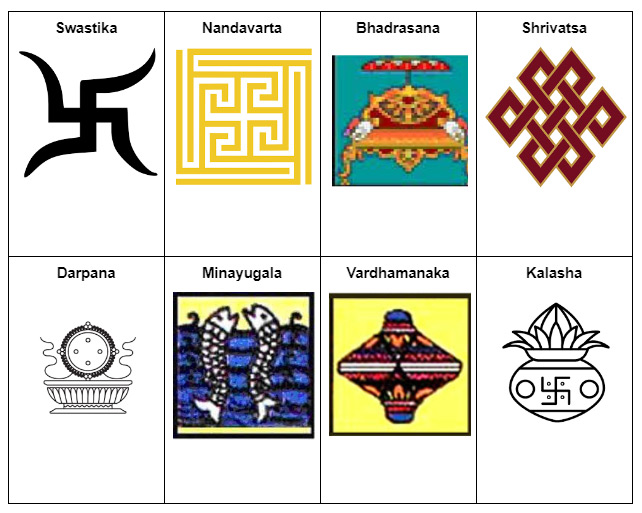
Jainism has 8 Auspicious Symbols that hold significant meaning for its followers. Here are some of the key symbols of Jainism:
- Swastika - It signifies the peace and well-being of humans.
- Nandavarta - It is a large swastika with nine endpoints.
- Bhadrasana - A throne is said to be sanctified by the Jains’ feet.
- Shrivatsa - A mark that manifests on the chest of Tirthankara's image and signifies his pure soul.
- Darpana - The mirror which reflects the inner self.
- Minayugala - A couple of fish which signifies the conquest over sexual urges.
- Vardhamanaka - A shallow dish is used as a lamp, which shows the increase in wealth, due, and merit.
- Kalasha - A pot filled with pure water.
Jainism Five Types of Knowledge
According to Jainism, knowledge is the quality of the soul. Understanding and acquiring knowledge are attained through pramana (instruments of knowledge) and naya (points of view).
- Mati Jnana: Perception through the activity of sense organs, including the mind.
- Sruta Jnana: Knowledge revealed by the scriptures.
- Avadhi Jnana: Clairvoyant perception.
- Manahparyaya Jnana: Telepathic knowledge
- Kevala Jnana: Temporal knowledge or omniscience.
Mahavira’s teachings were orally transmitted to people. His disciples, Ganadharas, wrote them down in the text form of fourteen ‘Purvas’ and twelve Angas.
Among the 12 Angas, the Acharanga sutta and Bhagavati sutta are the most important. While the former deals with the code of conduct which a Jain monk must follow, the latter expounds the Jaina doctrines comprehensively.
Doctrine of Syadvada and Anekantavada
- Syadvada (Theory of Judgement): The Jain view that all our ordinary knowledge is necessarily partial, always relative to some particular point of view and particular aspects of objects, is known as Syadvada.
- According to this concept, identity and difference must exist in reality.
- Anekantavada: According to this doctrine, ultimate truth and reality are complex and have multiple aspects.
- Anekantavada has also been interpreted to mean non-absolutism, intellectual ahimsa, religious pluralism, and rejection of fanaticism.
Jainism Sects
The Jain order has been divided into two major sects: Svetambara and Digambara.
- Reason for division: The division occurred mainly due to famine in Magadh, which compelled a group led by Bhadrabahu and Chandragupta Maurya to move to South India (Shravan Belgola) in 298 BC.
- The leader of the group that stayed back at Magadha was Sthulbhadra.
- During the 12 years of famine, the group in South India stuck to the strict practices, while the group in Magadha adopted a more lax attitude and started wearing white clothes.
- During later years, further splits took place among both sections, the most important of them being one that renounced idol worship altogether and devoted itself to worshipping the scriptures.
- They were called the Terapanthis among the Svetambaras and the Samaiyas among the Digambaras. (This sect came into existence about the sixth century CE).
|
Sects |
Digambaras |
Svetambaras |
|
Led by |
Bhadrabahu |
Sthulbhadra |
|
View on Clothing |
- They do not wear clothes, as this sect believes in complete nudity. - Female monks wear unstitched, plain white sarees and are called Aryikas. |
- They wear simple white clothes. |
|
Question on women |
- They believed that women could not be Tirthankaras and Malli was a man. |
- They believe that Tirthankaras can be men or women. |
|
Follow the teachings of |
- Mahavira, that is, “Pancha Mahavratas”, to attain Kaivalya. |
- Preachings of Parshvanatha, that is, only four restraints (except Brahmacharya). |
|
Follow the Jain literature |
- Prakrit Suttapahuda of Kundakunda. |
- Believed in the validity and sacredness of the twelve angas and sutras. |
|
Food for omniscient |
- Once a saint becomes a kevali or Kevala-jnani, that is, omniscient, he needs no morsel of food. |
- This view is not acceptable to the Svetambaras. |
|
Idols of Tirthankaras |
- They represent the idols of Tirthankaras as nude. Unadorned and with downcast eyes in a contemplative mood. |
- Depicts the idols of Tirthankars as wearing a loincloth adorned with jewels and with glass eyes inserted in the marble. |
Sub-sects of Jainism under Digambaras and Svetambaras
|
Digambaras |
Svetambaras |
|
- Mula Sangh:
- Bisapantha:
- Digambar Terapantha:
- Taranpantha:
|
- Sthanakavasi:
- Murtipujaka (Deravasi):
- Terapanthi:
|
Jainism Literature
Jain literature developed in Prakrit, Sanskrit, and regional languages and is broadly divided into canonical (Agama) and non-canonical literature.
- Agamas: The canonical scriptures of Jainism, traditionally preserving the teachings of Mahavira. The Agamas are primarily associated with the Śvetāmbara tradition.
- Angas: The principal divisions of the Jain canon, traditionally organised into 12 Angas.
- Upangas: Supplementary texts associated with the Angas and forming part of the Jain scriptural tradition.
- Kalpasutra: An important Jain text containing accounts of Mahavira and other Tirthankaras, traditionally attributed to Bhadrabahu.
- Tattvartha Sutra: A major Sanskrit philosophical work attributed to Umasvati (Umasvami), presenting a systematic summary of Jain doctrine. It is recognised across the major Jain traditions.
- Samayasara: A major philosophical work attributed to Acharya Kundakunda, focusing on the nature of the soul and spiritual liberation.
- Non-Agama Literature: Includes commentaries, philosophical works and independent writings composed in Prakrit, Sanskrit, Apabhramsha and several regional languages.
Jainism Significance
Jainism made lasting contributions to religion, society, philosophy, ethics and Indian culture. Its emphasis on non-violence, self-restraint and intellectual openness influenced Indian social and religious traditions.
- Religious and Ethical Reform: Emphasised Ahimsa, self-restraint, truth and Aparigraha, providing a strong ethical framework for religious life.
- Social Equality: Promoted the idea of social equality and opposed discrimination based on gender, contributing to changes in social thought.
- Intellectual Tolerance: Anekantavada recognised the many-sided nature of reality and encouraged consideration of different viewpoints.
- Literature and Education: Jain scholars contributed to Prakrit and regional literature, while Jain institutions supported the study of languages, philosophy and religious texts.
- Art and Architecture: Jainism enriched Indian cultural heritage through cave architecture, temples, paintings and sculptures, including important Jain monuments at places such as Mount Abu and Shravanabelagola.
Jainism vs Hinduism
Hinduism and Jainism are ancient Indian religious traditions that share concepts such as karma, samsara and liberation, while differing significantly in their views of God, the nature of the universe, scriptural authority, karma and the path to liberation.
- Creator God: Hinduism believes in a supreme reality (Brahman) and creator deities like Brahma. Jainism rejects a creator god, viewing the universe as eternal and self-sustaining.
- Nature of Karma: In Hindu traditions, karma generally refers to the moral consequences of actions that influence future experiences and rebirth. Different Hindu schools explain the relationship between karma, the self and divine reality differently. Jainism has a distinctive doctrine in which karma is understood as extremely subtle material particles (karma-pudgala) that become bound to the soul through actions and passions.
- Path to Liberation (Moksha): Hinduism teaches that salvation comes through self-realisation, devotion, and divine grace. Jainism teaches that liberation requires strict personal effort and adherence to the Three Jewels (Right Perception, Right Knowledge, and Right Conduct).
- Non-Violence (Ahimsa): Both Hinduism and Jainism value ahimsa. However, Jainism gives exceptionally strict and comprehensive importance to non-violence, extending it to thought, speech and action
- Authority of Scriptures: The Vedas hold foundational scriptural authority in Hindu traditions, particularly within the orthodox (āstika) philosophical schools. Hinduism also draws on texts such as the Upanishads, Bhagavad Gita and Puranas. Jainism belongs to the Śramaṇa tradition and does not accept the Vedas as the supreme scriptural authority.
- Core Concepts: Both Hinduism and Jainism teach karma and samsara, the cycle of birth, death and rebirth, and regard liberation from samsara as an important spiritual goal.
Jainism vs Buddhism
Jainism and Buddhism are two distinct Indian religious traditions that emerged in ancient north India and share ideas such as karma, rebirth, renunciation, and liberation. However, they differ fundamentally on the nature of the soul, the meaning of karma, the path to liberation, and the degree of asceticism required.
|
Aspect |
Jainism |
Buddhism |
|
Soul |
Accepts an eternal, individual soul, called jiva. Every living being possesses jiva. |
Rejects a permanent, unchanging soul or self; this doctrine is called anatta/anatman (“not-self”). |
|
Ultimate problem |
The soul is bound by karma and therefore remains in samsara, the cycle of rebirth. |
Beings experience dukkha—often translated as suffering, dissatisfaction, or unsatisfactoriness—because of craving, ignorance, and attachment. |
|
Karma |
Karma is understood as a subtle material bondage that attaches to the soul through passions and actions. Liberation requires stopping new karmic influx and removing accumulated karma. |
Karma primarily concerns intentional action. It shapes future experience and rebirth, but Buddhism does not treat karma as material particles adhering to a permanent soul. |
|
Final goal |
Moksha or kevala/kevalajnana: the fully purified soul is liberated from karmic bondage and rebirth. |
Nirvana/nibbana: the extinguishing of craving, ignorance, and the conditions that sustain suffering and rebirth. |
|
Path |
The Three Jewels: right faith, right knowledge, and right conduct; ethical vows, self-restraint, and austerity are central. |
The Four Noble Truths and the Noble Eightfold Path: ethical conduct, meditation, and wisdom. |
|
Asceticism |
Generally emphasises much stricter ascetic discipline, especially for monks and nuns. |
Rejects both sensual indulgence and self-mortification; the Buddha taught the Middle Way. |
|
Non-violence |
Ahimsa is the supreme ethical principle and is interpreted with exceptional strictness, extending to even minute living beings. |
Non-harming is a major ethical commitment, but Buddhist practice is generally less stringent in daily rules concerning accidental harm to small organisms. |
|
God and creator |
Does not accept an all-powerful creator God. Liberated Tirthankaras are revered but are not creators who govern the world. |
Does not make belief in a creator God necessary for liberation. Devas may exist in Buddhist cosmology, but they are not eternal creators and remain within samsara. |
Jainism Decline
The decline of Jainism as a major mass religion was gradual rather than sudden. Although it retained strong communities in several regions, its wider expansion was limited by competition from Buddhism and Brahmanical traditions, changes in royal patronage and the demanding nature of its religious practices.
- Limited Mass Appeal: Strict practices such as Ahimsa, fasting and asceticism made Jainism particularly demanding for ordinary followers.
- Competition from Other Traditions: The growth of Brahmanical traditions and Buddhism reduced the relative influence of Jainism in several regions.
- Loss of Royal Patronage: Changes in political power and the decline of some Jain-supporting rulers reduced institutional support in certain areas.
- Internal Divisions: The division between Digambara and Svetambara traditions contributed to institutional differences within Jainism.
Jainism Relevance in Today's World
The doctrines of Jainism with respect to the contemporary world situation are found to be very much relevant. With these doctrines of Jainism, we can bring back peace and harmony in society and the world.
- Anektavada: It teaches tolerance and the acceptance of diverse perspectives. In a polarised digital world, it counters dogmatism and fosters empathy during disagreements.
- Non-violence: The principle of non-violence gained prominence in today's nuclear-weapon world to attain long-lasting peace in society.
- Aparigraha: The principle of Aparigraha can help to control consumerist habits as there is a great increase in greed and possessive tendencies.
- Doctrine of Triratna: The doctrine of Triratna is relevant to present-time situations, which can liberate the souls of women along with men from subjugation to liberty and freedom.
- Ethical Living & Business: Promotes honesty, fair trade, transparency, and corporate social responsibility, guiding sustainable economic practices.
Jainism UPSC PYQs
Q1: Among the four main forms of existence of life recognised in Jainism, which one of the following is not included? (UPSC Prelims 2026)
a) Deva (gods)
b) Yaksha (demi-gods)
c) Manushya (humans)
d) Tiryancha (animals and plants)
Ans: (b)
Q2: “Souls are not only the property of animal and plant life, but also of rocks, running water and many other natural objects not looked on as living by other religious sects.”
The above statement reflects one of the core beliefs of which one of the following religious sects of ancient India? (UPSC Prelims 2023)
- a) Buddhism
- b) Jainism
- c) Shaivism
- d) Vaishnavism
Ans: (b)
Q3: With reference to Indian history, consider the following texts: (UPSC Prelims 2022)
- Nettipakarana
- Parishishtaparvan
- Avadanashataka
- Trishashtilakshana Mahapurana
Which of the above are Jaina texts?
- 1, 2 and 3
- 2 and 4 only
- 1, 3 and 4
- 2, 3 and 4
Ans: (b)
Q4: With reference to the religious practices in India, the "Sthanakvasi" sect belongs to (UPSC Prelims 2018)
- Buddhism
- Jainism
- Vaishnavism
- Shaivism
Ans: (b)
Q5: With reference to the religious history of India, consider the following statements (UPSC Prelims 2017)
- Sautrantika and Sammitiya were the sects of Jainism.
- Sarvastivadin held that the constituents of phenomena were not wholly momentary but existed forever in a latent form.
Which of the statements given above is/are correct?
- 1 only
- 2 only
- Both 1 and 2
- Neither 1 nor 2
Ans: (b)

 Last updated on Oct, 2026
→ UPSC 2027 Notification will be released on 13 January 2027 at upsconline.nic.in.
→ Check Nobel Prize 2026 Winners List here.
→ Download PIB PRiSM Monthly Magazine 2026 here.
→ Check UPSC Monthly Current Affairs Magazine The Recitals here.
→ Check out the latest UPSC Syllabus here.
→ Download UPSC Model Answers for Mains 2026
→ UPSC Mains Question Paper 2026 is out now for Essay & GS Paper 1, 2, 3 & 4.
→ UPSC Calendar 2027 has been released.
→ Enroll in Vajiram & Ravi’s UPSC Mains Test Series 2027 for structured answer writing practice, expert evaluation, and exam-oriented feedback.
→ Join Vajiram & Ravi’s UPSC Mentorship Program 2027 for personalized guidance, strategy planning, and one-to-one support from experienced mentors.
→ Go through the UPSC Mains Previous Year Papers to enhance your preparation.
→ UPSC has released UPSC Toppers List 2025 with the Civil Services final result on its official website.
→ Also check Best UPSC Coaching in India
Jainism FAQs
Q1. What is Jainism?+
Q2. Who was the actual founder of Jainism?+
Q3. Is Jainism older than Buddhism?+
Q4. Do Jains believe in God?+
Q5. What can't Jains eat?+
Tags: jainism quest upsc ancient history notes