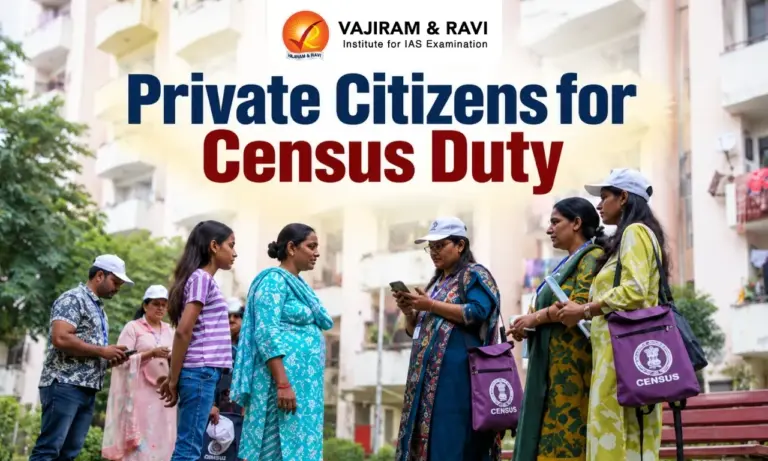
Private Citizens for Census Duty Latest News
- Recently, the Centre amended the Census Rules, 1990, to explicitly include teachers of private educational institutions and employees of private establishments (banks, companies, societies, trusts) as eligible Census enumerators.
- This has reignited a legal debate: can the government legally compel private individuals to perform Census duties — and why was this amendment needed if the old rules already allowed “any person” to be appointed?
What the Amendment Actually Changes
- The amended rules now expressly name teachers of government, local authority, aided, and unaided private institutions as eligible enumerators.
- It also retains the broader category: any person whom a state/UT government considers suitable.
- Crucially, this isn’t very different from before — the earlier Rule 3 already allowed enumerators to be chosen from “Teachers, Clerks or any official or any person.”
- MHA’s stated reason: to remove ambiguity and ensure smooth conduct of the Census, which needs lakhs of enumerators.


The Legal Backdrop That Triggered This
- May 2026: The Bombay High Court gave interim protection to over 500 private unaided and minority schools in Maharashtra, holding that Sections 6 and 7 of the Census Act did not confer authority to compulsorily requisition staff of private unaided schools, unlike Section 4A, which binds local authorities.
- The court rejected the government’s argument that “any person” under the old rules covered private teachers, warning this interpretation could extend unrestricted even to doctors, advocates, and chartered accountants. It held, prima facie, that subordinate legislation (rules) cannot exceed its parent statute (the Act).
- October 2026: The Punjab and Haryana High Court stayed Haryana government communications seeking private-school teacher details for Census duty.
- Later, the Centre issued the amendment — seen as a response to these judicial setbacks.
What the Census Act, 1948 Actually Says
- Section 4(2): Gives state governments power to “appoint persons as census-officers,” adding that such persons “shall be bound to serve.” This broad wording (“persons”) is the government’s strongest legal basis.
- Section 4A: Requires local authorities (when Centre-directed) to provide necessary staff.
- Sections 6 and 7: Allow seeking assistance from private establishments, but in limited, defined circumstances — mainly counting people within their premises, not deploying employees as general door-to-door enumerators.
Key Judicial Precedents
- 2010 — LIC Jalandhar case: Punjab & Haryana HC quashed an order requiring LIC to provide 150 employees as enumerators, ruling Section 7(c) only permits assistance for counting persons within an establishment — directions were “beyond the scope” of the Act. However, it left states free to invoke Section 4(2) instead.
- 2019 — Gujarat HC (LIC case): Similarly ruled against requisitioning LIC employees under Section 7; now under challenge before the Supreme Court.
- Census 2011 precedent: Bombay HC initially gave interim protection to private school teachers (Jan 2011), but later modified this (Feb 2011) — allowing deployment of private school teachers before/after school hours, exempting Class X/XII teachers, and letting school managements decide who could be spared.
Does the Constitution Permit Compulsory Public Service?
- Yes, in principle. Article 23(1) bans forced labour (begar), but Article 23(2) explicitly permits “compulsory service for public purposes” — provided it’s non-discriminatory.
Precedents For Compulsory Civilian Service
- Police Act, 1861: Allows appointing residents as special police officers in public-order situations — upheld as valid under Article 23(2) in Dulal Samanta v District Magistrate, Howrah (1958).
- National Service Act, 1972: Allowed calling up qualified doctors and engineers, but with an elaborate statutory framework — registration, hardship postponement, prescribed remuneration, employer release/reinstatement obligations.
- Key gap: The Census Act lacks this kind of detailed statutory machinery, making its compulsory-service basis legally weaker by comparison.
Why the Census Needs Such a Massive Workforce
- Despite digitisation, Census enumeration remains highly manpower-intensive.
- June 2025 estimate: ~34 lakh Enumerators and Supervisors needed; recent figures show ~31 lakh currently being trained.
- Enumerators are mainly drawn from school teachers and government/local-body officials — India has over 50 lakh government teachers.
- A former RGI official noted the issue is uneven availability, not a national shortage — remote/tribal areas often lack sufficient government teachers even as cities have a surplus.
- He added that substantial honoraria now encourage voluntary participation, potentially reducing the need for compulsion.
Conclusion
- The Census Rules amendment illustrates a recurring tension in Indian governance — between administrative necessity (deploying lakhs of enumerators for a nationwide exercise) and statutory limits on compulsory service.
- Courts have consistently signalled that while Section 4(2) may offer the government a legally sound path to requisition “any person,” the narrower Sections 6 and 7 cannot be stretched to justify blanket deployment of private employees.
- With the Gujarat High Court’s LIC ruling still pending before the Supreme Court, the ultimate legal clarity on this question — and the balance between citizen obligation and individual livelihood — remains to be settled before Census 2027 rolls out.
Source: IE

 Last updated on Oct, 2026
→ UPSC 2027 Notification will be released on 13 January 2027 at upsconline.nic.in.
→ Check Nobel Prize 2026 Winners List here.
→ Download PIB PRiSM Monthly Magazine 2026 here.
→ Check UPSC Monthly Current Affairs Magazine The Recitals here.
→ Check out the latest UPSC Syllabus here.
→ Download UPSC Model Answers for Mains 2026
→ UPSC Mains Question Paper 2026 is out now for Essay & GS Paper 1, 2, 3 & 4.
→ UPSC Calendar 2027 has been released.
→ Enroll in Vajiram & Ravi’s UPSC Mains Test Series 2027 for structured answer writing practice, expert evaluation, and exam-oriented feedback.
→ Join Vajiram & Ravi’s UPSC Mentorship Program 2027 for personalized guidance, strategy planning, and one-to-one support from experienced mentors.
→ Go through the UPSC Mains Previous Year Papers to enhance your preparation.
→ UPSC has released UPSC Toppers List 2025 with the Civil Services final result on its official website.
→ Also check Best UPSC Coaching in India
Private Citizens for Census Duty FAQs
Q1. Can the government compel private citizens for Census duty? +
Q2. What does the Census Rules amendment change? +
Q3. What is the role of Section 4(2) of the Census Act? +
Q4. Can private employees be requisitioned under Sections 6 and 7?+
Q5. Does the Constitution permit compulsory service for public purposes? +
Tags: mains articles Private Citizens for Census Duty upsc current affairs upsc mains current affairs