About Prokaryotes:
- They are single-celled organisms that lack a distinct nucleus and other membrane-bound organelles.
- Features
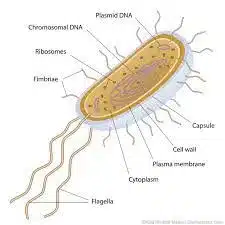
- Shape: They come in various shapes and sizes (0.5-5 µm), with four basic shapes being rod-like (bacillus), spherical (coccus), comma-shaped (vibrio), and spiral (spirillum).
- Cell organisation: Prokaryotic cells have a basic structural organisation, which includes a cell wall (except in mycoplasma), cytoplasm, and a plasma membrane. However, they lack a well-defined nucleus.
- Organelles: They lack membrane-bound organelles, except for ribosomes.
- They do have unique structures called mesosomes, which are extensions of the plasma membrane used for various functions.
- Reproduction: Prokaryotic cells reproduce primarily through binary fission, a type of asexual reproduction.
- DNA: Most prokaryotic cells have a single chromosome, which carries hereditary genes in the form of DNA.
- Prokaryotes include bacteria and “archaea”, another type of single-celled organism.
- These organisms are thought to be the oldest cell-based lifeforms on Earth.
- Habitat: They thrive across the entire planet – on land and in water, from the tropics to the poles.
- Ecological significance: They play a crucial role in the world’s food chains, helping support the nutrient needs of fish humans catch and eat.
Marine prokaryotes grow extremely fast – a process that emits a lot of carbon.
Q1: What are Eukaryotic Cells?
Eukaryotic cells are found in multi-cellular organisms such as protists, plants, animals, and fungi. They are more complex as compared to prokaryotic cells.
Source: Earth’s oldest, tiniest creatures are poised to be climate change winners


 Last updated on Oct, 2026
→ UPSC 2027 Notification will be released on 13 January 2027 at upsconline.nic.in.
→ Asian Games 2026 are being held in Aichi-Nagoya, Japan, from 19 September to 4 October.
→ Check Nobel Prize 2026 Winners List here.
→ Download PIB PRiSM Monthly Magazine 2026 here.
→ Check UPSC Monthly Current Affairs Magazine The Recitals here.
→ Check out the latest UPSC Syllabus here.
→ Download UPSC Model Answers for Mains 2026
→ UPSC Mains Question Paper 2026 is out now for Essay & GS Paper 1, 2, 3 & 4.
→ UPSC Calendar 2027 has been released.
→ Enroll in Vajiram & Ravi’s UPSC Mains Test Series 2027 for structured answer writing practice, expert evaluation, and exam-oriented feedback.
→ Join Vajiram & Ravi’s UPSC Mentorship Program 2027 for personalized guidance, strategy planning, and one-to-one support from experienced mentors.
→ Go through the UPSC Mains Previous Year Papers to enhance your preparation.
→ UPSC has released UPSC Toppers List 2025 with the Civil Services final result on its official website.
→ Also check Best UPSC Coaching in India