Psammophaga holzmannae and Psammophaga sinhai Latest News
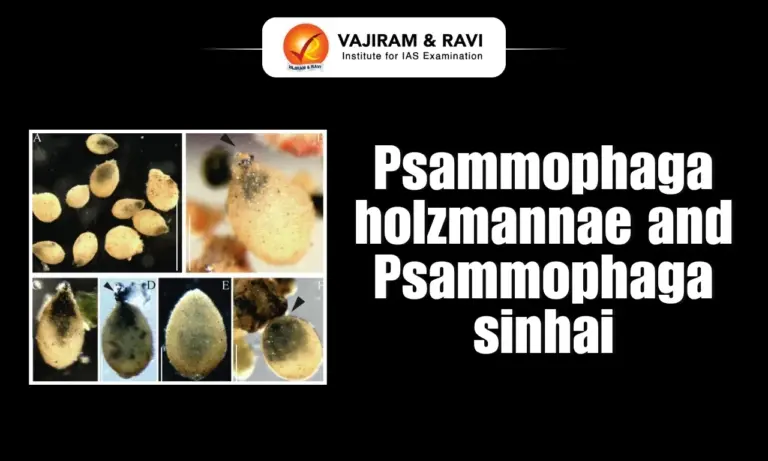
Scientists from Pune’s Agharkar Research Institute (ARI) recently discovered two new species of microscopic marine organisms named Psammophaga holzmannae and Psammophaga sinhai.
About Psammophaga holzmannae and Psammophaga sinhai
- They are two new species of microscopic marine organisms that selectively pick up and swallow specific mineral grains from the seafloor.
- They were found at Rajapuri Creek in Raigad district along Maharashtra’s Konkan coast.
- Psammophaga is a type of foraminifera, a group of microscopic organisms commonly found in oceans.
- The name comes from Greek words meaning ‘sand eater’.
- Unlike many foraminifera that have hard, multi-chambered shells, these organisms have just one chamber and a soft wall made mainly of very fine clay particles.
- The newly identified organisms are extremely small. P. holzmannae measures between 103 and 246 micrometres, while P. sinhai is larger, measuring between 279 and 448 micrometres.
- The two species also differ in shape and also in the way they store mineral grains.
- P. holzmannae is oval to almost round and has an orange or yellowish interior. The mineral grains it swallows are mainly kept near an opening called the aperture.
- P. sinhai is longer and may look like a droplet. Its mineral grains are spread throughout the body.
- The most interesting discovery was what the organisms choose to eat.
- Both species selectively take in heavy minerals containing titanium and iron. These include ilmenite and magnetite.
- This is important because these minerals occur only in small amounts in the surrounding sediment.
- So how do they do it?
- Psammophaga uses thin, temporary hair-like extensions called granuloreticulopodia.
- These extend from the aperture and help the organism interact with the surrounding sediment.
- Scientists believe these extensions may help the organism detect differences between mineral grains, although the exact mechanism is still not known.
News: TOI


 Last updated on Oct, 2026
→ UPSC 2027 Notification will be released on 13 January 2027 at upsconline.nic.in.
→ Asian Games 2026 are being held in Aichi-Nagoya, Japan, from 19 September to 4 October.
→ Check Nobel Prize 2026 Winners List here.
→ Download PIB PRiSM Monthly Magazine 2026 here.
→ Check UPSC Monthly Current Affairs Magazine The Recitals here.
→ Check out the latest UPSC Syllabus here.
→ Download UPSC Model Answers for Mains 2026
→ UPSC Mains Question Paper 2026 is out now for Essay & GS Paper 1, 2, 3 & 4.
→ UPSC Calendar 2027 has been released.
→ Enroll in Vajiram & Ravi’s UPSC Mains Test Series 2027 for structured answer writing practice, expert evaluation, and exam-oriented feedback.
→ Join Vajiram & Ravi’s UPSC Mentorship Program 2027 for personalized guidance, strategy planning, and one-to-one support from experienced mentors.
→ Go through the UPSC Mains Previous Year Papers to enhance your preparation.
→ UPSC has released UPSC Toppers List 2025 with the Civil Services final result on its official website.
→ Also check Best UPSC Coaching in India
Psammophaga holzmannae and Psammophaga sinhai FAQs
Q1. What are Psammophaga holzmannae and Psammophaga sinhai?+
Q2. Where were Psammophaga holzmannae and Psammophaga sinhai discovered?+
Q3. What does the name Psammophaga mean?+
Q4. Which minerals do the two Psammophaga species selectively consume?+
Tags: prelims pointers psammophaga holzmannae and psammophaga sinhai upsc current affairs upsc prelims current affairs