Purse Seine Fishing Latest News
The Supreme Court recently observed the Union and State Governments must abide by the principle of cooperative federalism to ensure effective implementation of the regulatory framework governing purse seine fishing in India’s EEZ and territorial waters.
About Purse Seine Fishing
- Purse seines are used in the open ocean to target dense schools of single-species pelagic (midwater) fish species of various sizes.
- Pelagic fish are those that swim in the water column of the open ocean, up to approximately 600 feet deep.
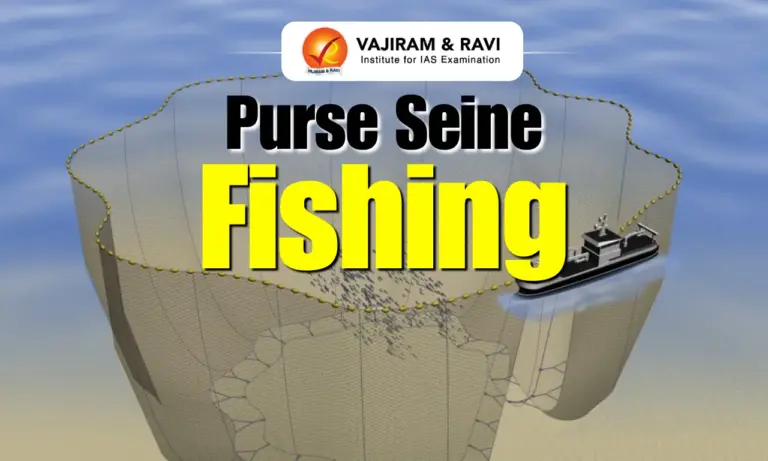
- A purse seine is a huge wall of netting that is set in a circle around a school of fish.
- Once the fish school is encircled, the net is closed underneath the school by hauling the purse line at the bottom of the net, which is called “pursing”.
- As the volume of the net becomes smaller, the fish become more concentrated, and the catch is harvested by either hauling the net aboard or bringing it alongside the vessel.
- A purse seine net can be more than 2000 metres in length and reach around 200 metres in depth.
- The size can vary depending on the vessel they are deployed from, the size of the mesh, and the target species.
- Advantages:
- Purse-seine fishing in open water is generally considered to be an efficient form of fishing.
- It has no contact with the seabed and can have low levels of bycatch (accidental catch of unwanted species).
- It can also be used to catch fish congregating around fish aggregating devices.
- Why is it banned in some states?
- In some States, it is linked to concerns about the decreasing stock of small, pelagic shoaling fish such as sardines, mackerel, anchovies, and trevally on the western coasts.
- Because this fishing method uses a wide net to draw in not only the targeted fish but also at-risk varieties, including turtles.
- Fishing is a State subject, and the management plan for marine fisheries in territorial waters is the job of the states (Under the Seventh Schedule of the Indian Constitution).
- Currently, bans on purse seine fishing are implemented in the territorial waters of Tamil Nadu, Kerala, Puducherry, Odisha, Dadra and Nagar Haveli and Daman and Diu, and the Andaman and Nicobar Islands up to 12 nautical miles.
News: LL


 Last updated on Oct, 2026
→ UPSC 2027 Notification will be released on 13 January 2027 at upsconline.nic.in.
→ Check Nobel Prize 2026 Winners List here.
→ Download PIB PRiSM Monthly Magazine 2026 here.
→ Check UPSC Monthly Current Affairs Magazine The Recitals here.
→ Check out the latest UPSC Syllabus here.
→ Download UPSC Model Answers for Mains 2026
→ UPSC Mains Question Paper 2026 is out now for Essay & GS Paper 1, 2, 3 & 4.
→ UPSC Calendar 2027 has been released.
→ Enroll in Vajiram & Ravi’s UPSC Mains Test Series 2027 for structured answer writing practice, expert evaluation, and exam-oriented feedback.
→ Join Vajiram & Ravi’s UPSC Mentorship Program 2027 for personalized guidance, strategy planning, and one-to-one support from experienced mentors.
→ Go through the UPSC Mains Previous Year Papers to enhance your preparation.
→ UPSC has released UPSC Toppers List 2025 with the Civil Services final result on its official website.
→ Also check Best UPSC Coaching in India
Purse Seine Fishing FAQs
Q1. What is purse seine fishing?+
Q2. What type of fish are primarily targeted by purse seine fishing?+
Q3. What is meant by “pursing” in purse seine fishing?+
Q4. Why is purse-seine fishing considered an efficient fishing method in open water?+
Q5. Does purse seine fishing normally involve contact with the seabed?+
Tags: prelims pointers purse seine fishing upsc current affairs upsc prelims current affairs