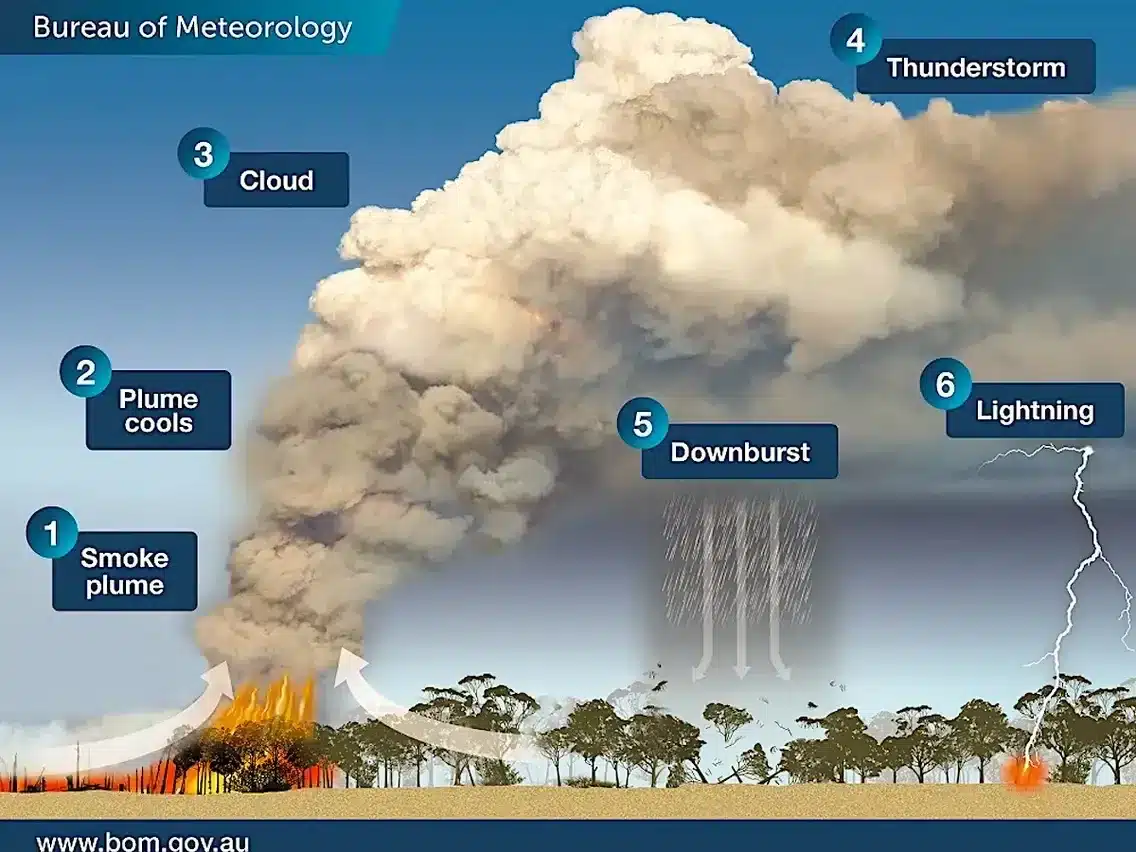
What is a Cumulonimbus Cloud (Cb)?
- It is a heavy and dense cloud of considerable vertical extent in the form of a mountain or huge tower, often associated with heavy precipitation, lightning, and thunder.
- More commonly known as thunderclouds, cumulonimbus is the only cloud type that can produce hail, thunder, and lightning.
- The base of the cloud is often flat, with a very dark wall-like feature hanging underneath, and may only lie a few hundred feet above the Earth’s surface.
- The vertical extent of Cumulonimbus ranges from 3 km to rarely more than 15 km (10 000 – 50 000 ft).
- Cb forms when three conditions are met:
- There must be a deep layer of unstable air.
- The air must be warm and moist.
- A trigger mechanism must cause the warm, moist air to rise:
- Heating of the layer of air close to the surface.
- Rising ground forcing the air upwards (orographic uplift).
- A front forcing the air upwards.
About Pyrocumulonimbus Clouds:
- They are thunder cloud screated by intense heat from the Earth’s surface.
- They are formed similarly to cumulonimbus clouds, but the intense heat that results in the vigorous updraft comes from fire, either large wildfires or volcanic eruptions.
- So it is, for this reason, the prefix ‘pyro’ is used – meaning fire in Greek.
- They look much darker than typical clouds because of their large amounts of smoke and ash.
- Pyrocumulonimbus clouds are thought to be responsible for several aerosol pollutants (such as smoke and ash) trapped in the stratosphere and upper atmosphere.
- And sometimes, lightning strikes generated from them even can ignite additional fires.
Q1: What are Cirrus Clouds?
Cirrus Clouds are delicate, feathery clouds that are made mostly of ice crystals. They are thin and wispy in appearance, often appearing as delicate, high-altitude filaments or strands. Their wispy shape comes from wind currents, which twist and spread the ice crystals into strands. They are usually white or have a light gray color. In the daytime, they are whiter than any other cloud in the sky. They are commonly known as “mare’s tails” because they are shaped like the tail of a horse.
Source: How Pyrocumulonimbus clouds are formed when wildfires spit storms, lightning


 Last updated on Oct, 2026
→ UPSC 2027 Notification will be released on 13 January 2027 at upsconline.nic.in.
→ Check Nobel Prize 2026 Winners List here.
→ Download PIB PRiSM Monthly Magazine 2026 here.
→ Check UPSC Monthly Current Affairs Magazine The Recitals here.
→ Check out the latest UPSC Syllabus here.
→ Download UPSC Model Answers for Mains 2026
→ UPSC Mains Question Paper 2026 is out now for Essay & GS Paper 1, 2, 3 & 4.
→ UPSC Calendar 2027 has been released.
→ Enroll in Vajiram & Ravi’s UPSC Mains Test Series 2027 for structured answer writing practice, expert evaluation, and exam-oriented feedback.
→ Join Vajiram & Ravi’s UPSC Mentorship Program 2027 for personalized guidance, strategy planning, and one-to-one support from experienced mentors.
→ Go through the UPSC Mains Previous Year Papers to enhance your preparation.
→ UPSC has released UPSC Toppers List 2025 with the Civil Services final result on its official website.
→ Also check Best UPSC Coaching in India