About RAD51
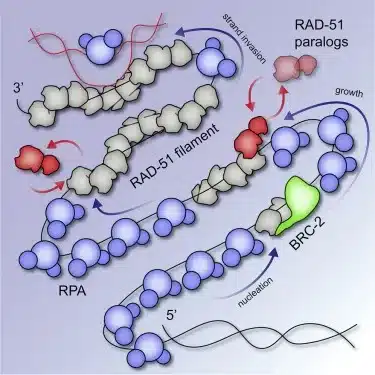
- RAD51 recombinase (RAD51) is a gene that encodes a protein that functions in homologous recombination and DNA repair.
- RAD51 has the function of finding and invading homologous DNA sequences to enable accurate and timely DNA repair.
- Breaks in DNA can be caused by natural and medical radiation or other environmental exposures, and also occur when chromosomes exchange genetic material in preparation for cell division.
- The RAD51 protein binds to the DNA at the site of a break and encases it in a protein sheath, which is an essential first step in the repair process.
- In the nucleus of many types of normal cells, the RAD51 protein interacts with many other proteins, including BRCA1 and BRCA2, to fix damaged DNA.
- The BRCA2 protein regulates the activity of the RAD51 protein by transporting it to sites of DNA damage in the nucleus.
- The interaction between the BRCA1 protein and the RAD51 protein is less clear, although research suggests that BRCA1 may also activate RAD51 in response to DNA damage.
- By helping repair DNA, these three proteins play a role in maintaining the stability of a cell’s genetic information.
What is Homologous Recombination?
- It is a type of genetic recombination in which genetic information is exchanged between two similar or identical molecules of double-stranded or single-stranded nucleic acids (usually DNA as in cellular organisms but may also be also RNA in viruses)
- It is widely used by cells to accurately repair harmful DNA breaks that occur on both strands of DNA, known as double-strand breaks (DSB), in a process called homologous recombinational repair (HRR).
- It also produces new combinations of DNA sequences during meiosis, the process by which eukaryotes make gamete cells, like sperm and egg cells in animals. These new combinations of DNA represent genetic variation in offspring, which in turn enables populations to adapt during the course of evolution.
- Homologous recombination is also used in horizontal gene transfer to exchange genetic material between different strains and species of bacteria and viruses. Horizontal gene transfer is the primary mechanism for the spread of antibiotic resistance in bacteria.
Q1) What is Deoxyribonucleic Acid (DNA)?
DNA, or deoxyribonucleic acid, is the hereditary material in humans and almost all other organisms. Nearly every cell in a person’s body has the same DNA. Most DNA is located in the cell nucleus (where it is called nuclear DNA), but a small amount of DNA can also be found in the mitochondria (where it is called mitochondrial DNA or mtDNA). Mitochondria are structures within cells that convert the energy from food into a form that cells can use.
Source: RAD51 protein identified as a key player in preventing DNA re-replication


 Last updated on Oct, 2026
→ UPSC 2027 Notification will be released on 13 January 2027 at upsconline.nic.in.
→ Check Nobel Prize 2026 Winners List here.
→ Download PIB PRiSM Monthly Magazine 2026 here.
→ Check UPSC Monthly Current Affairs Magazine The Recitals here.
→ Check out the latest UPSC Syllabus here.
→ Download UPSC Model Answers for Mains 2026
→ UPSC Mains Question Paper 2026 is out now for Essay & GS Paper 1, 2, 3 & 4.
→ UPSC Calendar 2027 has been released.
→ Enroll in Vajiram & Ravi’s UPSC Mains Test Series 2027 for structured answer writing practice, expert evaluation, and exam-oriented feedback.
→ Join Vajiram & Ravi’s UPSC Mentorship Program 2027 for personalized guidance, strategy planning, and one-to-one support from experienced mentors.
→ Go through the UPSC Mains Previous Year Papers to enhance your preparation.
→ UPSC has released UPSC Toppers List 2025 with the Civil Services final result on its official website.
→ Also check Best UPSC Coaching in India