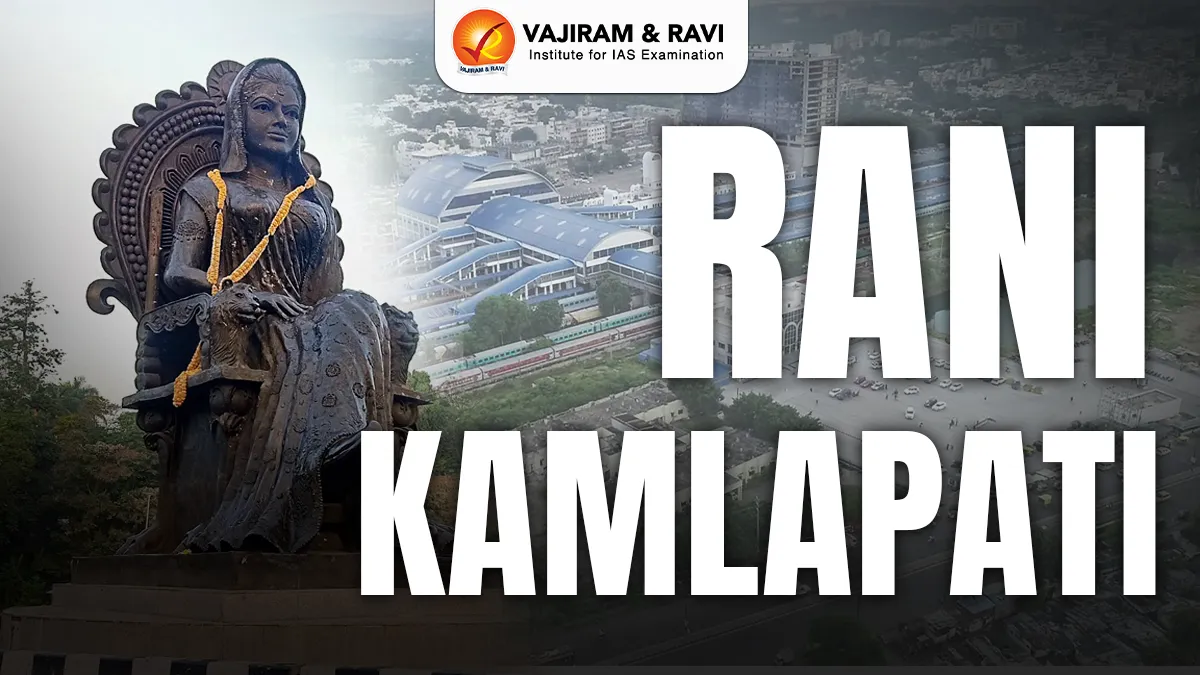
Rani Kamlapati was a Gond queen associated with Bhopal in the early 18th century. She is remembered as the last Hindu queen of Bhopal and is known for her courage, leadership, and sacrifice during a period of political instability in central India.
About Rani Kamlapati Early Life
- Rani Kamlapati belonged to the Gond tribe, one of the largest tribal communities of central India.
- She was born at Ginnorgarh Fort, which was an important Gond stronghold.
- She was married to Nizam Shah, a Gond ruler who controlled territories around Bhopal.
- According to historical accounts, Nizam Shah was poisoned by Alam Shah, his nephew, who wanted to capture the kingdom and marry Rani Kamlapati.
- To avenge the death of her husband and protect her kingdom, she sought the assistance of Dost Mohammad Khan, an Afghan military commander. She reportedly offered him a reward of one lakh rupees to defeat Alam Shah. Dost Mohammad Khan later led a combined force of Gond soldiers and Afghan warriors and defeated Alam Shah.
- After the assassination of Nizam Shah, Rani Kamlapati assumed responsibility for the administration of the kingdom and protected the interests of her minor son.
- Over time, Dost Mohammad Khan consolidated his influence and eventually took control of Bhopal. This marked a turning point in the region’s history, as Bhopal evolved into a princely state under his authority, bringing an end to Hindu rule in the area.
- According to historical traditions, Rani Kamlapati chose ‘Jal Jauhar’ (ritual self-sacrifice by drowning) after facing betrayal and the loss of her kingdom. Her sacrifice is remembered as a symbol of dignity and resistance.
Also Read: Sarojini Naidu
Rani Kamlapati Legacy
Rani Kamlapati is remembered not only for her political leadership but also for her developmental works. She made several contributions to the welfare of her people.
- She played an important role in water management, constructing tanks and improving water systems in the region.
- She promoted the construction of temples, gardens, and public spaces, which contributed to the cultural and social life of the kingdom.
- Her administration helped maintain stability in the region during a period of political turmoil.
Several places have been named in her honour, including the Rani Kamlapati Railway Station, formerly known as Habibganj Railway Station.Another important monument associated with her memory is the Rani Kamlapati Palace, located near the Upper Lake in Bhopal.
Also Read: Jhansi Rani Lakshmibai


 Last updated on Oct, 2026
→ UPSC 2027 Notification will be released on 13 January 2027 at upsconline.nic.in.
→ Check Nobel Prize 2026 Winners List here.
→ Download PIB PRiSM Monthly Magazine 2026 here.
→ Check UPSC Monthly Current Affairs Magazine The Recitals here.
→ Check out the latest UPSC Syllabus here.
→ Download UPSC Model Answers for Mains 2026
→ UPSC Mains Question Paper 2026 is out now for Essay & GS Paper 1, 2, 3 & 4.
→ UPSC Calendar 2027 has been released.
→ Enroll in Vajiram & Ravi’s UPSC Mains Test Series 2027 for structured answer writing practice, expert evaluation, and exam-oriented feedback.
→ Join Vajiram & Ravi’s UPSC Mentorship Program 2027 for personalized guidance, strategy planning, and one-to-one support from experienced mentors.
→ Go through the UPSC Mains Previous Year Papers to enhance your preparation.
→ UPSC has released UPSC Toppers List 2025 with the Civil Services final result on its official website.
→ Also check Best UPSC Coaching in India
Rani Kamlapati FAQs
Q1. Who was Rani Kamlapati?+
Q2. Which dynasty did Rani Kamlapati belong to?+
Q3. Who was the husband of Rani Kamlapati?+
Q4. Why did Rani Kamlapati seek help from Dost Mohammad Khan?+
Q5. Why was Rani Kamlapati in the news recently?+
Tags: history rani kamlapati