


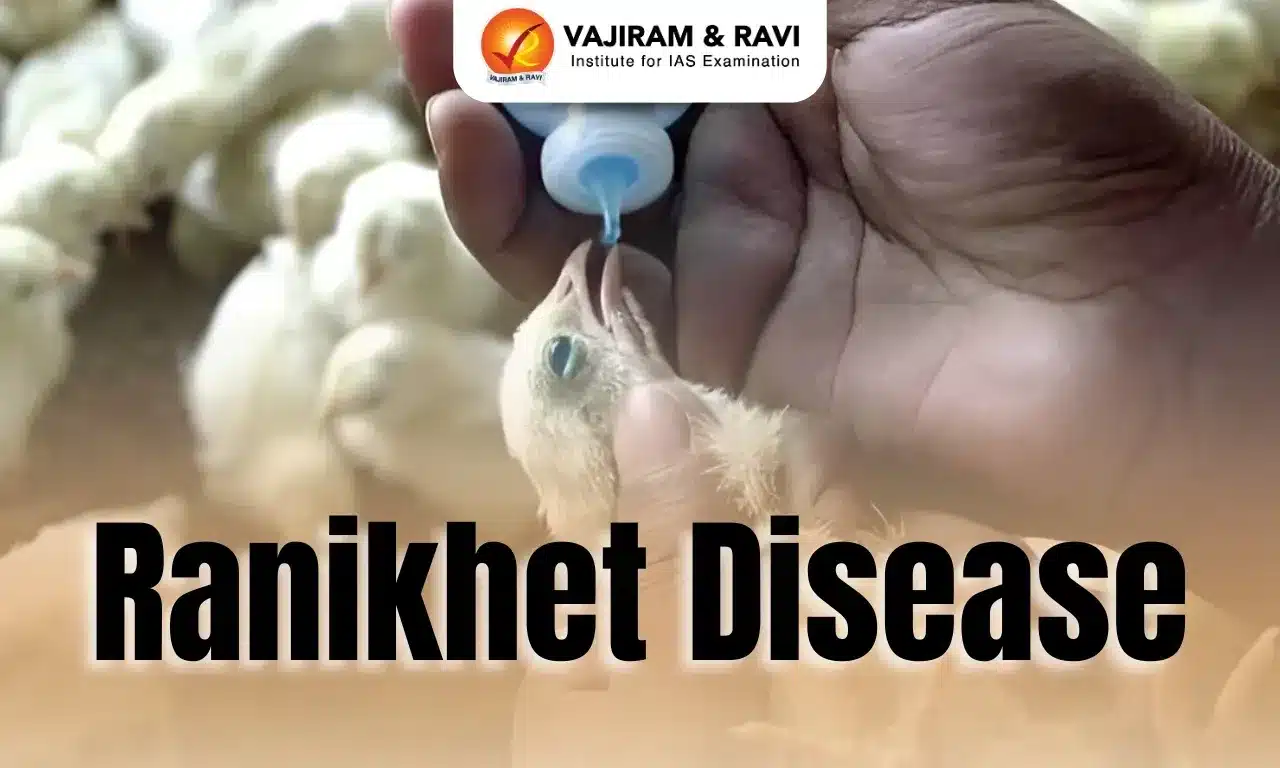
Ranikhet Disease Latest News
Suspected highly virulent Ranikhet disease is said to have caused the death of nearly 1.5 lakh chickens in Eluru, Guntur, Prakasam, and the twin Godavari districts in Andhra Pradesh recently.
About Ranikhet Disease
- It is a highly contagious viral disease that affects birds, particularly poultry such as chickens, turkeys, and ducks.
- It is caused by infections with virulent avian avulavirus 1, commonly known as Newcastle disease virus (NDV) and designated as avian paramyxovirus-1 (APMV-1).
- It attacks the respiratory, nervous, and digestive systems of birds.
- It causes production drops/fertility problems.
- Morbidity is usually high, and mortality varies from 50 to 100 percent.
- It is a minor zoonosis (disease of animals that can also infect humans) and can cause conjunctivitis in humans, but the condition is generally very mild and self-limiting.


Ranikhet Disease Transmission
- Direct contact with secretions, especially faeces, from infected birds
- Contaminated feed, water, implements, premises, human clothing, etc.
- ND viruses can survive for several weeks in the environment, especially in cool weather.
Ranikhet Disease Symptoms
- The symptoms vary according to the age of the affected birds.
- The first symptoms usually observed in young birds are sneezing, gasping, and often droopiness. It is in this stage of the disease that the manifestations rather closely resemble those of infections bronchitis.
- Within a short time after the appearance of respiratory symptoms, deaths occur in a flock in quick succession and in increasing numbers from day to day.
Ranikhet Disease Treatment
- At present there is no effective treatment of any value.
- Proper housing and general good care are indicated in an effort to shorten the duration and severity of the infection.
Ranikhet Disease FAQs
Q1. Which animal is affected by Ranikhet?
Ans. Ranikhet disease primarily affects poultry, especially chickens, causing respiratory, digestive, and nervous system issues.
Q2. What causes Ranikhet disease?
Ans. It is caused by infections with virulent avian avulavirus 1, commonly known as Newcastle disease virus (NDV).
Q3. Is Ranikhet disease curable?
Ans. Ranikhet disease is not curable once an animal is infected.
Source: TOI

 Last updated on Oct, 2026
→ UPSC 2027 Notification will be released on 13 January 2027 at upsconline.nic.in.
→ Check Nobel Prize 2026 Winners List here.
→ Download PIB PRiSM Monthly Magazine 2026 here.
→ Check UPSC Monthly Current Affairs Magazine The Recitals here.
→ Check out the latest UPSC Syllabus here.
→ Download UPSC Model Answers for Mains 2026
→ UPSC Mains Question Paper 2026 is out now for Essay & GS Paper 1, 2, 3 & 4.
→ UPSC Calendar 2027 has been released.
→ Enroll in Vajiram & Ravi’s UPSC Mains Test Series 2027 for structured answer writing practice, expert evaluation, and exam-oriented feedback.
→ Join Vajiram & Ravi’s UPSC Mentorship Program 2027 for personalized guidance, strategy planning, and one-to-one support from experienced mentors.
→ Go through the UPSC Mains Previous Year Papers to enhance your preparation.
→ UPSC has released UPSC Toppers List 2025 with the Civil Services final result on its official website.
→ Also check Best UPSC Coaching in India








