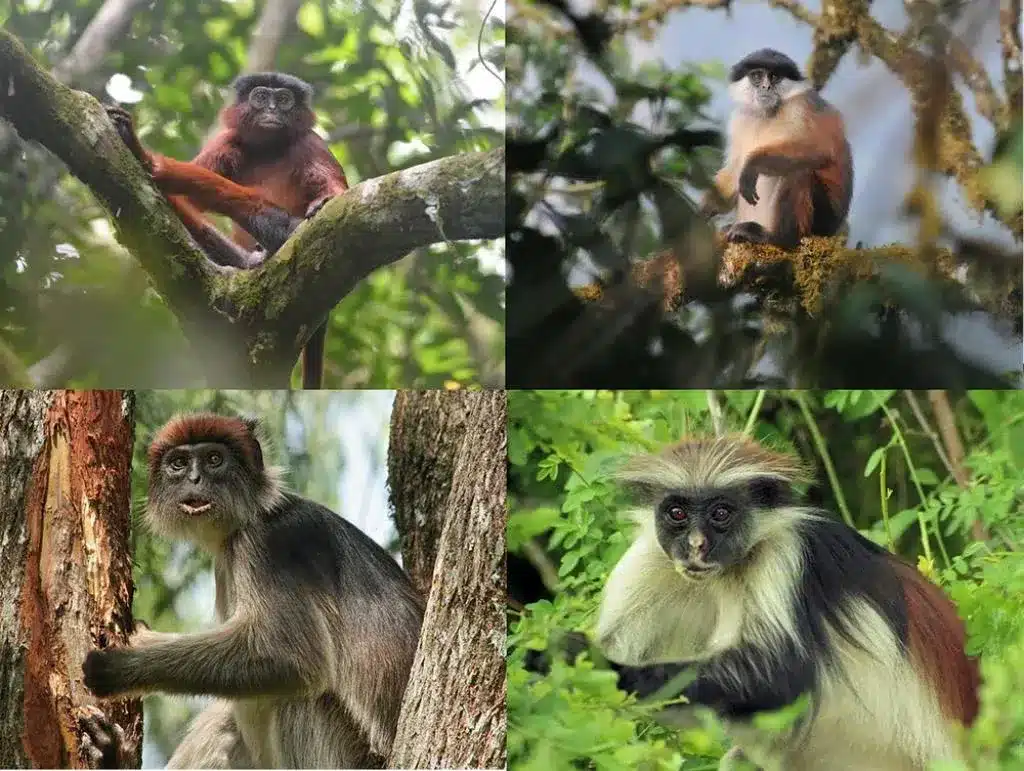
About Red Colobus
- These are a rare group of imperilled monkeys spread across Africa, are primary indicators of biodiversity.
- Red colobus monkeys are one of two major simian groups globally.
- Colobines are primarily leaf-eaters, as compared to the cercopithecines, which are omnivores and thus include animals in their diet as well.
- Colobines also include the langurs of south and southeast Asia besides Africa’s colobus (olive and black-and-white besides red) monkeys.
- Distribution: Ranging from forests in Senegal to the Zanzibar Archipelago.
- Most red colobus are facing extinction, making them the most threatened group of non-ape primates in mainland Africa.
- More than half of the 18 distinct forms of red colobus monkeys (scientists are unclear about how many species there are) are classified as Endangered or Critically Endangered on the IUCN Red List of Threatened Species.
- Threats
- Hunting for trade and local subsistence
- Habitat loss, degradation and fragmentation due to logging, mining, charcoal production, infrastructure development and conversion of forest to farms and agriculture plantations.
Initiative to conserve Red Colobus
- The Red Colobus Conservation Action Plan, initiated by the International Union for Conservation of Nature (IUCN) Species Survival Commission Primate Specialist Group and the African Primatological Society.
- The action plan aims to make red colobus a priority conservation target, which will help to secure Africa’s tropical forests and reduce unsustainable hunting for wild meat.
- A Red Colobus Working Group (RCWG) has been formed to guide implementation of the action plan and a Red Colobus Conservation Network (RCCN) has been created to promote communication, capacity-building and monitoring of red colobus conservation efforts.
Q1: What is the International Union for Conservation of Nature?
It is a global organization composed of governments, NGOs, scientists, and experts dedicated to conserving nature and promoting sustainability.


 Last updated on Oct, 2026
→ UPSC 2027 Notification will be released on 13 January 2027 at upsconline.nic.in.
→ Check Nobel Prize 2026 Winners List here.
→ Download PIB PRiSM Monthly Magazine 2026 here.
→ Check UPSC Monthly Current Affairs Magazine The Recitals here.
→ Check out the latest UPSC Syllabus here.
→ Download UPSC Model Answers for Mains 2026
→ UPSC Mains Question Paper 2026 is out now for Essay & GS Paper 1, 2, 3 & 4.
→ UPSC Calendar 2027 has been released.
→ Enroll in Vajiram & Ravi’s UPSC Mains Test Series 2027 for structured answer writing practice, expert evaluation, and exam-oriented feedback.
→ Join Vajiram & Ravi’s UPSC Mentorship Program 2027 for personalized guidance, strategy planning, and one-to-one support from experienced mentors.
→ Go through the UPSC Mains Previous Year Papers to enhance your preparation.
→ UPSC has released UPSC Toppers List 2025 with the Civil Services final result on its official website.
→ Also check Best UPSC Coaching in India