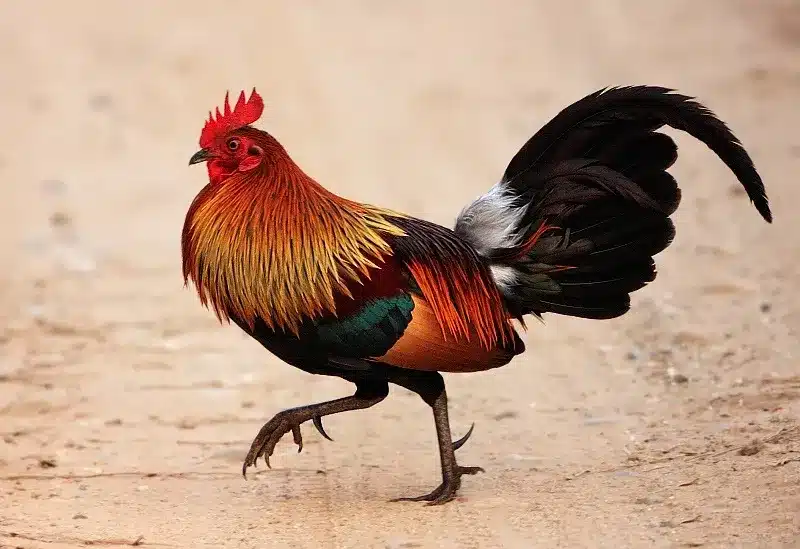
Key Legal and Environmental Implications
- Wildlife (Protection) Act, 1972: The Grey Junglefowl is listed under Schedule I, providing it with the highest level of legal protection.
- Hunting or consuming this species is a criminal offence, punishable under the Act.
- Sections of Bharatiya Nyaya Sanhita (BNS):
- Section 353(2): Pertains to spreading false information that promotes hatred.
- Section 356: Addresses defamation or intentional harm to reputation.
- Cultural Sensitivities: The incident highlights the need to preserve local traditions while ensuring adherence to environmental laws.
About the Red Junglefowl (Gallus gallus)
- Significance: The Red Junglefowl is a tropical pheasant species and the wild ancestor of the domestic chicken, making it vital for understanding avian domestication.
- It is native to India, Indo-China, Malaysia, and surrounding regions.
- Habitat: It is found in diverse habitats like primeval forests, dry scrublands, and secondary growth woodlands.
- Despite being listed as Least Concern by the IUCN Red List, the species faces threats from habitat loss and hybridization with domestic chickens.
- Threats:
- Hybridization: Feral domestic chickens and intermediate subspecies threaten the genetic purity of wild populations.
- Lack of Awareness: Insufficient education on the importance of preserving pure populations of the Red Junglefowl.
- Role in human history:
- Domesticated around 5,000 years ago in Southeast Asia, the Red Junglefowl became a crucial food source for early human societies.
- It was later introduced to Africa, South America, and Pacific Islands.
IUCN Status
- Category: Least Concern
- Reasons:
- Wide distribution: Found across a large geographical range.
- Stable population: Declines are not rapid enough to meet the criteria for vulnerability.
- Population size and trends, while not fully quantified, are believed to be sufficient to avoid vulnerable status.
Q1. What is the IUCN status?
The IUCN status refers to the conservation status of species as assessed by the International Union for Conservation of Nature (IUCN) through its Red List of Threatened Species. This list categorises species into several statuses, including Extinct (EX), Extinct in the Wild (EW), Critically Endangered (CR), Endangered (EN), Vulnerable (VU), Near Threatened (NT), Least Concern (LC), Data Deficient (DD) and Not Evaluated (NE).
News: ‘Jungli Murga’ on HP CM’s dinner menu? Police file case of defamation, fake news – The Hindu


 Last updated on Oct, 2026
→ UPSC 2027 Notification will be released on 13 January 2027 at upsconline.nic.in.
→ Check Nobel Prize 2026 Winners List here.
→ Download PIB PRiSM Monthly Magazine 2026 here.
→ Check UPSC Monthly Current Affairs Magazine The Recitals here.
→ Check out the latest UPSC Syllabus here.
→ Download UPSC Model Answers for Mains 2026
→ UPSC Mains Question Paper 2026 is out now for Essay & GS Paper 1, 2, 3 & 4.
→ UPSC Calendar 2027 has been released.
→ Enroll in Vajiram & Ravi’s UPSC Mains Test Series 2027 for structured answer writing practice, expert evaluation, and exam-oriented feedback.
→ Join Vajiram & Ravi’s UPSC Mentorship Program 2027 for personalized guidance, strategy planning, and one-to-one support from experienced mentors.
→ Go through the UPSC Mains Previous Year Papers to enhance your preparation.
→ UPSC has released UPSC Toppers List 2025 with the Civil Services final result on its official website.
→ Also check Best UPSC Coaching in India