What’s in Today’s Article?
- Regulating Digital Content in India Latest News
- Concerns Over Digital Content Regulation
- Existing Legal Framework
- Government Response to Concerns Over Digital Content Regulation
- Challenges in Regulation
- The Role of Youtube and Social Media Intermediaries
- Conclusion
- Regulating Digital Content in India FAQ’s
Regulating Digital Content in India Latest News
- The Indian government is examining the need for a new legal framework to regulate digital platforms amid concerns over violent and obscene content.
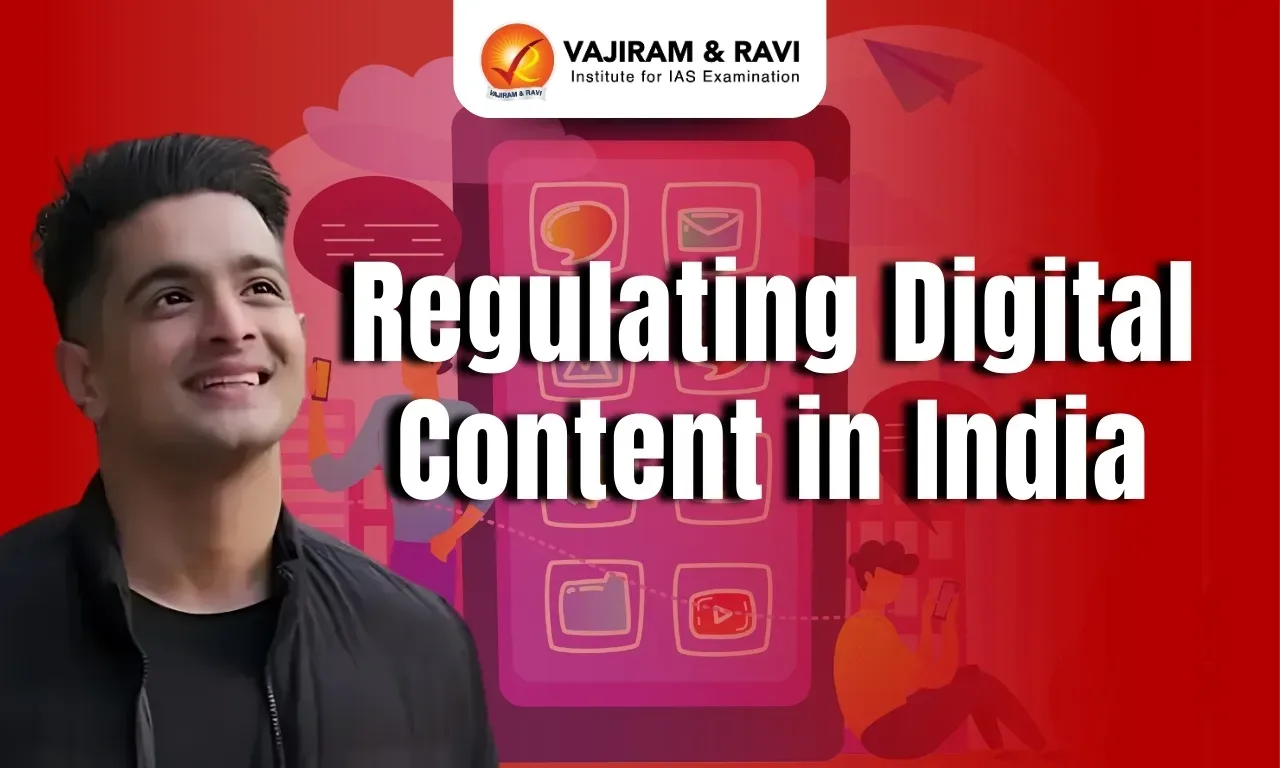
- The move comes in the wake of the Ranveer Allahbadia controversy and broader societal concerns regarding the misuse of the right to freedom of expression.


Concerns Over Digital Content Regulation
- The Union Information and Broadcasting (I&B) Ministry stated that the Supreme Court, multiple High Courts (HCs), MPs, and statutory bodies like the National Commission for Women have raised concerns regarding harmful content.
- For example, the SC granted Ranveer Allahbadia protection from arrest but strongly criticized his comments.
- The ministry acknowledges increasing public demand for stricter laws against harmful content on digital platforms, and is currently assessing the need for amendments or a new legal framework.
Existing Legal Framework
- The I&B Ministry has been reviewing statutory provisions and considering the need for a new regulatory framework.
- Existing regulations include:
- The Intermediary Guidelines and Digital Media Ethics Code (IT Rules, 2021): Mandate self-regulation and content classification.
- Indecent Representation of Women Act, 1986: Prohibits obscene depiction of women.
- Bhartiya Nyaya Sanhita (BNS), 2023: Contains provisions against obscene content.
- Protection of Children from Sexual Offences (POCSO) Act: Protects children from exposure to harmful content.
- Information Technology (IT) Act, 2000: Addresses publication of obscene or pornographic material.
- Recent government directives include:
- The I&B Ministry has asked social media channels and OTT platforms –
- To follow the Code of Ethics prescribed in the IT Rules 2021, and
- Implement “access control for A-rated content” to prevent children from consuming inappropriate material.
- The OTT platforms must not transmit any prohibited content and undertake age-based classification of content.
- The I&B Ministry has asked social media channels and OTT platforms –
Government Response to Concerns Over Digital Content Regulation
- The Standing Committee on Communications and Information Technology, led by BJP MP Nishikant Dubey, has sought clarification on necessary amendments to existing laws.
- The Ministry of Electronics and IT has been asked to assess the efficacy of existing laws and propose amendments to the IT Act, 2000.
Challenges in Regulation
- OTT platforms and social media currently lack a clear regulatory framework.
- The IT Rules, 2021, require a three-tier grievance redressal mechanism:
- Level 1: Self-regulation by the platform.
- Level 2: Industry-wide self-regulation.
- Level 3: Government oversight.
- This mechanism has been challenged in various HCs, with the Bombay and Madras HCs staying its enforcement.
- The Kerala HC has restrained coercive action over non-compliance with (Part III of) the IT Rules 2021.
- Over 15 petitions have been filed against these rules, and the SC has transferred all cases to the Delhi HC for a consolidated hearing.
The Role of Youtube and Social Media Intermediaries
- YouTube is regulated under the IT Rules but is not liable for user-generated content unless it violates government directives.
- Unlike traditional publishers, YouTube functions as a social media intermediary and has limited accountability for content uploaded by individual users.
- New media services like OTT platforms and YouTube currently operate without a specific regulatory framework, increasing demands for legal amendments.
Conclusion
- The debate over digital content regulation highlights the tension between freedom of expression and the need for responsible content dissemination.
- While there have been concerns regarding content censoring for extraneous reasons, the government is actively reviewing laws to create a more structured and enforceable legal framework for digital platforms.
- Judicial scrutiny and public discourse will play a key role in shaping the future of digital content regulation in India.
Regulating Digital Content in India FAQs
Q1. What is the primary concern driving the need for a new legal framework for digital content regulation in India?
Ans. The primary concern is the increasing misuse of the constitutional right to freedom of expression to showcase obscene and violent content on digital platforms.
Q2. What are the key legal provisions currently governing digital content in India?
Ans. Digital content is governed by the IT Rules, 2021, the Indecent Representation of Women Act, 1986, the Bhartiya Nyaya Sanhita (BNS), 2023, the POCSO Act, and the IT Act, 2000.
Q3. How does the IT Rules, 2021, regulate content on OTT platforms and social media?
Ans. The IT Rules, 2021, mandate a three-tier grievance redressal mechanism, require age-based classification of content, etc.
Q4. What challenges exist in regulating digital platforms like YouTube and OTT services?
Ans. Challenges include the absence of a specific regulatory framework, resistance from platforms advocating for self-regulation, the evolving nature of digital content, etc.
Q5. What is the Supreme Court’s stance on digital content regulation in the context of the Ranveer Allahbadia controversy?
Ans. The SC granted Allahbadia protection from arrest but strongly criticized his comments, urging the government to take steps to regulate obscene content.

 Last updated on Oct, 2026
→ UPSC 2027 Notification will be released on 13 January 2027 at upsconline.nic.in.
→ Asian Games 2026 are being held in Aichi-Nagoya, Japan, from 19 September to 4 October.
→ Check Nobel Prize 2026 Winners List here.
→ Download PIB PRiSM Monthly Magazine 2026 here.
→ Check UPSC Monthly Current Affairs Magazine The Recitals here.
→ Check out the latest UPSC Syllabus here.
→ Download UPSC Model Answers for Mains 2026
→ UPSC Mains Question Paper 2026 is out now for Essay & GS Paper 1, 2, 3 & 4.
→ UPSC Calendar 2027 has been released.
→ Enroll in Vajiram & Ravi’s UPSC Mains Test Series 2027 for structured answer writing practice, expert evaluation, and exam-oriented feedback.
→ Join Vajiram & Ravi’s UPSC Mentorship Program 2027 for personalized guidance, strategy planning, and one-to-one support from experienced mentors.
→ Go through the UPSC Mains Previous Year Papers to enhance your preparation.
→ UPSC has released UPSC Toppers List 2025 with the Civil Services final result on its official website.
→ Also check Best UPSC Coaching in India