Reinforcement Learning Latest News
In a paper published recently, the DeepSeek-AI team reported that their model, called just R1, could develop new forms of reasoning using reinforcement learning, a method of trial and error guided only by rewards for correct answers.
About Reinforcement Learning
- It is defined as a sub-field of machine learning (ML) that enables AI-based systems to take actions in a dynamic environment through trial and error methods to maximize the collective rewards based on the feedback generated for respective actions.
- In RL, an autonomous agent learns to perform a task by trial and error in the absence of any guidance from a human user.
- RL algorithms use a reward-and-punishment paradigm as they process data.
- RL is based on the hypothesis that all goals can be described by the maximization of expected cumulative reward.
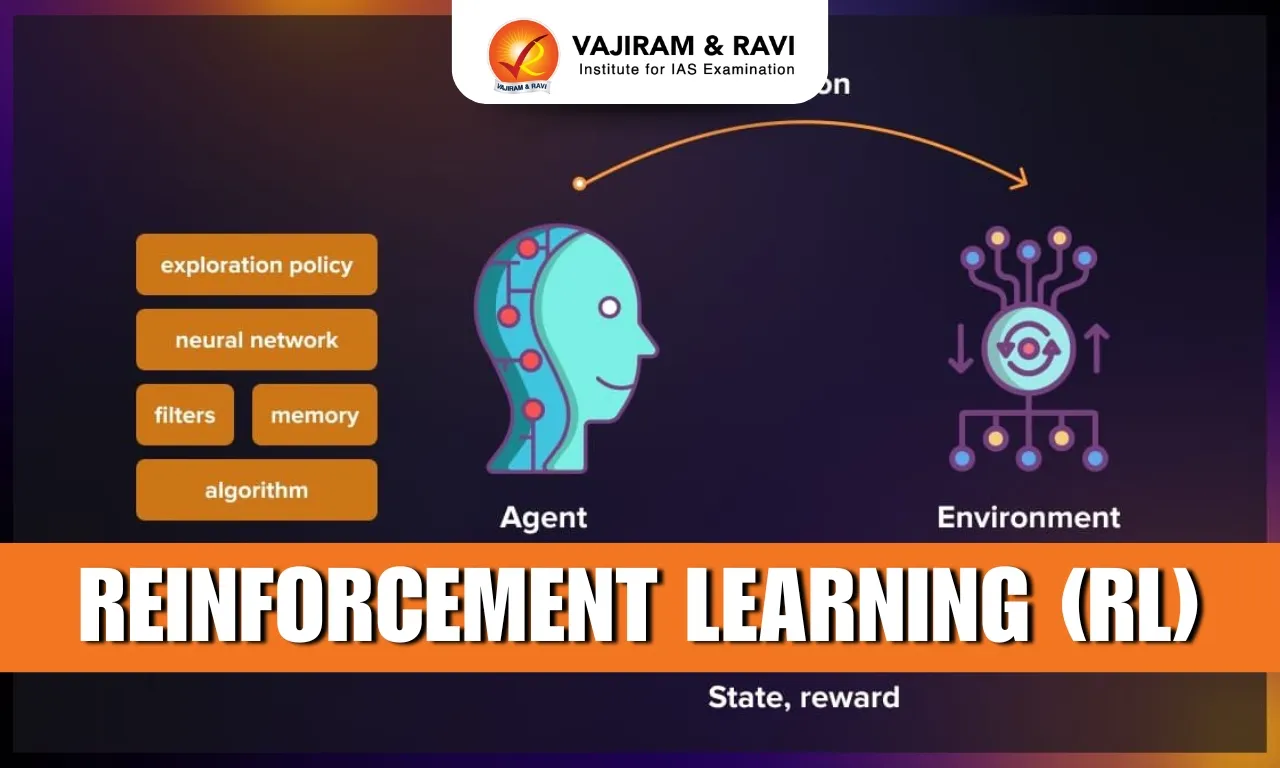
- The RL agent learns about a problem by interacting with its environment. The environment provides information on its current state.
- The agent then uses that information to determine which actions(s) to take.
- If that action obtains a reward signal from the surrounding environment, the agent is encouraged to take that action again when in a similar future state.
- This process repeats for every new state thereafter.
- Over time, the agent learns from rewards and punishments to take actions within the environment that meet a specified goal.
- The learning process in RL is driven by a feedback loop that consists of four key elements:
- Agent: The learner and decision-maker in the system.
- Environment: The external world the agent interacts with.
- Actions: The choices the agent can make at each step.
- Rewards: The feedback the agent receives after taking an action, indicating the desirability of the outcome.
- It particularly addresses sequential decision-making problems in uncertain environments and shows promise in artificial intelligence development.
Source: TH


 Last updated on Oct, 2026
→ UPSC 2027 Notification will be released on 13 January 2027 at upsconline.nic.in.
→ Asian Games 2026 are being held in Aichi-Nagoya, Japan, from 19 September to 4 October.
→ Check Nobel Prize 2026 Winners List here.
→ Download PIB PRiSM Monthly Magazine 2026 here.
→ Check UPSC Monthly Current Affairs Magazine The Recitals here.
→ Check out the latest UPSC Syllabus here.
→ Download UPSC Model Answers for Mains 2026
→ UPSC Mains Question Paper 2026 is out now for Essay & GS Paper 1, 2, 3 & 4.
→ UPSC Calendar 2027 has been released.
→ Enroll in Vajiram & Ravi’s UPSC Mains Test Series 2027 for structured answer writing practice, expert evaluation, and exam-oriented feedback.
→ Join Vajiram & Ravi’s UPSC Mentorship Program 2027 for personalized guidance, strategy planning, and one-to-one support from experienced mentors.
→ Go through the UPSC Mains Previous Year Papers to enhance your preparation.
→ UPSC has released UPSC Toppers List 2025 with the Civil Services final result on its official website.
→ Also check Best UPSC Coaching in India
Reinforcement Learning FAQs
Q1. What is Reinforcement Learning (RL) a sub-field of?+
Q2. How does an Reinforcement Learning (RL) agent learn to perform a task?+
Q3. Which paradigm forms the basis of Reinforcement Learning (RL) algorithms?+
Q4. What is the fundamental hypothesis of Reinforcement Learning?+
Tags: prelims pointers upsc current affairs upsc prelims current affairs