


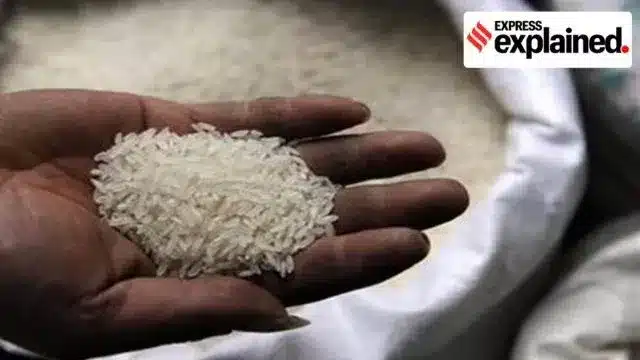
About Rice Fortification:
- Fortification is the process of adding Fortified Rice Kernels (FRK), containing FSSAI prescribed micronutrients (Iron, Folic Acid, Vitamin B12) to normal Rice in the ratio of 1:100 (Mixing 1 Kg of FRK with 100 Kg custom milled rice).
- Fortified rice is nearly identical to traditional rice in aroma, taste, and texture. This process is done in the rice mills at the time of milling of rice.
- It is a cost effective, culturally appropriate strategy to address micronutrient deficiency in countries with high per capita rice consumption.
- Rice Fortification is a 2 step process – (1) Production of Fortified Rice Kernels (FRK) (2) Blending of rice with FRK
- Processes used for rice is fortification
- Various technologies, such as coating, dusting, and ‘extrusion’, are available to add micronutrients to regular rice.
- Adding micronutrient technology involves the production of fortified rice kernels (FRKs) from a mixture using an ‘extruder’ machine. It is considered to be the best technology for India.
- Dry rice flour is mixed with a premix of micronutrients, and water is added to this mixture, which is then passed through a twin-screw extruder with heating zones.
- Kernels similar in shape and size to rice are produced, which must “resemble the normal milled rice as closely as possible”.
- The kernels are dried, cooled, and packaged. FRK has a shelf life of at least 12 months.
- The kernels are blended with regular rice to produce fortified rice. Under the Ministry’s guidelines, 10 g of FRK must be blended with 1 kg of regular rice.
- According to FSSAI norms, 1 kg of fortified rice will contain the following: iron (28 mg-42.5 mg), folic acid (75-125 microgram), and vitamin B-12 (0.75-1.25 microgram).
Q1: What is the Food Safety and Standards Authority of India (FSSAI)?
It is an autonomous body established under the Ministry of Health and Family Welfare, Government of India. The FSSAI has been established under the Food Safety and Standards Act, 2006, which is a consolidating statute related to food safety and regulation in India.
Source: What is fortified rice? Why did Centre extend initiative for its distribution in schemes


 Last updated on Oct, 2026
→ UPSC 2027 Notification will be released on 13 January 2027 at upsconline.nic.in.
→ Check Nobel Prize 2026 Winners List here.
→ Download PIB PRiSM Monthly Magazine 2026 here.
→ Check UPSC Monthly Current Affairs Magazine The Recitals here.
→ Check out the latest UPSC Syllabus here.
→ Download UPSC Model Answers for Mains 2026
→ UPSC Mains Question Paper 2026 is out now for Essay & GS Paper 1, 2, 3 & 4.
→ UPSC Calendar 2027 has been released.
→ Enroll in Vajiram & Ravi’s UPSC Mains Test Series 2027 for structured answer writing practice, expert evaluation, and exam-oriented feedback.
→ Join Vajiram & Ravi’s UPSC Mentorship Program 2027 for personalized guidance, strategy planning, and one-to-one support from experienced mentors.
→ Go through the UPSC Mains Previous Year Papers to enhance your preparation.
→ UPSC has released UPSC Toppers List 2025 with the Civil Services final result on its official website.
→ Also check Best UPSC Coaching in India








