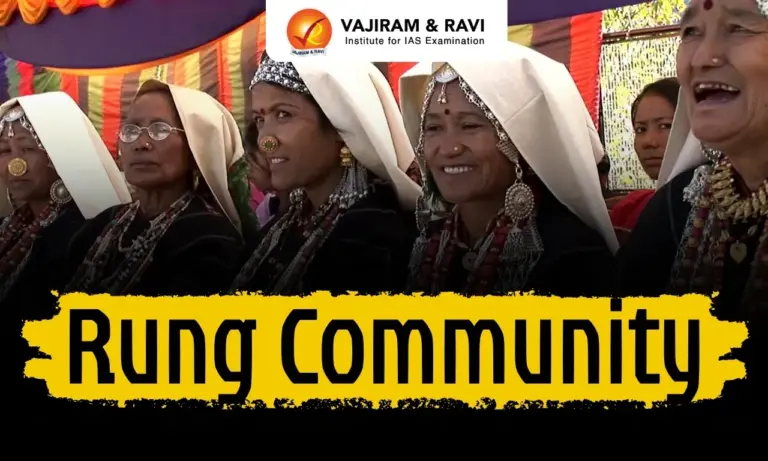
The Rung community, also called Rang or Shauka, is an indigenous Tibeto-Burman tribal community living in the high Himalayan border valleys of Pithoragarh district, Uttarakhand. They are recognised as a Scheduled Tribe and are grouped under the wider Bhotia label. For centuries they earned their living from trans-Himalayan trade with Tibet and moved between summer and winter settlements. This trade was cut off after the 1962 India-China War, and the community shifted to education, jobs, herb collection and tourism. Today they are also known for their nature worship and the Kandali festival.
Who Are the Rung Community?
The Rung Community are a mountain people with their own language, customs and way of life. They are one of the many Himalayan communities that have lived along the India-Tibet-Nepal border for generations.
- The Rung are also called Rang or Shauka, and they are an indigenous, Tibeto-Burman community of the Kumaon Himalayas.
- They are legally recognised as a Scheduled Tribe (ST) in India. They are commonly grouped under the broader Bhotia ST category, but they keep their own cultural and linguistic identity.
- The name Bhotia comes from Bod, the Tibetan name for Tibet. It was the term the British used for border people who seemed to resemble Tibetans. Kumaonis call them Shauka, a word linked to “money” or “rich”.
- They speak West Himalayish languages, collectively called Runglo (Rangkas). The main dialects are Byansi, Chaudangsi and Darmiya. These languages are linked to the old Zhangzhung language family.
- They live in the high border valleys of Vyans, Darma, Chaudans and Johar, in the Dharchula and Munsiyari areas of Pithoragarh.
- Traditionally they were traders, pastoralists and farmers. They practised transhumance, which means moving seasonally between higher and lower settlements.
- They are nature worshippers. They honour Lord Shiva through sacred mountains, rivers and forests.
Also Read : Tribes of Uttarakhand
Rung Community History and Origin
The Rung Community has long been a border and trading people. Their history is closely tied to the passes and markets between the Kumaon Himalayas and Tibet.
- The Rung Community is a Tibeto-Burman group. Their language family and culture show long-standing links with the Himalayan and Tibetan world.
- For centuries they ran trans-Himalayan trade between India and Tibet. Each of the Bhotia valleys had its own passes, including Lipulekh, Darma, Limpiya Dhura, Kungri-Bingri, Untadhura and Jayanti.
- Indian traders carried grain, sugar, jaggery, spices, tobacco, cotton, cloth, corals and beads to Tibet.
- They brought back salt, wool, borax and other goods, including pashmina and dried yak cheese.
- Trade was conducted at Tibetan markets such as Gyanima Mandi and Taklakot (Purang). Traders often worked through trusted Tibetan partners called “mitra”.
- Trade opened each year around April or May. A representative of the Tibetan governor of Ngari would travel to the Bhotia villages to announce the start of the season.
- Milam in the Johar valley was a major trading depot. A special census in 1900 recorded about 1,733 residents there, almost all Shauka traders.
- Because of this travel-based trade, families developed two settlements. They lived in the upper settlement during summer (about May-June to October-November) to trade and grow crops like buckwheat and hill wheat. They spent the rest of the year in the lower, winter settlement.
- The Rung also fought for their land. According to tradition, they defeated the army of Zorawar Singh, which attacked the Chaudans area from Ladakh in 1841. This victory is remembered in the Kandali festival.
- A border trade agreement between India and China in 1954, named Lipulekh as a trade and pilgrimage route.
- During 1959-1962, China’s control over Tibet and the 1962 India-China War closed the border. This abruptly ended the centuries-old trade and badly hurt the economy of the Bhotia and Shauka communities. Some trade continued through Tinkar Pass and with Nepal.
- After 1962 the community moved towards education, government jobs, herb collection (such as Yartsa Gumbu, Kutki and Gandrayan) and more recently, homestays for pilgrims.
- Limited, state-regulated trade reopened in the early 1990s through Lipulekh. It was suspended again in 2020. Reports from mid-2026 describe efforts to restart it, with the first batches of traders facing delays, so the situation is still developing.


Rung Community Culture, Traditions and Festivals
Rung culture is shaped by the mountains. Their beliefs, festivals and daily life all show respect for nature and for the land they depend on.
- Nature worship: The Rung honour Lord Shiva through sacred rivers, mountains and forests. Their worship centres on natural landscapes and not on man-made structures.
- Kandali festival: This is their best-known festival. It is celebrated once every 12 years, when the Kandali plant (Strobilanthes wallichii) flowers in the Chaudans valley.
- The Kandali festival is held between August and October and lasts about a week. The last blooming was recorded in 1999, and the festival was celebrated again in the years that followed.
- It begins with the worship of a Shiva linga made of barley and buckwheat flour. Families pray for prosperity, and a community feast follows.
- People dress in traditional clothes and gold and silver ornaments, gather around a tree on sacred ground, tie white cloth strips to it, and hoist a flag. The festival is linked to the 1841 victory over Zorawar Singh’s army.
- Language and dialects: Runglo, Byansi, Chaudangsi and Darmiya keep the community’s identity alive.
- Seasonal life: Families move between summer and winter settlements, growing grains and looking after livestock.
- Herb gathering: Many families collect Yartsa Gumbu (caterpillar fungus), Kutki and Gandrayan, following community rules on harvesting.
- Traditional governance: Village institutions and Gram Sabhas decide who can graze animals and when herbs can be collected.
- Recent example of tradition in action: In mid-2026, the community opposed a proposal to install a three-tonne artificial Shivling and Nandi statue near Om Parvat. They said it went against their tradition of revering natural Himalayan landscapes.
Also Read : Festivals of Uttarakhand
Geographical Distribution of the Rung Community in India
The Rung Community live in the remote border valleys of Pithoragarh district in the Kumaon Himalayas, close to the India-Nepal-Tibet region.
- Their main home is Pithoragarh district, Uttarakhand, especially around Dharchula and Munsiyari.
- They live in four valleys: Vyans, Darma, Chaudans and Johar.
- Johar valley (near Munsiyari): The Rung here are commonly called Shauka. Milam, once a major trade centre, is now sparsely inhabited.
- Darma, Chaudans and Vyans valleys (near Dharchula): these are home to the Darmiya, Chaudangsi and Byansi groups.
- Gunji, at about 10,500 feet, is among the last Indian villages near Lipulekh Pass, and it is a key base for border trade and pilgrim routes.
- The Bhotia communities of Uttarakhand live in seven river valleys: Jadh, Mana and Niti in Garhwal, and Johar, Darma, Byans and Chaudans in Kumaon. The Rung belong to the Kumaon valleys.
- Rung and related groups are also found in parts of Nepal, across the border.

 Last updated on Oct, 2026
→ UPSC 2027 Notification will be released on 13 January 2027 at upsconline.nic.in.
→ Check Nobel Prize 2026 Winners List here.
→ Download PIB PRiSM Monthly Magazine 2026 here.
→ Check UPSC Monthly Current Affairs Magazine The Recitals here.
→ Check out the latest UPSC Syllabus here.
→ Download UPSC Model Answers for Mains 2026
→ UPSC Mains Question Paper 2026 is out now for Essay & GS Paper 1, 2, 3 & 4.
→ UPSC Calendar 2027 has been released.
→ Enroll in Vajiram & Ravi’s UPSC Mains Test Series 2027 for structured answer writing practice, expert evaluation, and exam-oriented feedback.
→ Join Vajiram & Ravi’s UPSC Mentorship Program 2027 for personalized guidance, strategy planning, and one-to-one support from experienced mentors.
→ Go through the UPSC Mains Previous Year Papers to enhance your preparation.
→ UPSC has released UPSC Toppers List 2025 with the Civil Services final result on its official website.
→ Also check Best UPSC Coaching in India
Rung Community FAQs
Q1. Who are the Rung community?+
Q2. Where do the Rung people live?+
Q3. What language do the Rung people speak?+
Q4. What is the Kandali festival?+
Q5. How did the 1962 India-China War affect the Rung community?+
Q6. What did the Rung traditionally trade with Tibet?+
Tags: rung community