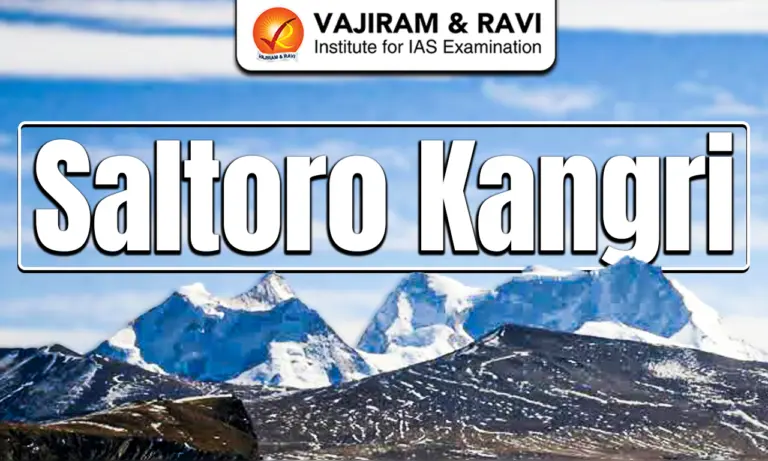
Saltoro Kangri is the highest peak of the Saltoro Range and one of the highest mountains in the Karakoram Mountain System. It rises to an elevation of 7,742 metres (25,400 feet), making it the 31st highest peak in the world. The mountain is surrounded by glaciers and remains snow-covered throughout the year. It is an important geographical feature of the Trans-Himalayan region and plays a significant role in sustaining glaciers, river systems and the fragile high-altitude ecosystem.
Saltoro Kangri Location
Saltoro Kangri is located in the Saltoro Range, a western sub-range of the Karakoram Mountain System. Its location makes it an important geographical feature of the north-western Himalayas.
- It is the highest peak of the Saltoro Range, which forms part of the Karakoram Mountain System.
- It lies west of the Siachen Glacier, one of the world’s longest non-polar glaciers.
- The peak is situated in the Ladakh region.
- It forms part of the Trans-Himalayan region, which is characterised by high-altitude cold desert conditions.
- The area lies close to the Actual Ground Position Line (AGPL), adding to its geographical significance.
Saltoro Kangri Geographical Features
Saltoro Kangri possesses several distinctive physical features that reflect the unique nature of high-altitude mountain environments.
- Rising to 7,742 metres, the peak remains snow-covered throughout the year due to its extreme altitude.
- It is part of a geologically young mountain system formed by the collision of the Indian and Eurasian tectonic plates, making the region tectonically active.
- Permanent snowfields and glaciers dominate the landscape, supporting one of the largest concentrations of ice outside the polar regions.
- The region is characterised by steep slopes, sharp ridges, deep valleys and rocky cliffs, making access and mountaineering extremely difficult.
- Very low temperatures, strong winds, low oxygen levels and frequent avalanches create one of the harshest mountain environments in the world.
- Snow and glacier melt from the region feed streams that ultimately contribute to the Indus River system.


Saltoro Kangri Drainage System
The glaciers and permanent snowfields of Saltoro Kangri play an important role in maintaining the drainage network of the north-western Himalayas.
- Glacial meltwater forms the primary source of surface water in the region.
- Meltwater drains into the Nubra River, which flows through the glaciated valleys of the Karakoram.
- The Nubra River later joins the Shyok River, an important tributary of the Indus River.
- The drainage system ultimately becomes part of the Indus River Basin, one of South Asia’s major river systems.
- Continuous glacier melt helps sustain river flow during the summer months, supporting downstream ecosystems and water availability.
Saltoro Kangri Environmental Importance
Saltoro Kangri is an ecologically sensitive region because of its glaciers, unique climate and fragile mountain ecosystem.
- Freshwater Storage: The glaciers act as natural reservoirs, storing freshwater and releasing it gradually to sustain downstream river flows.
- Climate Regulation: The extensive snow and ice cover reflects solar radiation, helping regulate the regional climate.
- Indicator of Climate Change: Changes in glacier size and snow cover provide valuable evidence of global warming and changing climatic conditions.
- Fragile Mountain Ecosystem: The harsh climate supports specialised cold-adapted plants and animals that are highly sensitive to environmental disturbances.
- Water Security: The region plays an important role in maintaining water availability for areas dependent on the Indus river system.
Saltoro Kangri Climate Change Concerns
Climate change is increasingly affecting the glaciers and ecosystems of the Saltoro Kangri region.
- Accelerated Glacier Retreat: Rising temperatures are increasing the rate of glacier melting.
- Changing River Flows: Variations in glacier melt may alter the seasonal discharge of rivers in the Indus basin.
- Increase in Natural Hazards: Glacier retreat raises the risk of avalanches, landslides and the formation of glacial lakes.
- Threat to Biodiversity: Warming temperatures can disrupt fragile high-altitude ecosystems and affect cold-adapted species.
- Long-term Water Stress: Continued glacier loss may reduce freshwater availability in the future.

 Last updated on Oct, 2026
→ UPSC 2027 Notification will be released on 13 January 2027 at upsconline.nic.in.
→ Check Nobel Prize 2026 Winners List here.
→ Download PIB PRiSM Monthly Magazine 2026 here.
→ Check UPSC Monthly Current Affairs Magazine The Recitals here.
→ Check out the latest UPSC Syllabus here.
→ Download UPSC Model Answers for Mains 2026
→ UPSC Mains Question Paper 2026 is out now for Essay & GS Paper 1, 2, 3 & 4.
→ UPSC Calendar 2027 has been released.
→ Enroll in Vajiram & Ravi’s UPSC Mains Test Series 2027 for structured answer writing practice, expert evaluation, and exam-oriented feedback.
→ Join Vajiram & Ravi’s UPSC Mentorship Program 2027 for personalized guidance, strategy planning, and one-to-one support from experienced mentors.
→ Go through the UPSC Mains Previous Year Papers to enhance your preparation.
→ UPSC has released UPSC Toppers List 2025 with the Civil Services final result on its official website.
→ Also check Best UPSC Coaching in India
Saltoro Kangri FAQs
Q1. What is Saltoro Kangri?+
Q2. Which river system is associated with Saltoro Kangri?+
Q3. Why is Saltoro Kangri environmentally important?+
Q4. How is climate change affecting Saltoro Kangri?+
Tags: saltoro kangri