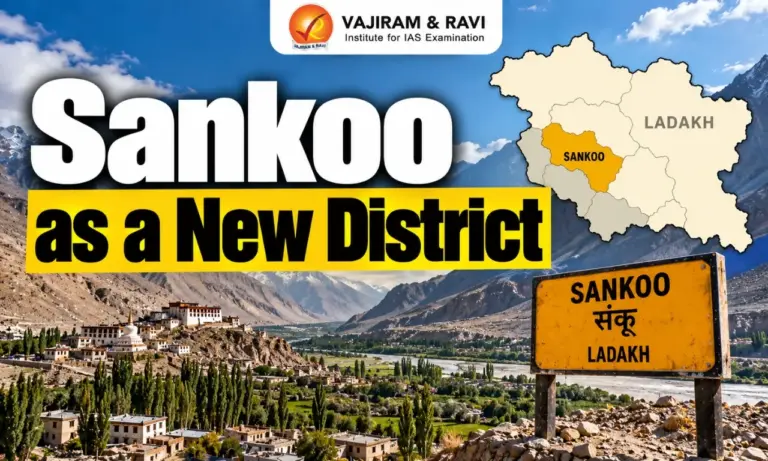
Sankoo has become the Eighth District of Ladakh following its formal notification by the Union Territory administration on October 16, 2026. It is located in the Suru Valley of the Kargil region. The New Sankoo District aims to improve administrative accessibility, strengthen public service delivery and address the long standing demand of local residents. The decision marks an important development in Ladakh’s administrative structure, bringing district level governance closer to people living in remote and geographically challenging areas.
Sankoo as a New District Latest News
The Ladakh Administration has formally notified Sankoo as a New District through Notification S.O. 284, issued by the Revenue Department on October 16, 2026. The notification follows the earlier Notification S.O. 180 dated April 27, 2026 and establishes Sankoo as the district headquarters. Lieutenant Governor Vinai Kumar Saxena announced the decision, describing it as the fulfilment of a long standing aspiration of local residents. The notification takes effect from its publication in the Official Gazette.
Background of Sankoo District Notification
The creation of Sankoo as a New District follows years of local demands for separate administrative status to improve governance and public access to essential services in remote parts of Ladakh.
- Demand for district status: Local residents demanded a separate district to address administrative difficulties and improve access to services, with around 3,000 people gathering in Sankoo in February 2020.
- Formation of Ladakh UT: On October 31, 2019, Ladakh became a separate Union Territory under the Jammu and Kashmir Reorganisation Act 2019, with Leh and Kargil as its two districts.
- Announcement of five districts: In August 2024, the Centre announced five new districts- Zanskar, Drass, Sham, Nubra and Changthang. Sankoo was excluded, leading to protests and demands for reconsideration.
- Continued public mobilisation: During 2024-25, the United Movement for Sankoo District Status submitted memoranda to the Union Government and organised public mobilisation, including a protest march in February 2025.
- Notification of new districts: On April 27, 2026, the five previously announced districts were formally notified, increasing Ladakh’s total to seven districts.
- Final notification of Sankoo: On October 16, 2026, the administration issued Notification S.O. 284, officially establishing Sankoo as Ladakh’s eighth district.
- Total districts in Ladakh: Ladakh now has eight districts: Leh, Kargil, Sham, Nubra, Changthang, Zanskar, Drass and Sankoo.


Sankoo District
Sankoo District lies in the Suru Valley of the Kargil region and brings together four tehsils under a separate district administration.
- Location: Sankoo is situated in the Suru Valley, approximately 40-42 kilometres south of Kargil town, within the Union Territory of Ladakh.
- District headquarters: Sankoo town serves as the headquarters of the newly created district, providing a central location for district level administrative functions.
- Population: The Sankoo Village has a reported population of approximately 40,548 people, highlighting the administrative needs of its residents.
- Legal basis: The Revenue Department issued Notification S.O. 284 under Section 5 of the Jammu and Kashmir Land Revenue Act 1996, as applicable to Ladakh.
- Territorial reorganisation: The jurisdiction of Kargil district has been modified to exclude the tehsils and revenue villages incorporated into Sankoo District.
- Geographical features: The region is shaped by the Suru River valley, with settlements including Sangra, Stakpa, Umba, Lankarchay, Thasgam, Barso, Farona and Nagma Kousar.
Sankoo District Significance
The creation of Sankoo District is significant for decentralised governance, improved public service delivery and more balanced regional development across the Kargil region.
- Improved administrative efficiency: A separate district can bring administrative offices closer to residents, reduce dependence on Kargil headquarters and make routine official procedures more accessible.
- Better public service delivery: District level administration can improve access to revenue, health, education and welfare services, particularly for residents of remote villages.
- Decentralised governance: The New Sankoo District strengthens local administrative access by bringing decision making and government services closer to the people they serve.
- Regional development: Separate district status may encourage the development of administrative infrastructure, public facilities and economic activity within Sankoo and its surrounding settlements.
- Addressing public aspirations: The decision responds to a long standing demand supported by memoranda, public representation and peaceful mobilisation, highlighting the role of local participation in administrative decisions.
- Support for remote villages: Villages located far from Kargil headquarters face additional difficulties during harsh winters. A closer administrative centre can help reduce these geographical barriers.
- Balanced regional growth: The district’s creation may help address perceptions of regional exclusion and support more balanced administrative development across the Kargil region.
Sankoo as a New District Notification Challenges
The major challenges associated with the implementation and administration of the new Sankoo District may include:
- Implementation challenges: Effective functioning will require adequate staffing, administrative buildings, police facilities, healthcare and education infrastructure, reliable connectivity and sufficient financial resources.
- Fiscal and staffing requirements: Establishing new offices and filling posts in a remote, high altitude region may increase administrative expenditure and create recruitment challenges.
- Future administrative demands: The decision may encourage other areas, including Shakar-Chiktan, to renew demands for separate district status, requiring careful consideration of administrative capacity and regional needs.

 Last updated on Oct, 2026
→ UPSC 2027 Notification will be released on 13 January 2027 at upsconline.nic.in.
→ Check Nobel Prize 2026 Winners List here.
→ Download PIB PRiSM Monthly Magazine 2026 here.
→ Check UPSC Monthly Current Affairs Magazine The Recitals here.
→ Check out the latest UPSC Syllabus here.
→ Download UPSC Model Answers for Mains 2026
→ UPSC Mains Question Paper 2026 is out now for Essay & GS Paper 1, 2, 3 & 4.
→ UPSC Calendar 2027 has been released.
→ Enroll in Vajiram & Ravi’s UPSC Mains Test Series 2027 for structured answer writing practice, expert evaluation, and exam-oriented feedback.
→ Join Vajiram & Ravi’s UPSC Mentorship Program 2027 for personalized guidance, strategy planning, and one-to-one support from experienced mentors.
→ Go through the UPSC Mains Previous Year Papers to enhance your preparation.
→ UPSC has released UPSC Toppers List 2025 with the Civil Services final result on its official website.
→ Also check Best UPSC Coaching in India
Sankoo as a New District FAQs
Q1. When was Sankoo declared a new district?+
Q2. Why has Sankoo been made a separate district?+
Q3. What is the headquarters of Sankoo District?+
Q4. How many districts are there in Ladakh after the creation of Sankoo?+
Q5. Under which law was Sankoo District officially notified?+
Q6. What is the significance of creating new districts in a Union Territory?+
Q7. What are the major challenges in the administration of Sankoo District?+
Q8. What is the difference between a district and a Union Territory?+
Tags: sankoo sankoo as a new district