Santhal Rebellion Latest News
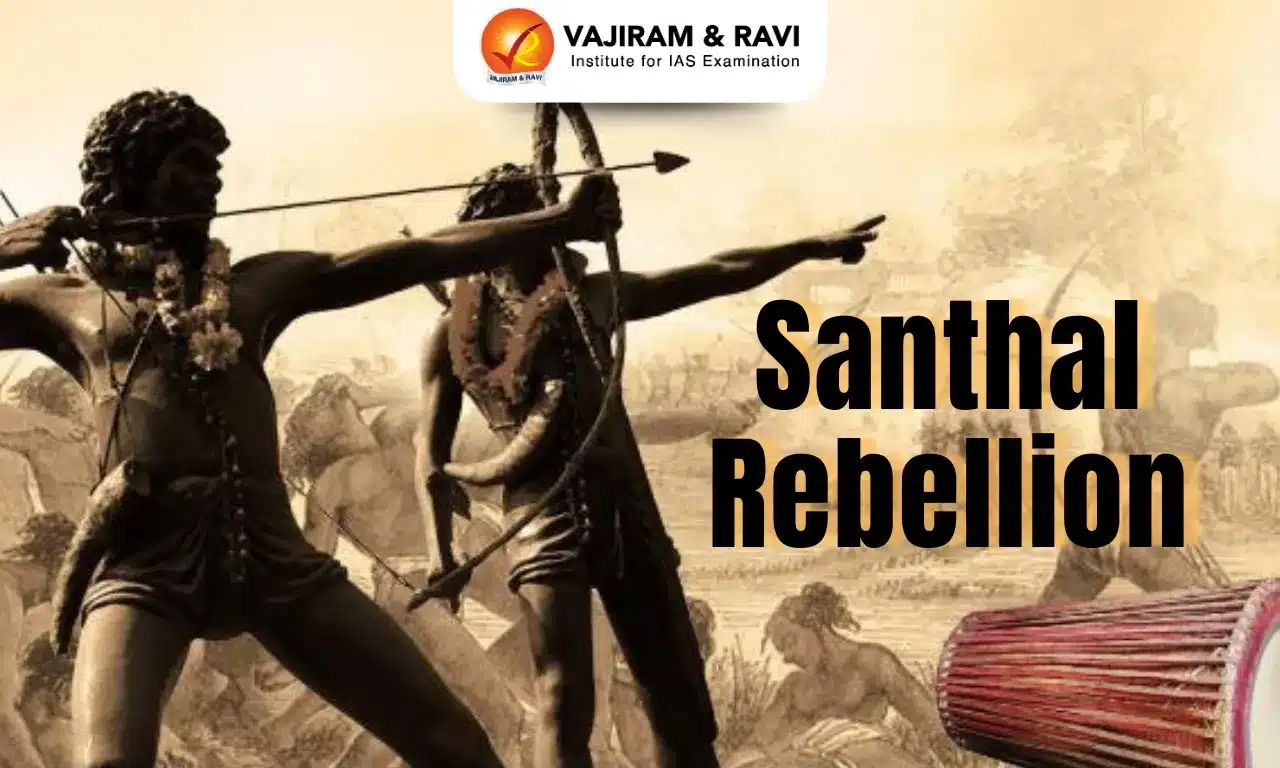
June 30 marked the 170th anniversary of the Santhal rebellion, or ‘Hul’ – literally, revolution – one of the earliest tribal uprisings against the British.
About Santhal Rebellion
- The Santhal rebellion, or ‘Hul’–literally, revolution–began in 1855, two years before the uprising of 1857, often referred to as “the first war for Indian independence”.
- The Santhal rebellion occurred in the Rajmahal hills of the Santhal region in Jharkhand.
- It was an “organised war against colonialism” led by the Santhals, standing against the myriad forms of oppression–economic and otherwise–they were subjected to by the British and their collaborator zamindars and corrupt moneylenders.
- The seeds of the Santhal rebellion, however, were sown in 1832 when the East India Company created the Damin-i-Koh region in the forested belt of the Rajmahal hills.
- The area was allocated to the Santhals displaced from Birbhum, Murshidabad, Bhagalpur, Barabhum, Manbhum, Palamau, and Chhotanagpur, all areas of the Bengal Presidency.
- While the Santhals were promised settlement and agriculture in Damin-i-Koh, what followed was the repressive practice of land-grabbing and begari (bonded labour) of two types: kamioti and harwahi.
- Over the years, Santhals found themselves at the receiving end of exploitative practices aided by the British.
- Led by two brothers, Sidhu and Kanhu, the Santhal Rebellion saw the participation of as many as 32 castes and communities rallying behind them.
- The brothers spread word about their plan through uniquely folded sal leaves, a communication system called Dharwak, and mobilised 10,000 people and declared a rebellion.
- Their brothers, Chand and Bairab, and sisters Phulo and Jhano Murmu, joined forces.
- With Phulo and Jhano joining the rebellion, more women took up arms against the British.
- After the rebellion broke out in 1855, both sides continued clashing till the uprising was crushed in 1856.
- The British defeated the Santhals using modern firearms and war elephants in a decisive action in which both Sidho and Kanho died.


Who were the Santhal Tribes?
- The Santhals were one of the largest tribal communities in India, predominantly residing in the states of Jharkhand, Bihar, West Bengal, and Odisha.
- They were known for their rich cultural heritage, distinct language (Santhali), and deep connection to the land they inhabited.
- Traditionally, the Santhals had been agriculturists, depending on the land for their livelihood.
- Their spiritual practices were closely linked to their agricultural lifestyle.
- The Santhal community had a strong social structure, with their society being organised into various clans known as ‘parhas.’
- They followed animism, a belief system deeply rooted in nature worship. They honoured spirits associated with the earth, water, and forests.
Source: IE

 Last updated on Oct, 2026
→ UPSC 2027 Notification will be released on 13 January 2027 at upsconline.nic.in.
→ Asian Games 2026 are being held in Aichi-Nagoya, Japan, from 19 September to 4 October.
→ Check Nobel Prize 2026 Winners List here.
→ Download PIB PRiSM Monthly Magazine 2026 here.
→ Check UPSC Monthly Current Affairs Magazine The Recitals here.
→ Check out the latest UPSC Syllabus here.
→ Download UPSC Model Answers for Mains 2026
→ UPSC Mains Question Paper 2026 is out now for Essay & GS Paper 1, 2, 3 & 4.
→ UPSC Calendar 2027 has been released.
→ Enroll in Vajiram & Ravi’s UPSC Mains Test Series 2027 for structured answer writing practice, expert evaluation, and exam-oriented feedback.
→ Join Vajiram & Ravi’s UPSC Mentorship Program 2027 for personalized guidance, strategy planning, and one-to-one support from experienced mentors.
→ Go through the UPSC Mains Previous Year Papers to enhance your preparation.
→ UPSC has released UPSC Toppers List 2025 with the Civil Services final result on its official website.
→ Also check Best UPSC Coaching in India
Santhal Rebellion FAQs
Q1. In which year did the Santhal Rebellion begin?+
Q2. The Santhal Rebellion took place in which present-day Indian state?+
Q3. Who were the main leaders of the Santhal Rebellion?+
Q4. What was Damin-i-Koh, mentioned in the context of the Santhal Rebellion?+
Tags: prelims pointers santhal rebellion upsc current affairs upsc prelims current affairs