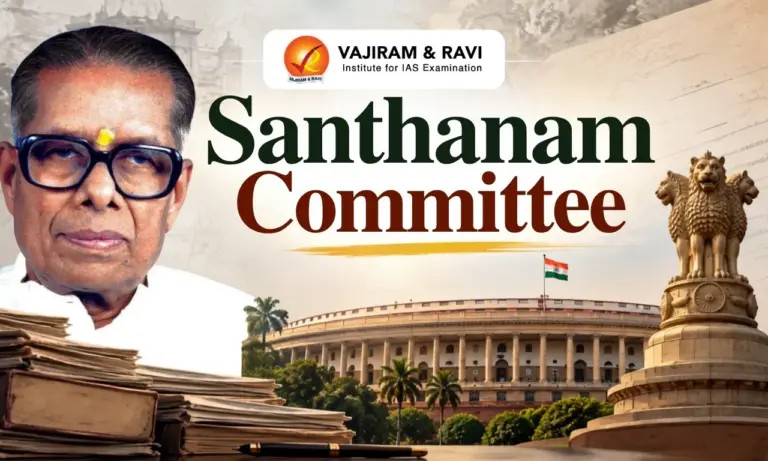
The Santhanam Committee laid the foundation for a systematic approach to preventing corruption in India by identifying key administrative causes of corruption and recommending institutional, legal and administrative reforms, including the establishment of the Central Vigilance Commission (CVC) in 1964.
About the Santhanam Committee
The Santhanam Committee, officially known as the Committee on Prevention of Corruption, was constituted to examine corruption in public administration and recommend measures for its prevention.
- The committee was constituted by the Government of India in 1962 under the chairmanship of K. Santhanam.
- It submitted its report in 1964, emphasising preventive measures rather than relying only on punishment.
- The committee linked corruption to administrative delays, excessive regulation, official discretion and complex procedures, not just individual misconduct.
Causes of Corruption Identified by the Santhanam Committee
The committee identified four major administrative factors that created opportunities for corruption.
- Administrative Delays: Delays in government decisions and services could create opportunities for officials to demand or accept illegal payments.
- Excessive Regulation: Excessive government regulation increased interactions between citizens and officials, creating greater opportunities for corrupt practices.
- Excessive Discretion: Wide discretionary powers gave officials greater scope for arbitrary decisions and misuse of authority.
- Cumbersome Procedures: Complicated procedures affecting citizens’ day-to-day affairs could create delays and opportunities for corruption.


Santhanam Committee Recommendations
The Santhanam Committee proposed institutional, administrative and legal measures to reduce opportunities for corruption and strengthen accountability in public administration.
- Establishment of the Central Vigilance Commission: The committee recommended an apex vigilance body to exercise general superintendence over vigilance administration in the Central Government.
- Strengthening Vigilance Machinery: It recommended strengthening departmental vigilance arrangements and making vigilance a continuous preventive activity rather than limiting it to action after corruption had occurred.
- Simplification of Rules and Procedures: The committee recommended simplifying laws, rules and administrative procedures to reduce unnecessary delays, complexity and opportunities for corrupt practices.
- Reduction of Discretionary Powers: It stressed the need to reduce excessive discretionary powers of public officials and make administrative decisions more objective and transparent.
- Strengthening Anti-Corruption Investigation: The committee recommended strengthening the Special Police Establishment (SPE) by increasing its personnel and powers to improve the investigation of corruption cases. The Central Bureau of Investigation (CBI) was established later on 1 April 1963, with the SPE becoming its Investigation and Anti-Corruption Division.
- Reform of Conduct Rules: It recommended stronger conduct rules for public servants, particularly regarding private interests, property and post-retirement employment.
- Restriction on Post-Retirement Employment: The committee recommended that government servants should not accept employment in a private commercial or industrial firm for two years after retirement, as a safeguard against conflicts of interest.
- Declaration of Assets: It recommended the declaration of private assets by civil servants, legislators and ministers to promote transparency and accountability.
- Improved Recruitment and Placement: The committee stressed careful appointment and promotion of officials, especially to sensitive posts, so that positions involving significant public responsibility were entrusted to persons of integrity.
- Better Service Conditions: It recommended adequate pay, accommodation and other facilities for government employees to reduce circumstances that could create incentives for accepting bribes.
- Transparency in Political Party Finances: It recommended greater transparency regarding private-sector donations to political parties, including making relevant information available to the public.
- Reforms Relating to Article 311: The committee examined how the safeguards under Article 311 of the Constitution could delay disciplinary action against corrupt public servants and recommended measures to make disciplinary proceedings more effective and expeditious.
Santhanam Committee Implementation and Impact
The recommendations of the Santhanam Committee influenced India’s institutional and legal framework for preventing corruption and strengthening vigilance administration.
- The recommendation for an apex vigilance body led to the establishment of the Central Vigilance Commission (CVC) on 11 February 1964 through a Government of India Resolution. The CVC was initially an executive body and received statutory status under the Central Vigilance Commission Act, 2003.
- Its recommendations influenced the Anti-Corruption Laws (Amendment) Act, 1964, which introduced changes to the existing anti-corruption legal framework.
- The committee’s emphasis on preventive vigilance contributed to the development and strengthening of vigilance arrangements within government departments.
- Its recommendations on conduct rules, asset declarations, recruitment, administrative procedures and disciplinary action contributed to broader efforts to improve integrity and accountability in public administration.

 Last updated on Oct, 2026
→ UPSC 2027 Notification will be released on 13 January 2027 at upsconline.nic.in.
→ Check Nobel Prize 2026 Winners List here.
→ Download PIB PRiSM Monthly Magazine 2026 here.
→ Check UPSC Monthly Current Affairs Magazine The Recitals here.
→ Check out the latest UPSC Syllabus here.
→ Download UPSC Model Answers for Mains 2026
→ UPSC Mains Question Paper 2026 is out now for Essay & GS Paper 1, 2, 3 & 4.
→ UPSC Calendar 2027 has been released.
→ Enroll in Vajiram & Ravi’s UPSC Mains Test Series 2027 for structured answer writing practice, expert evaluation, and exam-oriented feedback.
→ Join Vajiram & Ravi’s UPSC Mentorship Program 2027 for personalized guidance, strategy planning, and one-to-one support from experienced mentors.
→ Go through the UPSC Mains Previous Year Papers to enhance your preparation.
→ UPSC has released UPSC Toppers List 2025 with the Civil Services final result on its official website.
→ Also check Best UPSC Coaching in India
Santhanam Committee FAQs
Q1. What is the Santhanam Committee?+
Q2. When was the Santhanam Committee constituted?+
Q3. Who was the Chairman of the Santhanam Committee?+
Q4. What were the four major causes of corruption identified by the Santhanam Committee?+
Q5. Which institution was established on the recommendation of the Santhanam Committee?+
Q6. When did the Central Vigilance Commission (CVC) become a statutory body?+
Tags: santhanam committee