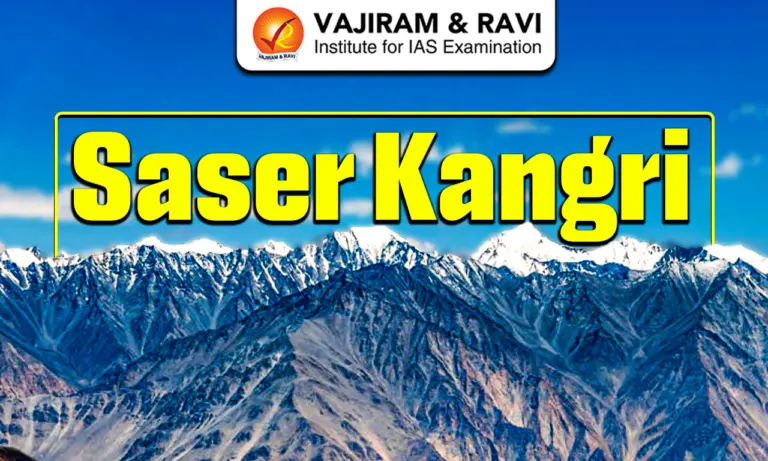
Saser Kangri is the highest peak of the Saser Muztagh range, an eastern sub-range of the Karakoram Mountain System. Rising to an elevation of 7,672 metres, it is among the highest peaks of India and the highest summit of the Saser Muztagh range. Located in the eastern Karakoram region of the Union Territory of Ladakh, it represents the extreme high-altitude cold desert environment of the Trans-Himalayas. The peak is important due to its glaciers, contribution to the Indus river system, fragile biodiversity and strategic geographical location.
Saser Kangri Location
Saser Kangri is located in the Saser Muztagh range of the Karakoram Mountains in Ladakh.
- It lies in the northeastern part of Ladakh, near the Karakoram Pass, an important mountain pass connecting Ladakh with Central Asia.
- The peak is situated in the eastern Karakoram region, close to the Siachen Glacier, one of the world’s longest non-polar glaciers.
- It forms part of the Trans-Himalayan region, characterised by high-altitude cold deserts, low precipitation and extreme climatic conditions.
- Its location near important mountain routes and sensitive border regions gives it strategic significance.
Saser Kangri Geographical Features
Saser Kangri reflects the rugged physical characteristics of the Karakoram mountain system.
- It is part of a young fold mountain system formed due to the collision of the Indian Plate with the Eurasian Plate.
- The region is characterised by steep slopes, sharp ridges, deep valleys and rocky peaks shaped by tectonic activity and glacial erosion.
- The summit remains snow-covered for most of the year due to its extreme elevation and harsh climatic conditions.
- The surrounding landscape contains glaciers, permanent snowfields and moraines, which indicate the dominance of glacial processes.
- Unlike the wetter Himalayan regions, the eastern Karakoram has a dry landscape due to its location in the rain-shadow zone of the Himalayas.


Saser Kangri Drainage System
Saser Kangri forms part of the Indus River Basin.
- Meltwater from glaciers and snowfields around the peak feeds mountain streams of eastern Karakoram.
- These streams contribute to the Nubra River, which flows into the Shyok River. The Shyok River is an important tributary of the Indus River.
- Seasonal glaciers and snowmelt play an important role in maintaining river discharge during summer months.
- The glacier-fed drainage system supports ecosystems and limited human settlements in the otherwise arid Ladakh region.
Saser Kangri Climate
Saser Kangri experiences a severe high-altitude cold desert climate.
- Winters are extremely cold, with prolonged freezing conditions and heavy snowfall at higher elevations.
- The region receives limited precipitation due to its location in the rain-shadow zone of the Himalayas.
- Most precipitation occurs in the form of snowfall rather than rainfall.
- Strong winds, low atmospheric pressure and reduced oxygen availability make the environment highly challenging.
- Large variations between daytime and nighttime temperatures occur due to the dry continental conditions.
Saser Kangri Flora and Fauna
The extreme environment supports a specialised Trans-Himalayan ecosystem.
- Vegetation is sparse and mainly consists of alpine grasses, shrubs and cold-resistant plants adapted to low moisture availability.
- Plant growth is mainly found in valleys and areas near streams where water availability is higher.
- The region supports wildlife species such as snow leopard, Himalayan ibex, bharal (blue sheep), marmot and red fox.
- These species possess adaptations that allow survival in extreme cold, low oxygen levels and limited food availability.
Saser Kangri Environmental Importance
Saser Kangri represents a fragile high-altitude ecosystem of the Karakoram with importance for water security, biodiversity and climate studies.
- Glaciers and snowfields act as natural freshwater reservoirs and contribute to the Nubra-Shyok-Indus river system.
- Changes in glacier extent and snowfall patterns provide evidence of climatic changes occurring in the Himalayan region.
- The region provides habitat for rare cold-adapted species of the Trans-Himalayan ecosystem.
- Its glaciers and landforms help scientists study glacial processes, mountain evolution and climate variability.
- Its location in the eastern Karakoram near important passes makes it significant from India’s geographical and security perspective.
Saser Kangri Climate Change Concerns
Climate change is affecting the fragile environment of the Saser Kangri region.
- Rising temperatures may accelerate glacier retreat and reduce long-term freshwater storage.
- Changes in glacier melt patterns can influence seasonal river flows in the Indus basin.
- Increasing instability of glaciers may enhance risks of avalanches and other high-altitude hazards.
- Warming conditions may disturb habitats of species adapted to extreme cold environments.

 Last updated on Oct, 2026
→ UPSC 2027 Notification will be released on 13 January 2027 at upsconline.nic.in.
→ Asian Games 2026 are being held in Aichi-Nagoya, Japan, from 19 September to 4 October.
→ Check Nobel Prize 2026 Winners List here.
→ Download PIB PRiSM Monthly Magazine 2026 here.
→ Check UPSC Monthly Current Affairs Magazine The Recitals here.
→ Check out the latest UPSC Syllabus here.
→ Download UPSC Model Answers for Mains 2026
→ UPSC Mains Question Paper 2026 is out now for Essay & GS Paper 1, 2, 3 & 4.
→ UPSC Calendar 2027 has been released.
→ Enroll in Vajiram & Ravi’s UPSC Mains Test Series 2027 for structured answer writing practice, expert evaluation, and exam-oriented feedback.
→ Join Vajiram & Ravi’s UPSC Mentorship Program 2027 for personalized guidance, strategy planning, and one-to-one support from experienced mentors.
→ Go through the UPSC Mains Previous Year Papers to enhance your preparation.
→ UPSC has released UPSC Toppers List 2025 with the Civil Services final result on its official website.
→ Also check Best UPSC Coaching in India
Saser Kangri FAQs
Q1. Where is Saser Kangri located?+
Q2. What is the elevation of Saser Kangri ?+
Q3. Which mountain system does Saser Kangri belong to?+
Q4. Which river basin is associated with Saser Kangri?+
Q5. Why is Saser Kangri geographically significant?+
Tags: saser kangri