Ali Khan Mahmudabad Free Speech Case Latest News
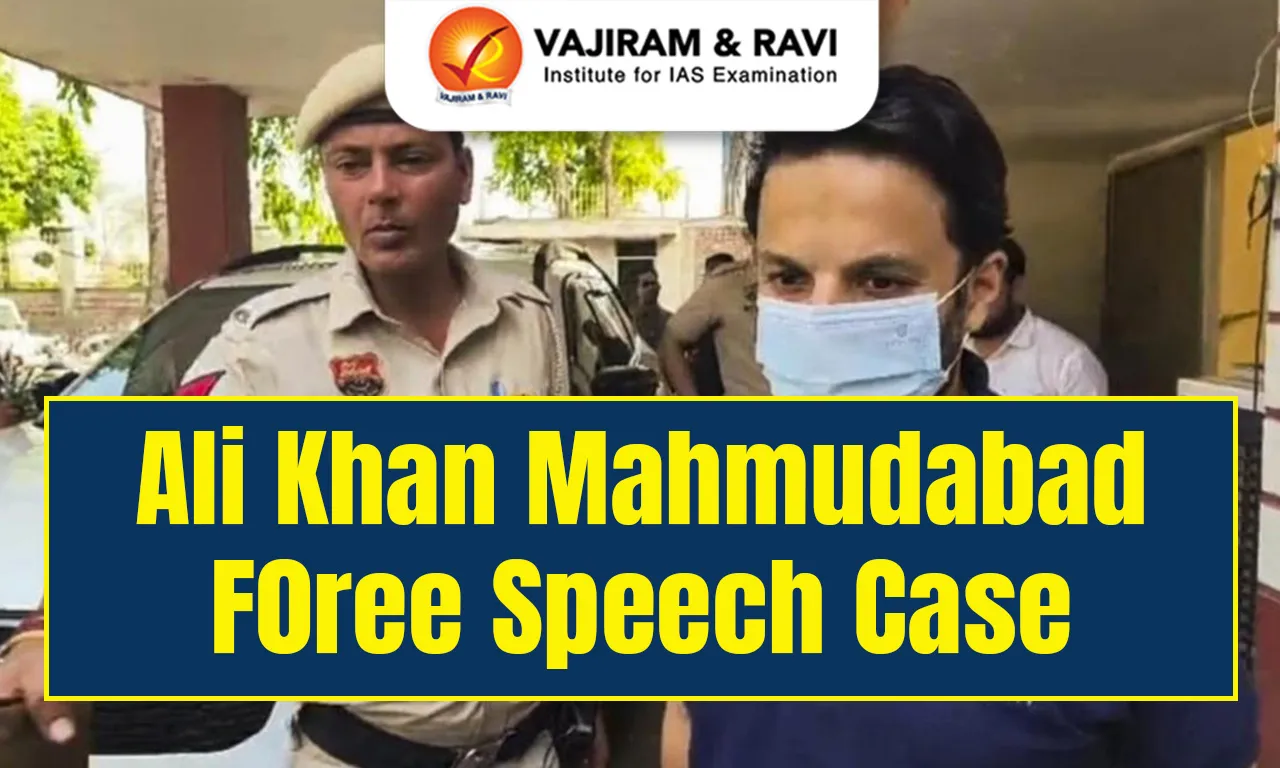
- Recently, the Supreme Court granted interim bail to Ashoka University professor Ali Khan Mahmudabad, who was arrested in Haryana over social media posts related to Operation Sindoor—India’s military action against terrorist bases in Pakistan and PoK.
- However, the Court refused to halt the ongoing investigation.
- The case now depends on whether the SIT can prove that the professor’s posts justify the serious charges against him.
- More significantly, it raises a key constitutional question: can unpopular or seemingly unpatriotic social media posts be denied protection under Article 19(1)(a), which guarantees freedom of speech?
Criminal Charges Invoked Against Professor Mahmudabad
- Professor Ali Khan Mahmudabad faces serious charges under the Bharatiya Nyaya Sanhita (BNS), 2023, following two FIRs.
Charges Under the First FIR
- Section 152: Penalises acts endangering the sovereignty, unity, and integrity of India. This provision resembles the repealed sedition law under the IPC. (Punishment: Up to 7 years imprisonment)
- Section 196(1)(b): Targets actions disturbing communal harmony and public tranquillity.
- Section 197(1)(c): Covers imputations or assertions prejudicial to national integration.
- Section 299: Criminalises deliberate and malicious acts intended to outrage religious feelings.
Charges Under the Second FIR
- Section 79: Penalises acts, words, or gestures intended to insult the modesty of a woman.
- Section 353: Covers statements that conduce to public mischief.
- Both sections carry a maximum penalty of 3 years imprisonment.
Key Highlight
- Among all the charges, Section 152 is the most severe, with a potential prison term of up to seven years.
- The others are punishable with imprisonment of up to three years.


Supreme Court’s Conditional Relief to Professor Mahmudabad
- The defence lawyer argued that Professor Mahmudabad had no criminal intent and that his social media posts reflected patriotism.
Court’s Observations
- Justice Surya Kant noted that some of the professor’s words had a “dual meaning” and questioned his motives, accusing him of seeking “cheap popularity” during a time of national crisis.
- The Bench emphasized that free speech must not be used in a way that causes harm to others.
Court’s Directions
- Investigation Participation: The professor must fully cooperate with the ongoing investigation.
- No Further FIRs: The court directed that no additional FIRs be filed concerning the two contentious posts.
- Formation of SIT: A three-member SIT comprising senior IPS officers from outside Haryana and Delhi will be formed to assess the true intent and meaning of the posts.
- Conditional Bail: Interim bail was granted with the following conditions:
- Surrender his passport.
- Avoid commenting on or writing about the two posts under investigation.
- Refrain from expressing views on the Pahalgam terror attack or Operation Sindoor.
‘Unpatriotic’ Speech Is Constitutionally Protected
- Limits on Restrictions under Article 19(2)
- The Constitution allows restrictions on free speech only on eight specific grounds under Article 19(2), such as incitement to violence or threat to public order.
- The Supreme Court has repeatedly held that no restrictions beyond these are permissible.
- Key Judicial Precedents
- Shreya Singhal v. Union of India (2015)
- The Court struck down Section 66A of the IT Act, ruling that vague terms like “annoyance” or “hatred” cannot justify criminalising speech.
- It affirmed that speech which offends or disturbs is still protected under Article 19(1)(a).
- Kaushal Kishore v. State of Uttar Pradesh (2023)
- A Constitution Bench reaffirmed that Article 19(2) is exhaustive.
- No additional restrictions, however well-intentioned, can be introduced.
- It emphasized that people cannot be penalized merely for holding non-conforming opinions.
- Shreya Singhal v. Union of India (2015)
Inconsistent Judicial Approach to Free Speech Cases
- Supreme Court’s Recent Precedent (March 2025)
- While hearing MP Imran Pratapgarhi’s case, the SC set clear standards for registering FIRs under Sections 196, 197(1), and 299 of the Bharatiya Nyaya Sanhita (BNS).
- The court stated that speech must be evaluated from the perspective of reasonable, strong-minded, firm and courageous individuals, not from overly sensitive or insecure viewpoints.
- Strong Defence of Free Expression
- The court emphasized that even speech which discomforts the judiciary is constitutionally protected.
- Criticism of Judicial Inconsistency
- Analysts have criticized the growing trend of ignoring precedents set by coordinate benches.
- They noted a rising tendency among judges to be influenced by personal biases or public sentiment, undermining genuine constitutional protections while maintaining only a superficial appearance of neutrality.
Ali Khan Mahmudabad Free Speech Case FAQs
Q1. What charges are filed against Professor Ali Khan Mahmudabad?
Ans. He faces charges under BNS Sections 152, 196, 197, 299, 79, and 353 for controversial social media posts.
Q2. What relief did the Supreme Court grant to the professor?
Ans. The court granted conditional bail, requiring passport surrender and barring commentary on the case or related incidents.
Q3. What constitutional issue does this case raise?
Ans. It questions if seemingly unpatriotic speech is protected under Article 19(1)(a) of the Indian Constitution.
Q4. What legal precedent supports Mahmudabad’s defense?
Ans. In Shreya Singhal (2015), the SC ruled vague expressions can’t justify criminalising speech under Article 19(1)(a).
Q5. Why is the judiciary facing criticism in this case?
Ans. Experts cite inconsistency and personal bias in judgments, ignoring established free speech precedents by coordinate benches.

 Last updated on Oct, 2026
→ UPSC 2027 Notification will be released on 13 January 2027 at upsconline.nic.in.
→ Check Nobel Prize 2026 Winners List here.
→ Download PIB PRiSM Monthly Magazine 2026 here.
→ Check UPSC Monthly Current Affairs Magazine The Recitals here.
→ Check out the latest UPSC Syllabus here.
→ Download UPSC Model Answers for Mains 2026
→ UPSC Mains Question Paper 2026 is out now for Essay & GS Paper 1, 2, 3 & 4.
→ UPSC Calendar 2027 has been released.
→ Enroll in Vajiram & Ravi’s UPSC Mains Test Series 2027 for structured answer writing practice, expert evaluation, and exam-oriented feedback.
→ Join Vajiram & Ravi’s UPSC Mentorship Program 2027 for personalized guidance, strategy planning, and one-to-one support from experienced mentors.
→ Go through the UPSC Mains Previous Year Papers to enhance your preparation.
→ UPSC has released UPSC Toppers List 2025 with the Civil Services final result on its official website.
→ Also check Best UPSC Coaching in India
Tags: ali khan mahmudabad free speech case mains articles upsc current affairs upsc mains current affairs