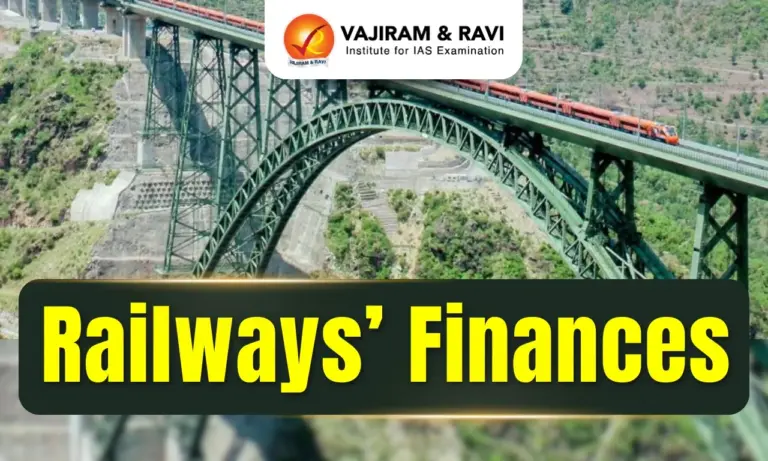
Railways’ Finances Latest News
- A recent Supreme Court order cancelling Indian Railways’ “Deemed Licensee” status — which had allowed it to procure electricity without paying surcharges — combined with a decline in freight loading and earnings in April, has triggered serious financial alarm within the Railway Board.
Background — How Electricity Procurement Works
- Under the Electricity Act, 2003, consumers can procure electricity in two ways:
- From the Distribution Licensee in their area of supply (the regular electricity company).
- From alternative sources through Open Access — directly from power generators or the grid.
- When a consumer uses Open Access, two surcharges apply:
- Cross-Subsidy Surcharge — levied to compensate distribution companies for the revenue they lose when large consumers bypass them.
- Additional Surcharge — levied to offset the cost of maintaining the distribution network.
- These surcharges exist because distribution companies provide subsidised electricity to certain categories like agricultural users and low-income households — and the revenue shortfall from large consumers leaving must be compensated.
Railways’ Special Status
- Indian Railways had been classified as a “Deemed Licensee” — a type of distribution company that supplies electricity rather than consuming it for its own use.
- Under this classification, Railways was procuring electricity through Open Access without paying Cross-Subsidy Surcharge and Additional Surcharge — resulting in significant cost savings.
What the Supreme Court Did
- The Supreme Court’s May 8 order cancelled this Deemed Licensee status, meaning Railways must now pay these surcharges like any other large consumer.
- The Railway Board estimates this will increase traction energy costs by more than 30%.


Why This is a Big Deal — Railways and Electricity
- Indian Railways is the largest single user of electrical energy in India.
- The total amount spent on traction electricity (electricity used to run trains) in 2024-25 was ₹32,378 crore — one of the biggest components of Ordinary Working Expenses (OWE).
- A 30%+ increase in this cost alone would translate to an additional burden of approximately ₹9,700 crore or more — a significant blow to an already strained budget.
The Broader Financial Stress — Multiple Pressures Simultaneously
- The Supreme Court order arrives at a particularly vulnerable moment for Railways.
- The Railway Board’s letter to general managers of all zonal railways highlighted several concurrent financial pressures:
- Rising Expenditure
- Ordinary Working Expenses (OWE) increased by 11.6%.
- Pension expenditure increased by 9.1%.
- Declining Freight Performance
- Freight loading declined by 1%.
- Freight earnings declined more sharply by 5% — worse than even the corresponding figures for April 2024.
- This is a “double whammy” — costs rising sharply while the primary revenue source is simultaneously declining.
- Rising Expenditure
The Operating Ratio Challenge
- Operating Ratio measures how much Railways spends to earn every ₹100.
- It should ideally be as low as possible — a lower operating ratio means greater financial efficiency and more surplus available for investment.
- Indian Railways’ operating ratio has remained above 98% for years — meaning it spends over ₹98 to earn every ₹100.
- This leaves a razor-thin margin for capital investment, debt repayment, and network expansion.
- The combination of rising energy costs and falling freight revenue risks pushing the operating ratio even higher — potentially above 100%, meaning Railways would spend more than it earns.
Revenue Structure of Indian Railways
- Passenger services in Indian Railways are heavily subsidised — fares are kept below cost for social and political reasons.
- This means freight revenue is the lifeline of Railways’ finances, contributing over 65% of total revenue.
- The net earnings trend is deeply concerning — declining from ₹2,660 crore to a revised ₹1,957 crore in 2025-26, leaving virtually no financial cushion for the system.
- Indian Railways is simultaneously facing:
- Revenue Side — Freight earnings declining, passenger revenue subdued due to subsidised fares, freight loading falling.
- Expenditure Side — OWE rising 11.6%, pension costs rising 9.1%, and traction energy costs set to rise 30%+ due to Supreme Court order.
- Structural Challenge — Operating ratio chronically above 98%, leaving no room for absorbing additional shocks.
- Together, these pressures constitute a financial perfect storm for Indian Railways.
Way Forward — What Needs to Change
- For Railways to restore financial health, several structural interventions are needed —
- rationalising passenger fare subsidies to reduce cross-subsidisation from freight,
- diversifying revenue sources beyond freight and passenger (real estate, advertising, logistics parks),
- improving energy efficiency through faster electrification and renewable energy adoption to reduce dependence on grid electricity,
- increasing freight competitiveness to win back traffic lost to road transport, and
- exploring legal remedies or legislative changes to restore or replace the financial benefits lost from the Deemed Licensee status cancellation.
Source: IE

 Last updated on Oct, 2026
→ UPSC 2027 Notification will be released on 13 January 2027 at upsconline.nic.in.
→ Check Nobel Prize 2026 Winners List here.
→ Download PIB PRiSM Monthly Magazine 2026 here.
→ Check UPSC Monthly Current Affairs Magazine The Recitals here.
→ Check out the latest UPSC Syllabus here.
→ Download UPSC Model Answers for Mains 2026
→ UPSC Mains Question Paper 2026 is out now for Essay & GS Paper 1, 2, 3 & 4.
→ UPSC Calendar 2027 has been released.
→ Enroll in Vajiram & Ravi’s UPSC Mains Test Series 2027 for structured answer writing practice, expert evaluation, and exam-oriented feedback.
→ Join Vajiram & Ravi’s UPSC Mentorship Program 2027 for personalized guidance, strategy planning, and one-to-one support from experienced mentors.
→ Go through the UPSC Mains Previous Year Papers to enhance your preparation.
→ UPSC has released UPSC Toppers List 2025 with the Civil Services final result on its official website.
→ Also check Best UPSC Coaching in India
Railways’ Finances FAQs
Q1. How could the Supreme Court verdict affect Railways’ Finances?+
Q2. Why are Railways’ Finances already under pressure?+
Q3. What does the Supreme Court ruling mean for Railways’ Finances in the long run?+
Q4. Can the SC verdict impact railway services through Railways’ Finances?+
Q5. Why is Railways’ Finances an important public policy issue?+
Tags: mains articles Railways’ Finances upsc current affairs upsc mains current affairs