Black Hole Merger Discovery Latest News
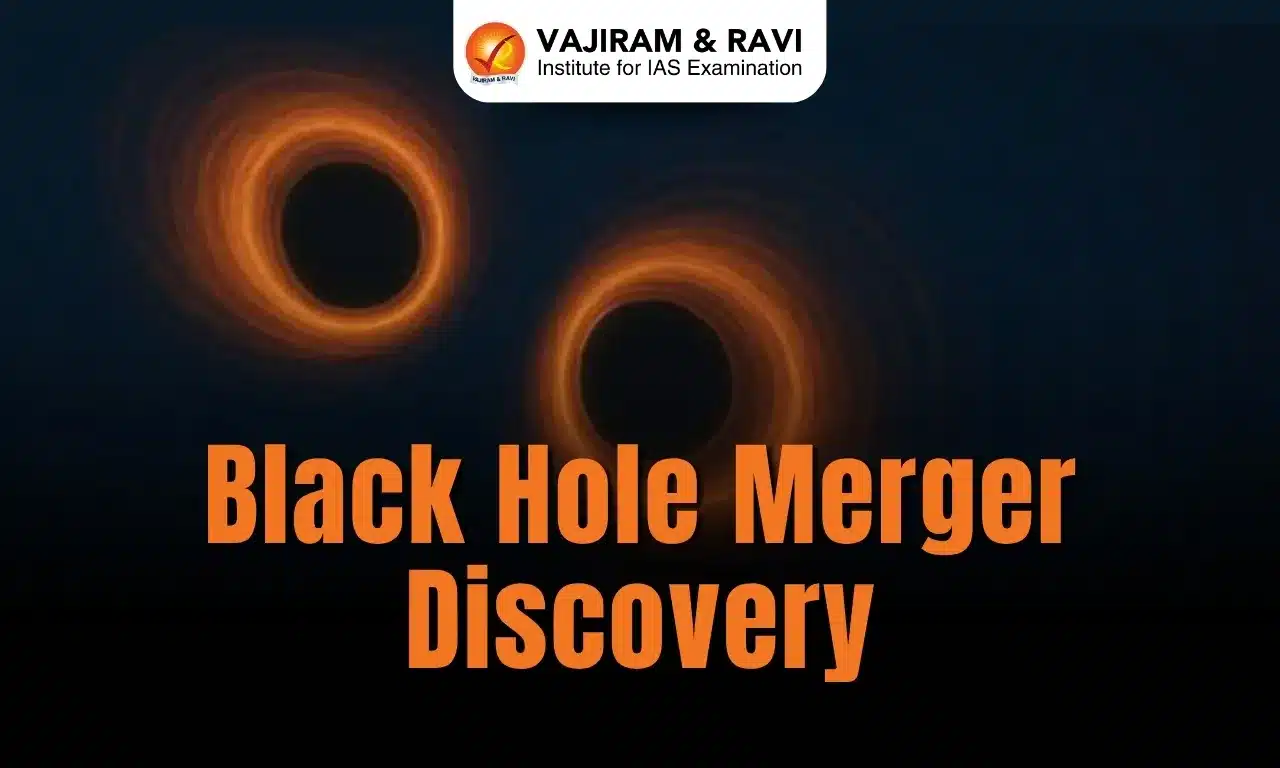
- Scientists have detected gravitational waves from the largest black hole merger ever observed.
- Such mergers are rare but release immense energy, sending ripples—gravitational waves—across spacetime. These waves, predicted by Einstein’s General Relativity in 1915, are extremely weak and only detectable from major cosmic events like black hole collisions.
- The latest discovery, given the name GW231123, is exceptional because it involves the biggest black holes to have been observed in any such event.
Why This Black Hole Merger Discovery Is Unique
- Scientists have detected gravitational waves from the merger of two unusually large black holes—one 140 times and the other 100 times the mass of the Sun—forming a new black hole about 225 times larger than the Sun.
- In general, a black hole is a region in Space where the pulling force of gravity is so strong that neither matter nor light can ever escape.
- This size range, between 100 and 150 solar masses, defies current scientific theories, which suggest stars that are large typically don’t collapse into black holes.
- Stars in this size range are believed to end their lives in powerful explosions, not by collapsing into black holes, according to current scientific theories.
- Adding to the surprise, one of the black holes was spinning near the maximum speed allowed by Einstein’s General Theory of Relativity.
- This discovery not only breaks previous records for black hole mergers but also challenges existing models of black hole formation and the life cycle of massive stars, offering fresh insights into the structure and evolution of the universe.


Gravitational Waves: A New Window to Understand the Universe
- Before 2015, scientists mainly relied on electromagnetic waves—like light, X-rays, and radio waves—to study the universe.
- However, vast portions of the cosmos, especially those involving dark matter and dark energy, remain invisible to these methods.
- Black holes are a prime example; their existence was known, but they couldn’t be directly observed.
- The discovery of gravitational waves changed this. Generated by massive cosmic events such as black hole mergers, these ripples in spacetime can now be detected on Earth using highly sensitive instruments.
- Though all moving objects create gravitational waves, only those from extremely large events are strong enough to reach us.
- Gravitational waves offer scientists a new kind of vision, revealing previously hidden aspects of the universe.
LIGO and the Expansion of Gravitational Wave Detection
- The first-ever detection of gravitational waves in 2015 was achieved by two LIGO observatories in the United States.
- Since then, additional detectors like Virgo in Italy and KAGRA in Japan have joined the effort, forming the LVK (LIGO-Virgo-KAGRA) collaboration, which made the latest major discovery.
- To strengthen this global network, a third LIGO observatory is planned in India, called LIGO-India. However, the project has faced significant delays.
- Originally scheduled to begin operations in 2024, final government approval and a budget of ₹2,600 crore were only secured in 2023.
- The Department of Atomic Energy has identified Hingoli district in Maharashtra as the site for the observatory.

 Last updated on Oct, 2026
→ UPSC 2027 Notification will be released on 13 January 2027 at upsconline.nic.in.
→ Check Nobel Prize 2026 Winners List here.
→ Download PIB PRiSM Monthly Magazine 2026 here.
→ Check UPSC Monthly Current Affairs Magazine The Recitals here.
→ Check out the latest UPSC Syllabus here.
→ Download UPSC Model Answers for Mains 2026
→ UPSC Mains Question Paper 2026 is out now for Essay & GS Paper 1, 2, 3 & 4.
→ UPSC Calendar 2027 has been released.
→ Enroll in Vajiram & Ravi’s UPSC Mains Test Series 2027 for structured answer writing practice, expert evaluation, and exam-oriented feedback.
→ Join Vajiram & Ravi’s UPSC Mentorship Program 2027 for personalized guidance, strategy planning, and one-to-one support from experienced mentors.
→ Go through the UPSC Mains Previous Year Papers to enhance your preparation.
→ UPSC has released UPSC Toppers List 2025 with the Civil Services final result on its official website.
→ Also check Best UPSC Coaching in India
Black Hole Merger Discovery FAQs
Q1. Why is the latest black hole merger significant?+
Q2. What makes this black hole merger unique?+
Q3. How do gravitational waves help scientists?+
Q4. What is the LVK collaboration?+
Q5. What is the status of LIGO-India?+
Tags: black hole merger discovery mains articles upsc current affairs upsc mains current affairs