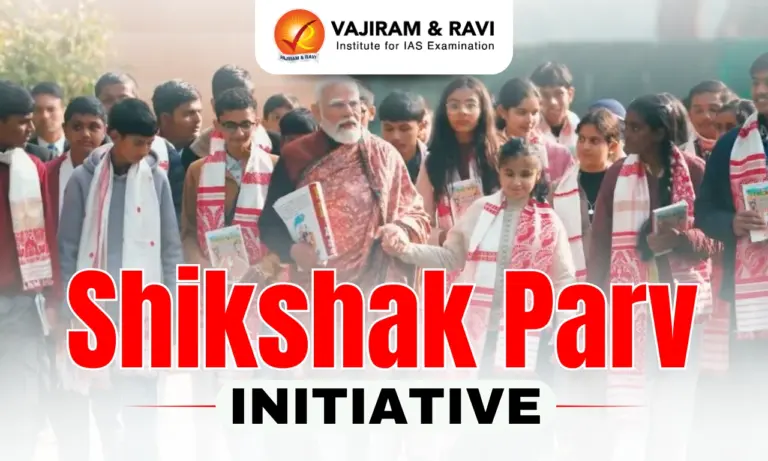
The Shikshak Parv Initiative is an education-focused program aimed at promoting learning, awareness, and community participation in the field of education. It emphasizes the importance of quality education, innovative teaching methods, and the overall development of students. The initiative highlights the need to create an inclusive and engaging learning environment while encouraging collaboration among teachers, students, and parents for better educational outcomes.
About Shikshak Parv Initiative
- Shikshak Parv Institute is a national-level initiative organized by the Ministry of Education to celebrate and recognize the valuable contribution of teachers in shaping the future of the nation.
- It is observed every year from 5th September (Teachers’ Day) to 17th September, creating a dedicated period for educational discussions and reforms.
- The main objective is not only to honor teachers but also to promote quality education, innovation, and continuous improvement in the education system.
- It acts as a platform for sharing best practices, discussing challenges in education, and encouraging active participation from educators.
Shikshak Parv Initiative and National Education Policy (NEP)
- Shikshak Parv strongly supports the vision of the National Education Policy (NEP) 2020, which aims to transform the Indian education system.
- The policy focuses on shifting from rote learning to competency-based learning, where understanding and application of knowledge are prioritized.
- It promotes holistic development, including critical thinking, problem-solving skills, and conceptual clarity among students.
- Through this initiative, teachers are guided to adopt modern pedagogy, updated curriculum, and improved assessment methods.
Also Read : Education Sector in India


Role of Teachers in Education Reform
- Teachers are the backbone of the education system and play a key role in implementing educational reforms effectively.
- Shikshak Parv recognizes teachers as frontline contributors in achieving the goals of NEP 2020.
- It encourages teachers to take part in training programs, capacity-building initiatives, and professional development activities.
- Teachers are motivated to use innovative teaching methods, interactive classrooms, and student-centered learning approaches.
- Their involvement ensures that reforms are practical, effective, and grounded in real classroom experiences.
Competency-Based Learning and Assessment
- A major focus of Shikshak Parv is promoting competency-based education, which emphasizes skills, understanding, and application rather than memorization.
- It aims to shift assessment methods from summative evaluation (final exams) to formative assessment (continuous evaluation).
- Students are encouraged to develop higher-order thinking skills such as analysis, evaluation, and creativity.
- This approach improves learning outcomes, makes education more meaningful, and prepares students for real-life challenges.
Teacher Participation through Challenges
- Teachers across India are invited to participate in competency-based assessment challenges, where they design innovative questions and activities.
- Submissions are made through platforms like the MyGov App and are reviewed by organizations such as NCERT.
- Selected entries are compiled into a competency-based item bank, which becomes a useful resource for schools nationwide.
- This initiative promotes creativity among teachers and helps in improving the quality of assessments in schools.
- It also ensures that classroom practices align with learning outcomes and curriculum standards.
Key Initiatives Launched at Shikshak Parv Initiative
- The Indian Sign Language Dictionary was introduced to support hearing-impaired students and promote inclusive communication.
- Talking Books (Audiobooks) were launched to help visually impaired learners access educational content easily.
- The School Quality Assessment and Accreditation Framework (SQAA) provides a structured system for evaluating school performance and ensuring quality standards.
- NISHTHA (National Initiative for School Heads’ and Teachers’ Holistic Advancement) focuses on teacher training and capacity building.
- The NIPUN Bharat Mission aims to ensure foundational literacy and numeracy for all children by early grades.
- The Vidyanjali Portal promotes community participation, allowing volunteers, donors, and organizations to support school development.
- Initiatives like Digital Education Architecture (NDEAR) and Education Technology Forums encourage the use of technology in education.
Focus on Inclusive and Quality Education
- Shikshak Parv emphasizes inclusive education, ensuring that every child gets equal opportunities to learn and grow.
- Special efforts are made to support children with disabilities, economically weaker sections, and diverse backgrounds.
- It promotes equity in education by reducing gaps in access, resources, and learning outcomes.
- The use of digital tools, online learning platforms, and assistive technologies helps make education more accessible and effective.
Encouraging Innovation and Collaboration
- Teachers are encouraged to adopt innovative teaching strategies, including activity-based learning, experiential learning, and project-based learning.
- The initiative promotes collaboration among teachers, students, parents, and the community to improve the education system.
- Sharing best practices, success stories, and new ideas helps in creating a supportive learning environment.
- It also encourages the use of technology, digital content, and interactive tools in classrooms.
Key Reforms Needed in the Education Sector
- Societal Involvement: There is a strong need for active participation from all stakeholders such as academicians, experts, teachers, parents, and communities in reforming the education system. Greater community engagement can improve accountability, awareness, and overall educational outcomes.
- Private Sector Participation: The private sector should actively contribute through public-private partnerships (PPP), investment in infrastructure, digital learning tools, and teacher training to enhance the quality of education, especially in government schools.
- Inclusive and Equitable Education: Education must ensure both inclusivity and equity, providing equal opportunities to marginalized groups, rural populations, and children with disabilities. Initiatives like digital education platforms can help reduce the urban-rural divide.
- Strengthening Digital Infrastructure: There is a need to expand digital infrastructure, including internet connectivity, smart classrooms, and affordable devices, to ensure effective implementation of online and blended learning.
- Transfer of Capabilities: The skills and adaptability developed during the COVID-19 pandemic, such as online teaching, self-learning, and digital literacy, should be retained and strengthened to handle future disruptions.
- Adoption of New Academic Strategies: Teachers must continuously upgrade themselves with modern teaching methods like experiential learning, activity-based learning, and project-based learning, along with the use of educational technology (EdTech).
- Continuous Curriculum Reform: The curriculum should be regularly updated to match global standards, industry requirements, and 21st-century skills such as critical thinking, creativity, and problem-solving.
- Focus on Skill Development: Greater emphasis should be placed on vocational education, skill-based learning, and employability skills to prepare students for the job market and promote self-reliance.
Significance of Teachers’ Day
- Shikshak Parv begins on Teachers’ Day (5th September), celebrated in honor of Dr. Sarvepalli Radhakrishnan.
- He was a great teacher, philosopher, and the second President of India, known for his dedication to education.
- This day highlights the importance of teachers’ contributions in shaping students’ lives and society.
- It also recognizes their hard work, commitment, and ability to adapt during challenges like online teaching during the pandemic.

 Last updated on Oct, 2026
→ UPSC 2027 Notification will be released on 13 January 2027 at upsconline.nic.in.
→ Check Nobel Prize 2026 Winners List here.
→ Download PIB PRiSM Monthly Magazine 2026 here.
→ Check UPSC Monthly Current Affairs Magazine The Recitals here.
→ Check out the latest UPSC Syllabus here.
→ Download UPSC Model Answers for Mains 2026
→ UPSC Mains Question Paper 2026 is out now for Essay & GS Paper 1, 2, 3 & 4.
→ UPSC Calendar 2027 has been released.
→ Enroll in Vajiram & Ravi’s UPSC Mains Test Series 2027 for structured answer writing practice, expert evaluation, and exam-oriented feedback.
→ Join Vajiram & Ravi’s UPSC Mentorship Program 2027 for personalized guidance, strategy planning, and one-to-one support from experienced mentors.
→ Go through the UPSC Mains Previous Year Papers to enhance your preparation.
→ UPSC has released UPSC Toppers List 2025 with the Civil Services final result on its official website.
→ Also check Best UPSC Coaching in India
Shikshak Parv Initiative FAQs
Q1. What is the Shikshak Parv Initiative?+
Q2. When is Shikshak Parv celebrated in India?+
Q3. How is Shikshak Parv connected to NEP 2020?+
Q4. What is competency-based learning in Shikshak Parv?+
Q5. What role do teachers play in the Shikshak Parv Initiative?+
Tags: indian society indian society notes shikshak parv initiative