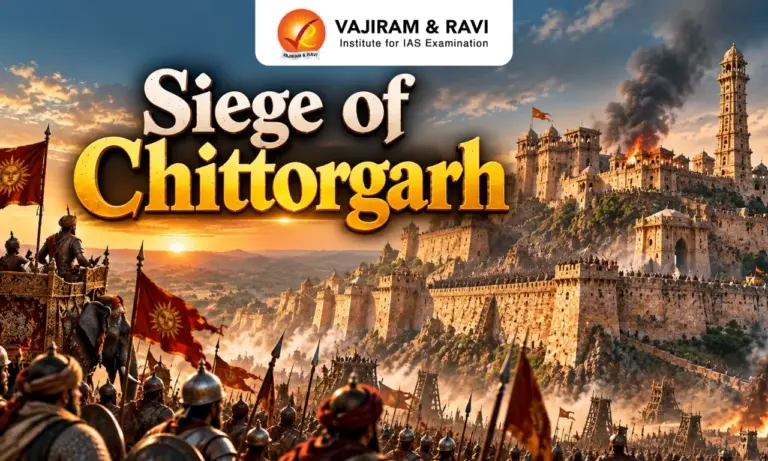
The Siege of Chittorgarh was a major military conflict between the Mughal emperor Akbar and the Kingdom of Mewar in 1567–1568. The siege ended with the capture of the Chittorgarh Fort by the Mughal forces after months of fierce resistance. The battle is remembered for the defence led by Jaimal Rathore and Patta Sisodia, as well as for its wider impact on the political relations between the Mughals and Rajput states.
What Was the Siege of Chittorgarh?
The Siege of Chittorgarh (1567–1568) was a major military confrontation between the Mughal Empire under Emperor Akbar and the Kingdom of Mewar ruled by Maharana Udai Singh II. The siege began in October 1567 and ended with the Mughal capture of Chittorgarh Fort on 23 February 1568.
- Chittorgarh Fort was the principal stronghold of Mewar and held considerable strategic and political importance in Rajasthan. Located on a high hill, the fort was exceptionally difficult to capture and had already witnessed major conflicts in earlier periods.
- Akbar’s campaign against Chittorgarh was part of his wider effort to expand Mughal authority in Rajputana. Mewar remained one of the important Rajput states that had not accepted Mughal supremacy.
- When Akbar’s army approached Chittorgarh, Maharana Udai Singh II withdrew towards the hilly areas of Mewar with his family and some nobles. The defence of the fort was entrusted mainly to Rao Jaimal Rathore of Merta and Patta Sisodia of Kelwa. Rajasthan’s official historical material also identifies Jaimal and Patta as the principal commanders who defended the fort.
- The Mughal army faced strong resistance for several months. Akbar’s forces used artillery, mines and covered approaches known as sabats to gradually move closer to the fortifications.
- The final phase of the siege became associated with the Jauhar and Saka of Chittorgarh. According to historical accounts, several women inside the fort performed Jauhar, while the Rajput defenders prepared for their final battle.
Siege of Chittorgarh Causes and Historical Context
The Siege of Chittorgarh was shaped by both the strategic importance of Mewar and Akbar’s larger policy of extending Mughal political authority over the Rajput states.
- Mewar’s political position: Unlike some other Rajput rulers, Maharana Udai Singh II had not accepted Akbar’s overlordship. Chittorgarh therefore remained an important centre of Rajput resistance to Mughal expansion.
- Strategic importance of Chittorgarh: The fort occupied an important position in western India and was connected with routes towards Malwa and Gujarat. Controlling Chittor strengthened the Mughal position in Rajasthan and helped secure important routes.
- Akbar’s expansion in Rajputana: By the 1560s, Akbar was consolidating Mughal power in northern India. The submission of Amber under Raja Bharmal had opened the way for closer Mughal-Rajput relations, but several other Rajput states continued to maintain their independence.
- Refuge given to Akbar’s opponents: Contemporary Mughal accounts also associated the campaign with Udai Singh’s decision to provide refuge to Baz Bahadur of Malwa, who had been defeated by Akbar. This added to the political tensions between Mewar and the Mughal emperor.
- Jaimal’s connection with Mewar: After being displaced from Merta, Jaimal Rathore received refuge from Udai Singh II and was given an important position in Mewar. He later became one of the principal commanders during the defence of Chittorgarh.
- By 1567, after dealing with internal rebellions and strengthening his position, Akbar personally led the campaign against Chittorgarh. The Mughal army reached the fort in October 1567, beginning one of the most important sieges of Akbar’s reign.


Major Events and Outcome of the Siege of Chittorgarh
The siege lasted for several months and involved repeated Mughal attempts to break through the fort’s strong defensive walls.
- Beginning of the siege: Akbar’s forces surrounded Chittorgarh in October 1567. Udai Singh II withdrew to the hills, while Jaimal Rathore and Patta Sisodia remained responsible for the defence of the fort.
- Mughal siege operations: Direct attacks against the massive fortifications proved difficult. The Mughal forces therefore constructed sabats and mines and gradually moved their artillery towards the walls. These engineering operations allowed the attackers to weaken the fortifications while remaining partially protected from the defenders.
- Strong Rajput resistance: The defenders repeatedly repaired damaged sections of the walls and resisted Mughal attacks. Jaimal emerged as the leading figure in the defence, while Patta became another important symbol of resistance.
- Death of Jaimal: On 22 February 1568, during the final stage of the siege, Jaimal was fatally shot by Akbar with a matchlock, according to Mughal accounts. His death weakened the morale and defensive organisation of the Rajputs and helped the Mughals break through the fort.
- Jauhar and Saka: Following the death of Jaimal and the imminent fall of the fort, women inside Chittorgarh are traditionally described as performing Jauhar, while the remaining Rajput warriors prepared for Saka, or a final fight to the death. The final assault took place on 23 February 1568, coinciding with Holi.
- Capture of Chittorgarh: The Mughal forces captured the fort on 23 February 1568. Akbar subsequently placed the fort under the charge of Asaf Khan and returned towards Agra.
- Massacre after the capture: Persian chronicles and later historical works record that Akbar ordered a large-scale massacre following the capture of Chittor. The figure of 30,000 people is commonly cited in historical accounts, although estimates and interpretations of the episode vary among historians.
- Fate of the fort: The fall of Chittorgarh did not mean the complete submission of Mewar. Udai Singh II continued to remain outside Mughal control until his death in 1572, while Udaipur became the principal centre of Mewar after the fall of Chittor.
Significance of the Siege of Chittorgarh in Indian History
The Siege of Chittorgarh occupies an important place in the history of the Mughal-Rajput relationship and is remembered for both its political consequences and the resistance associated with the defence of the fort.
- Strengthened Mughal control over Rajputana: The capture of Chittorgarh significantly strengthened Akbar’s position in Rajasthan. It demonstrated the military power of the Mughal Empire and was followed by the submission or accommodation of several important Rajput states.
- Chittorgarh became a symbol of Rajput resistance: The defence led by Jaimal and Patta became an enduring part of the historical memory of Mewar. Rajasthan Tourism continues to describe the Jaimal and Patta complex within Chittorgarh Fort as a symbol of their bravery and sacrifice.
- Akbar recognised the defenders’ resistance: Historical accounts state that Akbar ordered statues of Jaimal and Patta mounted on elephants to be erected outside the Agra Fort. Rajasthan’s official historical material also records this tradition.
- Impact on Mewar’s later history: Although Chittorgarh was captured, Mewar continued to resist Mughal authority. This later became particularly important during the reign of Maharana Pratap, who continued the struggle against Mughal expansion in the 1570s.
- The siege became part of Rajasthan’s historical memory: The events of 1568, particularly the defence of the fort, Jauhar and Saka, became deeply embedded in the cultural traditions and historical narratives of Rajasthan. At the same time, accounts of the massacre and the destruction following the Mughal victory remain an important part of discussions on the violence associated with medieval warfare.
- A turning point in Mughal-Rajput relations: The fall of Chittorgarh showed that military resistance could be overcome by the Mughal state, but it also highlighted the limits of conquest. Akbar subsequently relied not only on military campaigns but also on alliances, diplomacy and political accommodation in dealing with several Rajput rulers.
- Today, Chittorgarh Fort remains an important heritage site and a major symbol of Rajasthan’s history. The fort, situated on a 180-metre-high hill and spread across a large area, preserves monuments and memorials associated with different phases of Mewar’s history, including those connected with Jaimal and Patta.

 Last updated on Oct, 2026
→ UPSC 2027 Notification will be released on 13 January 2027 at upsconline.nic.in.
→ Check Nobel Prize 2026 Winners List here.
→ Download PIB PRiSM Monthly Magazine 2026 here.
→ Check UPSC Monthly Current Affairs Magazine The Recitals here.
→ Check out the latest UPSC Syllabus here.
→ Download UPSC Model Answers for Mains 2026
→ UPSC Mains Question Paper 2026 is out now for Essay & GS Paper 1, 2, 3 & 4.
→ UPSC Calendar 2027 has been released.
→ Enroll in Vajiram & Ravi’s UPSC Mains Test Series 2027 for structured answer writing practice, expert evaluation, and exam-oriented feedback.
→ Join Vajiram & Ravi’s UPSC Mentorship Program 2027 for personalized guidance, strategy planning, and one-to-one support from experienced mentors.
→ Go through the UPSC Mains Previous Year Papers to enhance your preparation.
→ UPSC has released UPSC Toppers List 2025 with the Civil Services final result on its official website.
→ Also check Best UPSC Coaching in India
Siege of Chittorgarh FAQs
Q1. What was the Siege of Chittorgarh?+
Q2. When did the Siege of Chittorgarh take place?+
Q3. Who defended Chittorgarh Fort during the siege?+
Q4. Why did Akbar attack Chittorgarh?+
Q5. How did the Mughals capture Chittorgarh Fort?+
Q6. What happened during the Jauhar of Chittorgarh in 1568?+
Q7. What was the outcome of the Siege of Chittorgarh?+
Q8. Why is the Siege of Chittorgarh important in Indian history?+
Tags: chittorgarh siege of chittorgarh