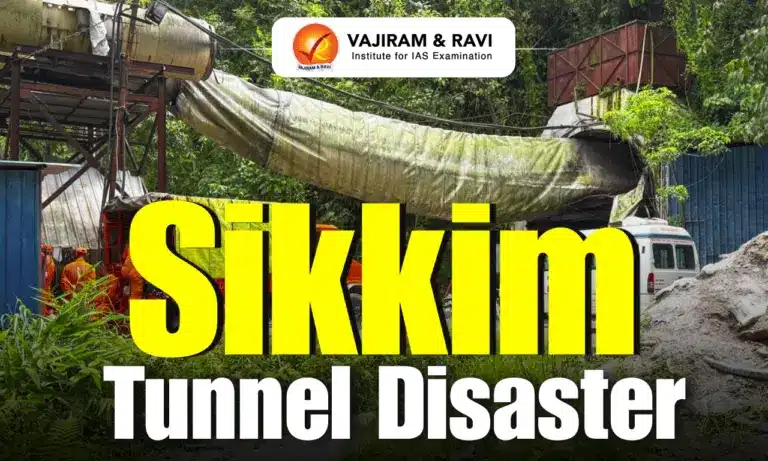
Sikkim Tunnel Disaster Latest News
- Recently, a methane gas explosion inside the under-construction Head Race Tunnel (HRT) of NHPC’s 500 MW Teesta Stage VI Hydropower Project in Samardung, Namchi district, Sikkim, killed 25 workers.
- The disaster has renewed scrutiny of hydropower infrastructure safety, project management, and the ecological fragility of the Himalayan region.
What Happened
- A sudden release of methane trapped in rocks near Tunnel 4B triggered an explosion, giving workers little time to escape.
- Nineteen employees of Patel Engineering Ltd and six personnel of PRW Manpower were inside the tunnel at the time; all 25 were killed.
- Five workers remained trapped roughly 1.5 km inside the tunnel for over 24 hours before rescue operations concluded.


Why the Explosion Occurred
- Preliminary cause: Sudden explosive release of methane trapped or embedded in rock, likely ignited by drilling sparks.
- How methane accumulates in hills: It occurs as natural gas in porous rock or localised pockets in young, fragile geological formations — common in the Himalayan belt with historical coal-bearing strata. Oxygen-deprived, waterlogged hilly depressions and decomposing organic matter also generate methane.
- Sikkim-specific geology: Though Sikkim has no coalfields, it lies in the Rangit Tectonic Window zone. Geological Survey of India studies found around 1.40 lakh tonnes of coal reserves in southern Sikkim, mainly in Namchi — the disaster site. A regional coal exploration project began there in December 2025.
- Detection challenge: Methane is colourless and odourless. NHPC officials noted that standard tunnel surveys (topographical, geotechnical, geophysical, hydrological, resistivity, utility tests) cannot detect it.
Warning Signs Ignored
- A 2025 paper by five NHPC engineers, presented at an international geology conference in Croatia, documented repeated encounters with flammable gas, unstable rock, cavities, and heavy groundwater inflows during excavation.
- Flammable gas was first encountered in November 2009 under original developer Lanco Teesta Hydro Power Ltd, causing a tunnel fire.
- After NHPC revived the project, methane was again detected seeping through an excavation face, with concentrations reaching nearly one-third of the lower explosive limit.
- Workers alleged prior gas-related fires (six-seven months earlier) injured labourers, but no corrective action was taken; those who raised safety concerns faced job threats.
- Workers also alleged safety equipment (helmets, safety shoes) was provided only during official inspections, and basic medical facilities like bandages were unavailable inside the tunnel.
Ecological and Regional Concerns
- Environmental groups have long warned that extensive tunnelling and blasting across the Teesta basin could destabilise slopes and increase vulnerability to earthquakes and Glacial Lake Outburst Floods (GLOFs).
- The October 2023 South Lhonak GLOF devastated the Teesta valley, destroying the Teesta III dam — reviving concerns about hydropower expansion in the basin.
- These groups have demanded fresh Environmental Impact Assessments for existing and proposed Teesta basin projects, arguing conditions have changed significantly since the GLOF.
- Activists argue the tunnel blast is proof of long-ignored concerns that hydropower tunnels and reservoirs can generate methane, a climate concern beyond just safety.
Pattern of Himalayan Tunnel Disasters
- Tunnelling risk is not isolated to Teesta VI. Notable prior incidents include:
- Parbati-II Project, Himachal Pradesh (May 2021) — tunnel collapse killed 4 labourers
- Subansiri Lower Hydroelectric Project, Arunachal-Assam border (June 2022, July 2024) — tunnel roof collapses killed workers
- Khooni Nallah tunnel, Jammu-Srinagar highway (May 2022) — 10 killed
- Silkyara Bend-Barkot tunnel, Uttarakhand (November 2023) — 41 workers rescued after cave-in
- Srisailam Left Bank Canal tunnel (February 2025) — collapse trapped 8 engineers/labourers
- Tupul Railway Station, Manipur (June 2022) — landslip killed 61, India’s worst such disaster
- Dhauliganga Hydroelectric Project, Uttarakhand (August 2025) — landslip; all 19 trapped NHPC employees rescued
Conclusion
- The Teesta Stage VI tragedy is a grim convergence of fragile Himalayan geology, chronic project mismanagement, and disregarded worker safety warnings.
- It underscores the urgent need for updated environmental assessments, robust methane-detection protocols, and enforceable safety accountability before India expands infrastructure further into its most seismically and ecologically sensitive terrain.

 Last updated on Oct, 2026
→ UPSC 2027 Notification will be released on 13 January 2027 at upsconline.nic.in.
→ Check Nobel Prize 2026 Winners List here.
→ Download PIB PRiSM Monthly Magazine 2026 here.
→ Check UPSC Monthly Current Affairs Magazine The Recitals here.
→ Check out the latest UPSC Syllabus here.
→ Download UPSC Model Answers for Mains 2026
→ UPSC Mains Question Paper 2026 is out now for Essay & GS Paper 1, 2, 3 & 4.
→ UPSC Calendar 2027 has been released.
→ Enroll in Vajiram & Ravi’s UPSC Mains Test Series 2027 for structured answer writing practice, expert evaluation, and exam-oriented feedback.
→ Join Vajiram & Ravi’s UPSC Mentorship Program 2027 for personalized guidance, strategy planning, and one-to-one support from experienced mentors.
→ Go through the UPSC Mains Previous Year Papers to enhance your preparation.
→ UPSC has released UPSC Toppers List 2025 with the Civil Services final result on its official website.
→ Also check Best UPSC Coaching in India
Sikkim Tunnel Disaster FAQs
Q1. What caused the Sikkim Tunnel Disaster?+
Q2. Why is the Sikkim Tunnel Disaster significant for Himalayan infrastructure projects?+
Q3. What safety concerns were highlighted by the Sikkim Tunnel Disaster?+
Q4. How does the Sikkim Tunnel Disaster relate to environmental governance?+
Q5. What lessons does the Sikkim Tunnel Disaster offer for future infrastructure planning? +
Tags: mains articles Sikkim Tunnel Disaster upsc current affairs upsc mains current affairs