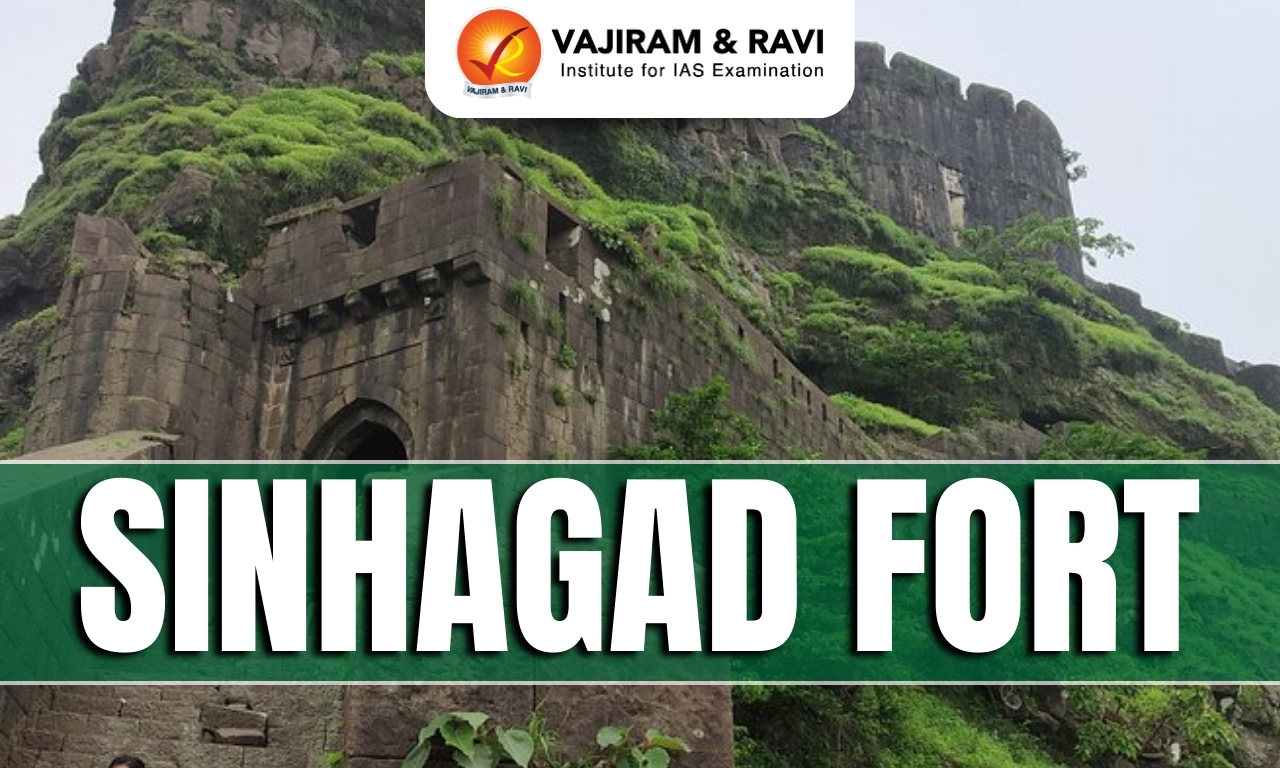
Sinhagad Fort Latest News
At least 25 people were injured after a swarm of bees attacked visitors at Sinhagad Fort recently.
About Sinhagad Fort
- Sinhagad, earlier known as ‘Kondhana’, is a fortress located near Pune, Maharashtra.
- It perched on an isolated cliff of the Bhuleswar range of Sahyadri Mountains, 1,312 m above sea level.
- According to history, the fort was built 2,000 years ago and it is said that the name Kondana was derived from sage Kaundinya.
- Early inscriptions and carvings suggest it served as a spiritual retreat and strategic outpost for ancient dynasties.
- Mohammed bin Tughalak captured the fort from the Koli tribal chieftain, Nag Naik in 1340 CE.
- In 1496 CE, Malik Ahmad, the founder of the Nizam Shahi dynasty took control of the fort.
- Nearly 200 years later, the Maratha leader Shahaji Bhonsale captured the fort.
- In 1647 CE, Shivaji held the stronghold.
- In 1665 CE, as per the Treaty of Purandar, Shivaji handed over Sinhagad to the Mughals and again captured it in 1670 CE, under the direction of Tanaji Malusare who was Shivaji’s favorite general.
- It has witnessed epic battles, including the legendary Battle of Sinhagad in 1670, where valor, sacrifice, and strategy led to an unforgettable victory for the Marathas over the Mughal Army.
- While recouping the fort during Battle of Sinhagad, Malusare lost his life for which Shivaji Maharaj honoured the fort with the name Sinhagad Fort or Lion’s Fort.
- Aurangzeb laid siege to Sinhagad in 1701- 03 CE, but could not hold it for long.
- Finally the British seized the fort from the Marathas in 1818 AD. The fort was later used as a retreat for many European residents of Pune.


Sinhagad Fort Architecture
- It is a marvel of Maratha architecture and engineering.
- The fort features two main entrances—the Pune Darwaza, facing Pune, and the Kalyan Darwaza, opening towards the Konkan region—both showcasing intricate stonework and strategic placement for enhanced security.
- It has an advanced water storage system, which includes ancient rainwater harvesting techniques and natural reservoirs that ensure a continuous water supply.
- The fort has several bastions, ramparts, walls, and gates that enclose its premises.
- The fort also houses a temple dedicated to Goddess Kali, a brewery, some military sheds and the tombs of Rajaram Chhatrapati (Shivaji’s youngest son) and Tanaji Malusare.
Source: IE

 Last updated on Oct, 2026
→ UPSC 2027 Notification will be released on 13 January 2027 at upsconline.nic.in.
→ Asian Games 2026 are being held in Aichi-Nagoya, Japan, from 19 September to 4 October.
→ Check Nobel Prize 2026 Winners List here.
→ Download PIB PRiSM Monthly Magazine 2026 here.
→ Check UPSC Monthly Current Affairs Magazine The Recitals here.
→ Check out the latest UPSC Syllabus here.
→ Download UPSC Model Answers for Mains 2026
→ UPSC Mains Question Paper 2026 is out now for Essay & GS Paper 1, 2, 3 & 4.
→ UPSC Calendar 2027 has been released.
→ Enroll in Vajiram & Ravi’s UPSC Mains Test Series 2027 for structured answer writing practice, expert evaluation, and exam-oriented feedback.
→ Join Vajiram & Ravi’s UPSC Mentorship Program 2027 for personalized guidance, strategy planning, and one-to-one support from experienced mentors.
→ Go through the UPSC Mains Previous Year Papers to enhance your preparation.
→ UPSC has released UPSC Toppers List 2025 with the Civil Services final result on its official website.
→ Also check Best UPSC Coaching in India
Sinhagad Fort FAQs
Q1. Where is Sinhagad Fort located?+
Q2. What was the earlier name of Sinhagad Fort?+
Q3. Which famous battle was fought at Sinhagad Fort in 1670?+
Q4. Which Maratha warrior’s tomb is also located in Sinhagad Fort?+
Tags: prelims pointers sinhagad fort upsc current affairs upsc prelims current affairs