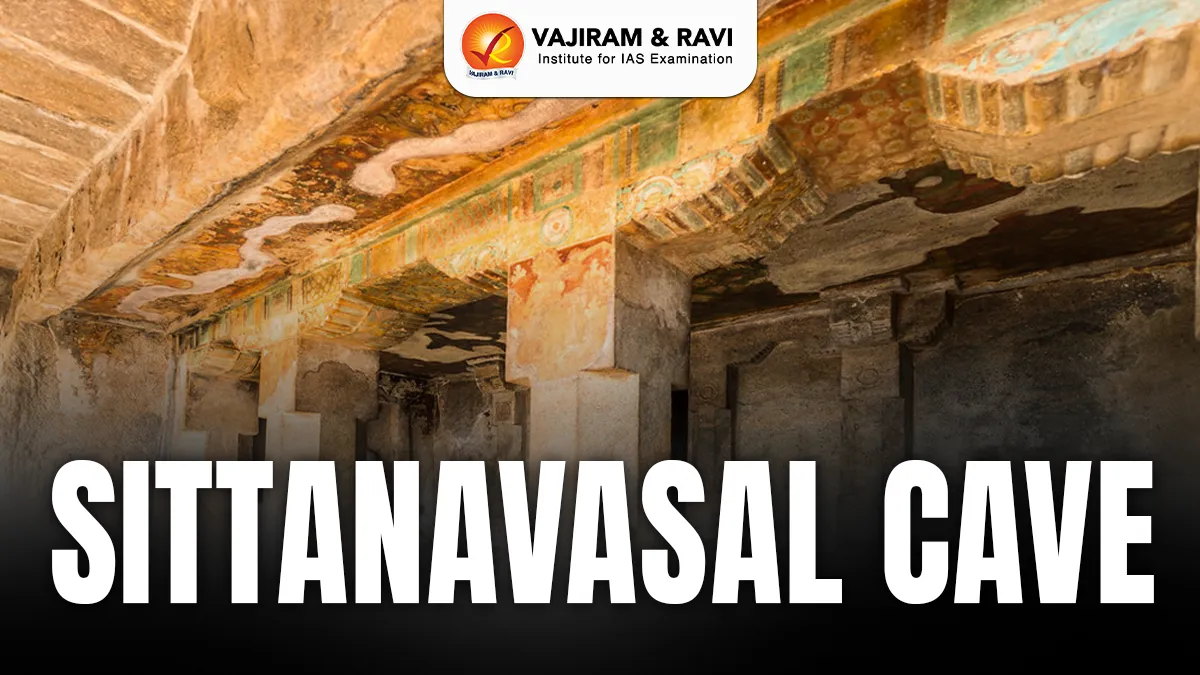
The Sittanavasal Caves are one of the most important examples of ancient rock-cut architecture and mural painting in South India. These caves are located in the small village of Sittanavasal in the Pudukkottai district. The cave complex dates back to around the 2nd century CE and is closely associated with the Jain religious tradition.
The main monument in the complex is a rock-cut shrine known as Arivar Koil, which means “Temple of the Arhats” (enlightened Jain saints). The name Sittanavasal in Tamil literally means “abode of the great saints”, indicating that the site was once an important centre for Jain monks and spiritual practices.
Sittanavasal Cave Historical Background
The Sittanavasal Caves developed as an important Jain religious center between the 1st century BCE and 9th century CE. The cave temple was built during the rule of Mahendravarman I and later restored by the Pandya dynasty, reflecting the region’s strong Jain cultural influence.
- The cave temple known as Arivar Koil was constructed during the reign of Mahendravarman I (580-630 CE).
- The temple was later renovated by Pandyan rulers, possibly Maran Sendan or Arikesari Maravarman in the 7th century.
- Jain stone beds on the hilltop indicate that monks lived and meditated there for centuries.
- The area served as a Jain pilgrimage and monastic center until about the 9th century CE.
- Archaeological discoveries in Pudukkottai district also reveal older megalithic burial sites, suggesting ancient human settlement in the region.
Sittanavasal Cave Architecture
The Sittanavasal Caves are an excellent example of early rock-cut cave architecture in South India. It combines simple structural design with rich mural paintings and Jain religious symbolism.
- The cave temple was carved into a north–south running hill and faces the western direction, which was common in many early rock-cut temples.
- The original structure mainly consisted of two parts, the Garbhagriha (sanctum) and the Ardha-mandapa (semi-hall) used for worship and meditation.
- Later, a Mukha-mandapa (front hall) was added during the rule of the Pandya dynasty, though part of it collapsed over time.
- In the 20th century, a pillared veranda was constructed in front of the cave with support from the Maharaja of Pudukkottai to protect the monument.
- The interior of the cave has simple stone pillars and sculptures of Jain Tirthankaras, reflecting the religious purpose of the site.
- The ceilings and walls of the Ardha-mandapa are decorated with 7th-century mural paintings created using the fresco-secco technique.


 Last updated on Oct, 2026
→ UPSC 2027 Notification will be released on 13 January 2027 at upsconline.nic.in.
→ Check Nobel Prize 2026 Winners List here.
→ Download PIB PRiSM Monthly Magazine 2026 here.
→ Check UPSC Monthly Current Affairs Magazine The Recitals here.
→ Check out the latest UPSC Syllabus here.
→ Download UPSC Model Answers for Mains 2026
→ UPSC Mains Question Paper 2026 is out now for Essay & GS Paper 1, 2, 3 & 4.
→ UPSC Calendar 2027 has been released.
→ Enroll in Vajiram & Ravi’s UPSC Mains Test Series 2027 for structured answer writing practice, expert evaluation, and exam-oriented feedback.
→ Join Vajiram & Ravi’s UPSC Mentorship Program 2027 for personalized guidance, strategy planning, and one-to-one support from experienced mentors.
→ Go through the UPSC Mains Previous Year Papers to enhance your preparation.
→ UPSC has released UPSC Toppers List 2025 with the Civil Services final result on its official website.
→ Also check Best UPSC Coaching in India
Sittanavasal Cave FAQs
Q1. Where are the Sittanavasal Caves located?+
Q2. What is the other name of the Sittanavasal Cave temple?+
Q3. Which religion is associated with the Sittanavasal Caves?+
Q4. Who built the Sittanavasal Cave temple?+
Q5. What is special about the paintings in the Sittanavasal Caves?+
Tags: archaeology sittanavasal cave