Social Security Boards Latest News
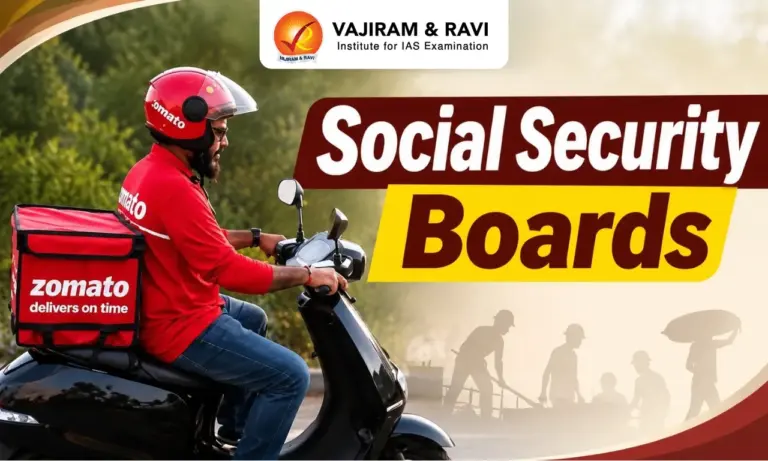
- The Ministry of Labour and Employment has notified the constitution of two key bodies: the National Social Security Board (NSSB) for unorganised workers (40 members) and a separate NSSB for gig and platform workers (22 members).
- Both boards are tasked with designing, monitoring, and recommending welfare schemes to bridge India’s long-standing social security gap for workers outside the formal employment structure.
Background: The Code on Social Security
- Notified last year (November 2025), alongside three other labour codes, the Code on Social Security merged nine existing social security laws to cover both organised and unorganised sectors.
- For the first time, the Code legally defined “gig workers” and “platform workers.”
- It mandated a national registration system and a dedicated social security fund for unorganised and gig workers.


Composition of the Boards
- National Social Security Board (Unorganised Workers) — 40 members:
- Chairperson: Union Minister for Labour and Employment
- Vice-Chairperson: Secretary, Ministry of Labour and Employment
- Includes employee and employer representatives.
- Nominated Members:
- Unorganised sector workers: 7 representatives representing workers in the unorganised sector
- Employers of unorganised sector: 7 representatives representing employers
- Eminent persons from civil society: 7 representatives
- Parliamentary representatives: 2 members representing the Lok Sabha and 1 member representing the Rajya Sabha (3 total)
- Central Government Ministries and Departments: 10 members representing concerned central ministries and departments
- State Governments: 5 members representing State Governments
- Union Territories: 1 member representing the Union territories [1, 2]
- National Social Security Board (Gig and Platform Workers) — 22 members:
- Union Labour Minister chairs it; Labour Secretary serves as Vice-Chairperson (same structure as the unorganised workers’ board).
- Industry representation: Aggregators and quick-commerce operators like Eternal (Zomato’s parent), Zepto, Swiggy, and Urban Company.
- Worker representation: BMS, the Indian Federation of App-Based Transport Workers (IFAT), and the National Front of Indian Trade Unions (NFITU).
Functions and Powers of the Boards
- As per the Code, the NSSB must meet at least thrice a year.
- Core mandate: Recommend that the Central government frame suitable schemes for different categories of unorganised, gig, and platform workers.
Key Responsibilities
- Monitor social welfare schemes for unorganised workers.
- Review expenditure from the social security fund and its accounts.
- Review record-keeping functions related to gig workers’ welfare schemes performed at the state level.
- Advise the Central government on matters arising from administering the Code.
- Undertake other functions as assigned by the Central government from time to time.
The Social Security Fund: Who Pays, and for What?
- The Code envisions a Social Security Fund for gig and platform workers, funded through:
- Central and State government contributions.
- Corporate Social Responsibility (CSR) funds.
- Fines collected through compounding.
- Aggregator Contributions: Companies like Amazon, Flipkart, Swiggy, and Zomato must contribute 1-2% of their annual turnover to the fund — with total contribution capped at 5% of the amount payable to workers.
- Covered benefits the Centre may frame schemes for include:
- Life and disability cover.
- Accident insurance.
- Health and maternity benefits.
- Old age protection.
- Crèche facilities.
Expanded EPFO Coverage: A Major Structural Shift
- EPFO (Employees’ Provident Fund Organisation) provisions now apply to all establishments with 20+ employees, regardless of industry type.
- Previously, EPFO applied only to establishments listed in Schedule 1 of the Act — primarily manufacturing sector entities.
- This restriction has been removed under the Code on Social Security, bringing both organised and unorganised sector workers under the social security umbrella.
- Schemes will be funded wholly or partly by Central/State governments or CSR contributions.
What Changes for Gig Workers Specifically
- Gig and platform workers will receive social security cover for the first time in India’s labour history.
- Mandatory Registration: Platforms must work with the government to register all gig and platform workers.
- Technology Enabler: Registration will use an Aadhaar-linked Universal Account Number (UAN) — ensuring benefits remain portable across states, crucial given gig workers’ frequent inter-state mobility for work.
- Scale of Impact: As per NITI Aayog, India’s gig economy is projected to employ 2.35 crore (23.5 million) workers by 2029-30 — making this reform potentially transformative for a rapidly growing workforce segment.
Conclusion
- The notification of these two Social Security Boards operationalises one of the most significant labour reforms in recent Indian history — extending formal social security protections to a workforce segment that has historically operated entirely outside such safeguards.
- By mandating aggregator contributions, enabling portable Aadhaar-linked registration, and expanding EPFO coverage beyond manufacturing-sector limits, the Code addresses a genuine structural gap as India’s gig economy approaches a projected 2.35 crore workers by 2029-30.
- However, the real test will lie in implementation — particularly ensuring that board composition remains genuinely representative of worker interests, and that the promised benefits translate into accessible, timely support for a workforce often characterised by precarious, fragmented employment.
Source: IE

 Last updated on Nov, 2026
→ UPSC 2027 Notification will be released on 13 January 2027 at upsconline.nic.in.
→ Check Nobel Prize 2026 Winners List here.
→ Download PIB PRiSM Monthly Magazine 2026 here.
→ Check UPSC Monthly Current Affairs Magazine The Recitals here.
→ Check out the latest UPSC Syllabus here.
→ Download UPSC Model Answers for Mains 2026
→ UPSC Mains Question Paper 2026 is out now for Essay & GS Paper 1, 2, 3 & 4.
→ UPSC Calendar 2027 has been released.
→ Enroll in Vajiram & Ravi’s UPSC Mains Test Series 2027 for structured answer writing practice, expert evaluation, and exam-oriented feedback.
→ Join Vajiram & Ravi’s UPSC Mentorship Program 2027 for personalized guidance, strategy planning, and one-to-one support from experienced mentors.
→ Go through the UPSC Mains Previous Year Papers to enhance your preparation.
→ UPSC has released UPSC Toppers List 2025 with the Civil Services final result on its official website.
→ Also check Best UPSC Coaching in India
Social Security Boards FAQs
Q1. What are the Social Security Boards for Gig Workers? +
Q2. What is the composition of the Social Security Boards for Gig Workers? +
Q3. What are the main functions of the Social Security Boards for Gig Workers? +
Q4. How will the Social Security Boards for Gig Workers be funded? +
Q5. How will the Social Security Boards for Gig Workers benefit platform workers? +
Tags: mains articles Social Security Boards upsc current affairs upsc mains current affairs