Solar Cycle Latest News
Researchers from the Indian Institute of Astrophysics (IIA) have used over 100 years of observations from the Kodaikanal solar observatory to investigate how large cellular structures known as supergranulations behave during different phases of the solar cycle.
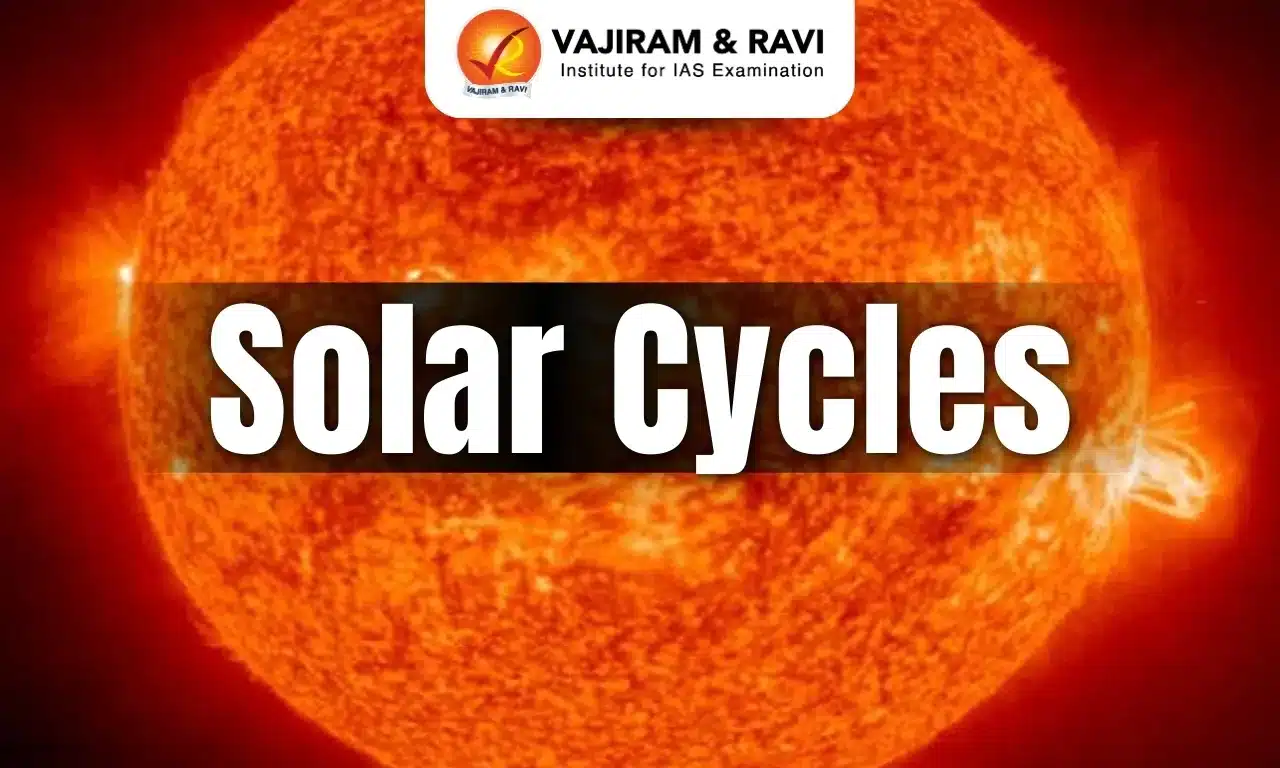
About Solar Cycle
- It describes an approximately 11-year cycle of solar activity driven by the sun’s magnetic field.
- It is indicated by the frequency and intensity of sunspots visible on the surface.
- Every 11 years or so, the Sun’s magnetic field completely flips.
- This means that the Sun’s north and south poles switch places. Then it takes about another 11 years for the Sun’s north and south poles to flip back again.
- The solar cycle affects activity on the surface of the Sun, such as sunspots, which are caused by the Sun’s magnetic fields.
- As the magnetic fields change, so does the amount of activity on the Sun’s surface.
- It can be tracked by counting the number of sunspots.
- Cycle Stages
- Solar minimum: It is the beginning of a solar cycle or when the Sun has the least sunspots.
- Over time, solar activity—and the number of sunspots—increases.
- Solar maximum: It is the middle of the solar cycle or when the Sun has the most sunspots.
- As the cycle ends, it fades back to the solar minimum, and then a new cycle begins.
- Impact: The solar cycle has the potential to impact Earth’s climatic conditions through changes in solar radiation, cosmic rays, and ozone distribution.
What is the Sun’s supergranulation?
- The Sun’s supergranulation refers to a physical pattern covering the surface of the quiet Sun with a typical horizontal scale of approximately 30,000 km and a lifetime of around 1.8 d.
- Supergranulation was discovered by Hart (1954) using Doppler images of the Sun.
Source: PIB


 Last updated on Oct, 2026
→ UPSC 2027 Notification will be released on 13 January 2027 at upsconline.nic.in.
→ Check Nobel Prize 2026 Winners List here.
→ Download PIB PRiSM Monthly Magazine 2026 here.
→ Check UPSC Monthly Current Affairs Magazine The Recitals here.
→ Check out the latest UPSC Syllabus here.
→ Download UPSC Model Answers for Mains 2026
→ UPSC Mains Question Paper 2026 is out now for Essay & GS Paper 1, 2, 3 & 4.
→ UPSC Calendar 2027 has been released.
→ Enroll in Vajiram & Ravi’s UPSC Mains Test Series 2027 for structured answer writing practice, expert evaluation, and exam-oriented feedback.
→ Join Vajiram & Ravi’s UPSC Mentorship Program 2027 for personalized guidance, strategy planning, and one-to-one support from experienced mentors.
→ Go through the UPSC Mains Previous Year Papers to enhance your preparation.
→ UPSC has released UPSC Toppers List 2025 with the Civil Services final result on its official website.
→ Also check Best UPSC Coaching in India
Solar Cycle FAQs
Q1. How does Solar Cycle is measured?+
Q2. During Solar Maximum, which activity increases on Sun?+
Tags: solar cycles