About Solid-fuel missiles
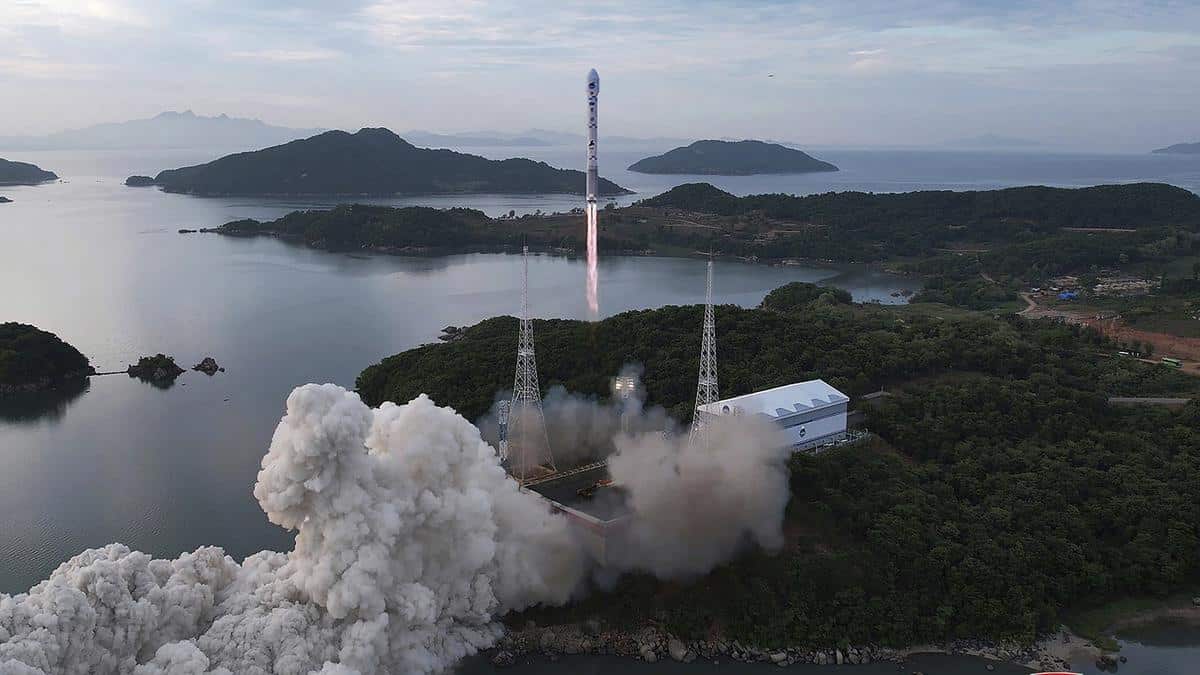
- Solid-fuel missiles do not need to be fuelled immediately ahead of launch.
- They are often easier and safer to operate, and require less logistical support.
- They are harder to detect and more survivable than liquid-fuel weapons.
- Working of Solid Fuel Technology
- Solid propellants are a mixture of fuel and oxidiser.
- Metallic powders such as aluminium often serve as the fuel, and ammonium perchlorate, which is the salt of perchloric acid and ammonia, is the most common oxidiser.
- The fuel and oxidiser are bound together by a hard rubbery material and packed into a metal casing.
- When solid propellant burns, oxygen from the ammonium perchlorate combines with aluminium to generate enormous amounts of energy and temperatures of more than 5,000 degrees Fahrenheit (2,760 degrees Celsius), creating thrust and lifting the missile from the launch pad.
Solid Fuel VS Liquid Fuel Missiles
- Liquid propellants provide greater propulsive thrust and power, but require more complex technology and extra weight.
- Solid fuel is dense and burns quite quickly, generating thrust over a short time.
- Solid fuel can remain in storage for an extended period without degrading or breaking down – a common issue with liquid fuel.
Q1) What is an Oxidiser?
It is also referred to as an oxidizing agent, oxidant, or oxidiser can be defined as either a chemical compound that readily transfers oxygen atoms, or a substance that gains electrons in a redox chemical reaction.
Source: Explainer: What are solid-fuel missiles, and why is North Korea developing them?


 Last updated on Oct, 2026
→ UPSC 2027 Notification will be released on 13 January 2027 at upsconline.nic.in.
→ Check Nobel Prize 2026 Winners List here.
→ Download PIB PRiSM Monthly Magazine 2026 here.
→ Check UPSC Monthly Current Affairs Magazine The Recitals here.
→ Check out the latest UPSC Syllabus here.
→ Download UPSC Model Answers for Mains 2026
→ UPSC Mains Question Paper 2026 is out now for Essay & GS Paper 1, 2, 3 & 4.
→ UPSC Calendar 2027 has been released.
→ Enroll in Vajiram & Ravi’s UPSC Mains Test Series 2027 for structured answer writing practice, expert evaluation, and exam-oriented feedback.
→ Join Vajiram & Ravi’s UPSC Mentorship Program 2027 for personalized guidance, strategy planning, and one-to-one support from experienced mentors.
→ Go through the UPSC Mains Previous Year Papers to enhance your preparation.
→ UPSC has released UPSC Toppers List 2025 with the Civil Services final result on its official website.
→ Also check Best UPSC Coaching in India