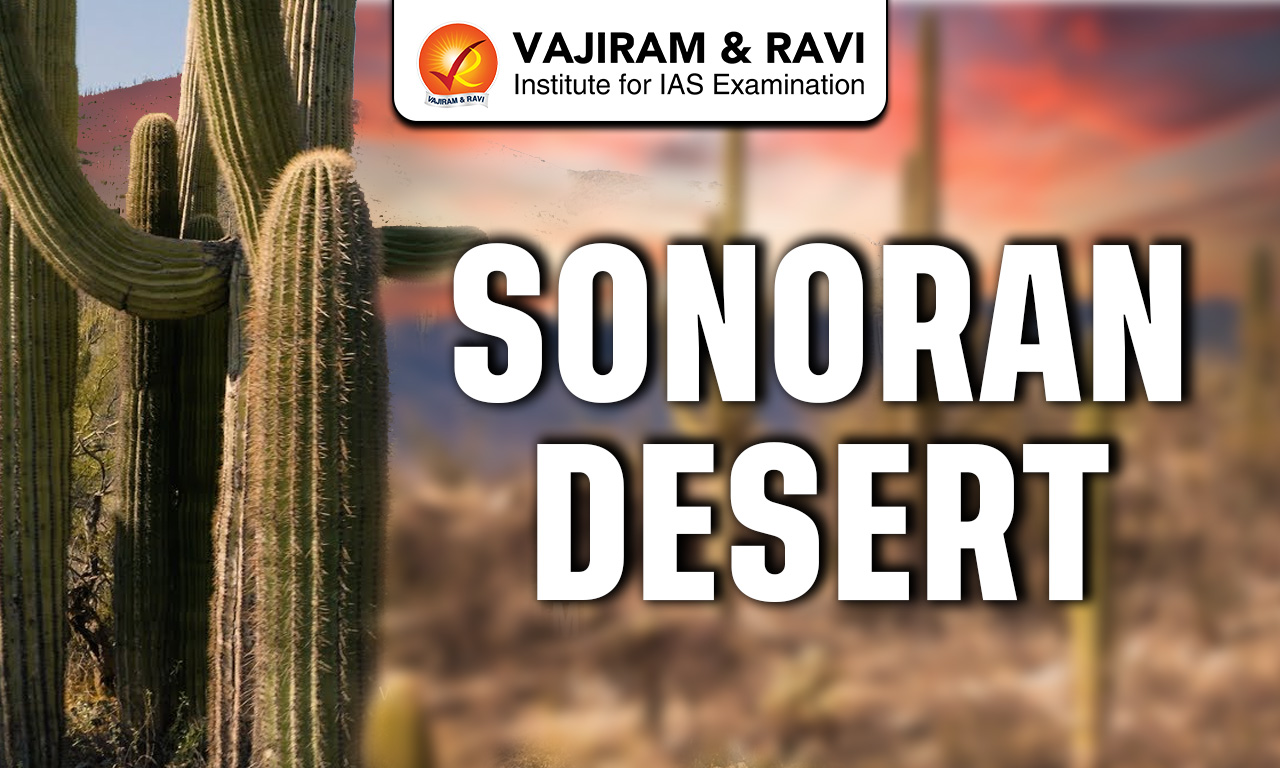
The Sonoran Desert is one of the most ecologically rich and geographically diverse desert regions in the world. Spread across approximately 120,000 square miles, it extends over the southwestern United States (primarily Arizona and California) and northwestern Mexico, including the states of Sonora and Baja California. Unlike typical deserts, it supports a remarkable diversity of life forms due to its unique climatic conditions, varied topography, and dual rainfall system. It is widely regarded as the most biologically diverse desert in North America.
About Sonoran Desert
- The Sonoran Desert is distinguished by its unique bimodal rainfall pattern, receiving precipitation during both winter (from Pacific storms) and summer (from monsoon thunderstorms), which supports a wide range of plant and animal life not typically found in other deserts.
- The Sonoran Desert experiences extreme climatic conditions, with summer temperatures frequently exceeding 40°C and occasionally reaching up to 48°C, while winters remain relatively mild, especially in lowland areas where frost is rare.
- The Sonoran Desert has a highly varied topography characterized by the Basin and Range system, including rugged mountain ranges, expansive valleys, and gently sloping alluvial fans known as bajadas, which contribute to diverse microclimates.
- The Sonoran Desert contains geological formations that range from ancient Precambrian rocks over two billion years old to relatively recent volcanic features, including lava flows and craters found in regions like the Pinacate volcanic field.
- The Sonoran Desert is home to the iconic saguaro cactus, along with a wide variety of vegetation such as barrel cactus, cholla, prickly pear, ocotillo, mesquite, palo verde, and creosote bush, making it the most vegetatively diverse desert in North America.
- The Sonoran Desert supports a rich diversity of fauna, including mammals like desert bighorn sheep, mule deer, coyotes, and mountain lions, as well as reptiles such as the Gila monster, desert tortoise, and numerous snake species adapted to arid conditions.
- The Sonoran Desert provides habitat for a wide range of bird species, including roadrunners, Gila woodpeckers, Gambel’s quail, hawks, and owls, many of which are specially adapted to survive in extreme heat and limited water availability.
- The Sonoran Desert ecosystem includes important river systems such as the Colorado River, Gila River, and Salt River, which provide crucial water resources for both wildlife and human populations.
- The Sonoran Desert is characterized by large diurnal temperature variations, often exceeding 15°C, due to low humidity and minimal vegetation cover, which allows rapid heat loss after sunset.
- The Sonoran Desert is influenced by surrounding mountain systems such as the Sierra Madre Occidental and the Peninsular Ranges, which affect rainfall patterns and climatic conditions.
- The Sonoran Desert contains several protected areas, including Saguaro National Park, Organ Pipe Cactus National Monument, and Cabeza Prieta National Wildlife Refuge, which help conserve its unique biodiversity.
- The Sonoran Desert plays a crucial ecological role by supporting pollinators such as bats, bees, and birds, which are essential for the reproduction of many desert plants, including cacti and flowering shrubs.


 Last updated on Oct, 2026
→ UPSC 2027 Notification will be released on 13 January 2027 at upsconline.nic.in.
→ Check Nobel Prize 2026 Winners List here.
→ Download PIB PRiSM Monthly Magazine 2026 here.
→ Check UPSC Monthly Current Affairs Magazine The Recitals here.
→ Check out the latest UPSC Syllabus here.
→ Download UPSC Model Answers for Mains 2026
→ UPSC Mains Question Paper 2026 is out now for Essay & GS Paper 1, 2, 3 & 4.
→ UPSC Calendar 2027 has been released.
→ Enroll in Vajiram & Ravi’s UPSC Mains Test Series 2027 for structured answer writing practice, expert evaluation, and exam-oriented feedback.
→ Join Vajiram & Ravi’s UPSC Mentorship Program 2027 for personalized guidance, strategy planning, and one-to-one support from experienced mentors.
→ Go through the UPSC Mains Previous Year Papers to enhance your preparation.
→ UPSC has released UPSC Toppers List 2025 with the Civil Services final result on its official website.
→ Also check Best UPSC Coaching in India
Sonoran Desert FAQs
Q1. Where is the Sonoran Desert located?+
Q2. Why is the Sonoran Desert considered unique?+
Q3. What is the climate of the Sonoran Desert?+
Q4. Which is the most famous plant found in the Sonoran Desert?+
Q5. What types of animals are found in the Sonoran Desert?+
Tags: geography geography notes sonoran desert