Sovereign Credit Ratings Latest News
- Speaking at a business conference in London, Commerce Minister Piyush Goyal questioned the methodologies of sovereign rating agencies, saying they have been “unfair to India.”
- He contrasted this with praise for one agency — CareEdge Ratings — for being “objective.” This is not the first time India has raised this concern, and it has revived the debate over how the country is rated.
What Do Rating Agencies Measure
- India is rated by seven international sovereign credit rating agencies: S&P, Moody’s, Morningstar DBRS, Fitch, the Japanese Credit Rating Agency (JCRA), Rating and Investment Information (R&I), and CareEdge Ratings.
- The three most widely accepted globally are S&P, Fitch, and Moody’s.
- Their core job is to measure an entity’s ability and willingness to repay its debt. The entity can be a company, a municipal corporation, a state, or — in the case of sovereign ratings — a national government.
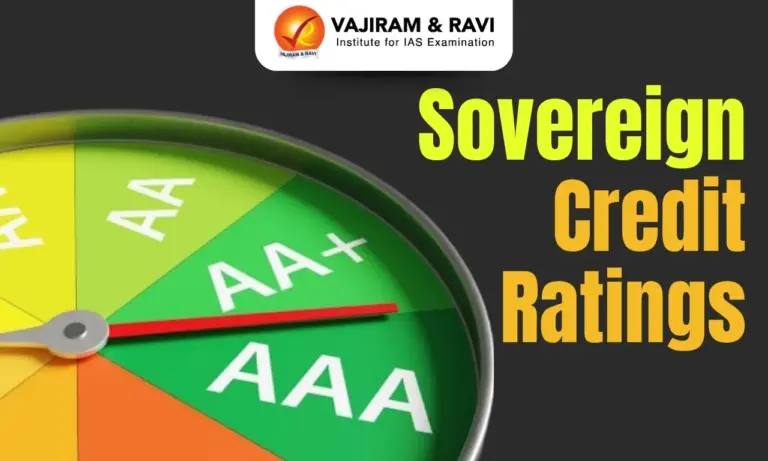
- How the scale works: Ratings use an alphabet scale. Fitch and S&P use AAA as the highest (Moody’s uses Aaa), descending through AA+, AA, AA-, A+, A, A-, then into the ‘B’ ratings, down to D, which means the entity is in default.
- Why ratings matter: They determine the interest rate at which an entity can borrow. A AAA rating implies no default risk and the lowest borrowing costs. The lower the rating, the higher the perceived risk — and the higher the interest rate demanded to offset it.


The Key Distinction: Ability vs. Willingness to Repay
- This is the conceptual heart of the dispute. The two metrics are very different:
- Ability to repay is largely quantitative — backed by hard numbers that show whether a country can service its debt.
- Willingness to repay is largely qualitative — it relies on opinion and judgement rather than hard data.
- This distinction underpins India’s entire grievance.
How India Has Been Rated So Far
- For years, India has been rated at the lowest rung of investment grade — just a grade or two above “junk” status (the point at which lenders stop lending for fear of default).
- Strikingly, these ratings went unchanged for over a decade, and in some cases nearly two decades.
- Recent upgrades have come, but slowly:
- Even after these upgrades, India remains only just above junk grade.
India’s Core Objections
- Despite the upgrades, the government argues the ratings do not reflect reality. The agencies “haven’t recognised the India growth story, the strong India fundamentals and the sovereign capabilities.”
- The issue has even featured in official documents. The Economic Survey 2020-21 devoted an entire chapter to it. Its key arguments:
- It was the first time the world’s fifth-largest economy had been assigned such a low rating.
- India’s macroeconomic fundamentals are strong — more than enough to demonstrate its ability to repay.
- On willingness, India has never defaulted on its sovereign debt despite several crises — which should be strong proof of its willingness to pay.
- The central allegation: Global agencies rely too heavily on qualitative metrics rather than quantitative ones. These qualitative judgements are often based on the opinions of a small group of experts, making them subjective and prone to skewing the overall rating.
- Meanwhile, quantitative metrics — where India performs relatively well — are given comparatively lower weightage.
Why CareEdge Ratings Is Favoured
- CareEdge stands apart for two reasons:
- It is the first sovereign rating agency headquartered in India, so the perception is that it can better capture the ground realities of India’s economy.
- More importantly, its stated methodology gives primary importance to quantitative factors — precisely the metrics on which India scores well, and precisely the fix India has been demanding of the global agencies.
Conclusion
- India’s dispute with global rating agencies boils down to a single argument: that ratings lean too much on subjective, opinion-based qualitative judgements and too little on hard quantitative data, where India performs well.
- With strong fundamentals, a clean record of never defaulting, and status as the world’s fifth-largest economy, New Delhi feels its persistent ranking just above junk grade is unjustified.
- The recent upgrades by S&P, Moody’s, R&I and others suggest some movement, but the deeper concern remains — that the methodology itself needs reform.
- The government’s endorsement of the India-headquartered, quantitatively-driven CareEdge signals the kind of approach it believes would rate India more fairly.

 Last updated on Oct, 2026
→ UPSC 2027 Notification will be released on 13 January 2027 at upsconline.nic.in.
→ Check Nobel Prize 2026 Winners List here.
→ Download PIB PRiSM Monthly Magazine 2026 here.
→ Check UPSC Monthly Current Affairs Magazine The Recitals here.
→ Check out the latest UPSC Syllabus here.
→ Download UPSC Model Answers for Mains 2026
→ UPSC Mains Question Paper 2026 is out now for Essay & GS Paper 1, 2, 3 & 4.
→ UPSC Calendar 2027 has been released.
→ Enroll in Vajiram & Ravi’s UPSC Mains Test Series 2027 for structured answer writing practice, expert evaluation, and exam-oriented feedback.
→ Join Vajiram & Ravi’s UPSC Mentorship Program 2027 for personalized guidance, strategy planning, and one-to-one support from experienced mentors.
→ Go through the UPSC Mains Previous Year Papers to enhance your preparation.
→ UPSC has released UPSC Toppers List 2025 with the Civil Services final result on its official website.
→ Also check Best UPSC Coaching in India
Sovereign Credit Ratings FAQs
Q1. Why does India object to current Sovereign Credit Ratings?+
Q2. How do Sovereign Credit Ratings affect a country's economy?+
Q3. What is the difference between ability and willingness in Sovereign Credit Ratings?+
Q4. Why does India consider its Sovereign Credit Ratings unfair?+
Q5. Why is CareEdge Ratings highlighted in the debate on Sovereign Credit Ratings?+
Tags: mains articles Sovereign Credit Ratings upsc current affairs upsc mains current affairs