What’s in Today’s Article?
- Kosmos 482 Re-Entry Latest News
- Kosmos 482 Mission
- Kosmos 482: Mission Failure Explained
- Kosmos 482’s Uncontrolled Re-entry
- Frequency of Space Debris Re-Entry
- Kosmos 482 Re-Entry FAQs
Kosmos 482 Re-Entry Latest News
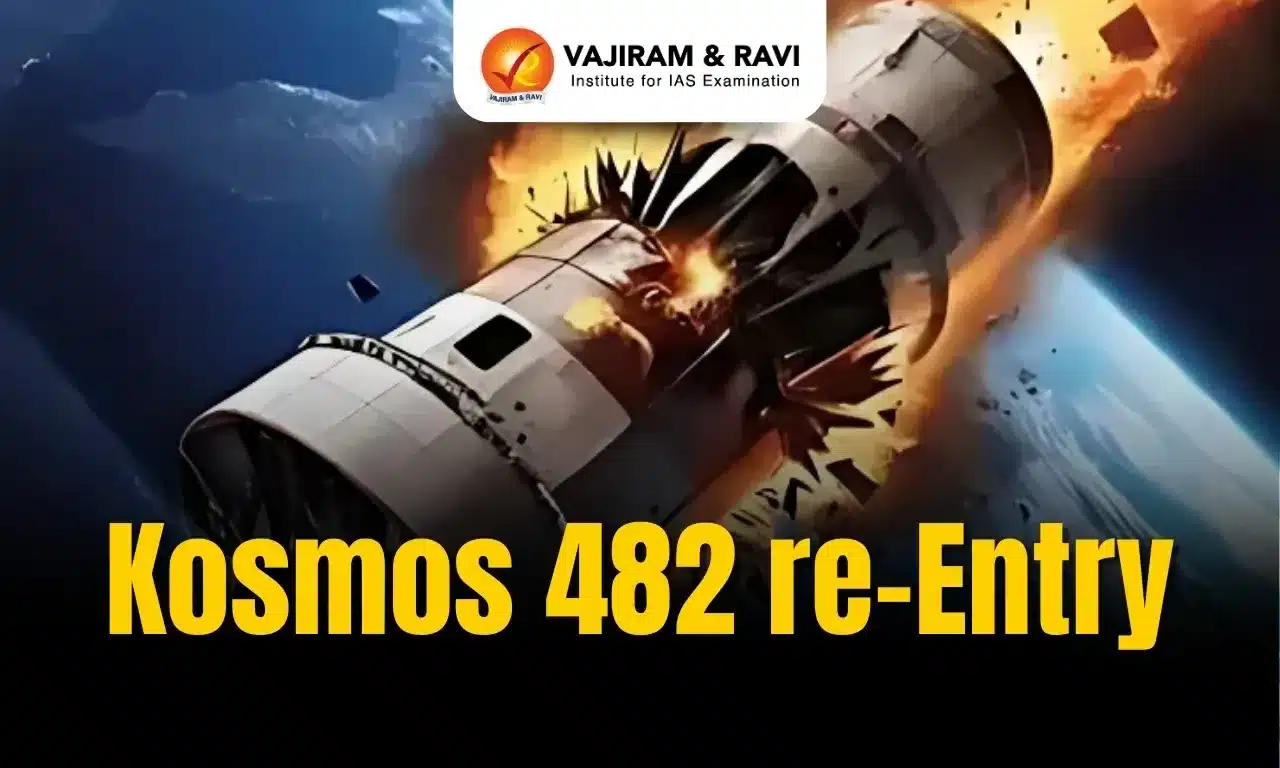
- A 500 kg fragment of the Soviet Kosmos 482 spacecraft, launched on March 31, 1972, is expected to crashed in Indian Ocean, west of Jakarta.
- Originally intended to land on Venus, the mission failed, and while most parts re-entered Earth within a decade, this particular piece remained in orbit. Till the very end, experts could not determine the exact time or location of its re-entry.


Kosmos 482 Mission
- Kosmos 482 was part of the Soviet Union’s Cold War-era effort to explore Venus and showcase scientific dominance.
- The mission aimed to study Venus’s surface and atmosphere.
Background
- Launched under the Venera Program (1961–1984), the Soviet Union sent 28 spacecraft to Venus.
- Of these, 13 entered the atmosphere and 10 landed successfully, but extreme conditions limited their survival to 23 minutes–2 hours.
Mission Details
- Kosmos 482 lifted off on March 31, 1972, just days after its twin mission, Venera 8, which landed on Venus 117 days later.
- Kosmos 482 carried instruments to measure temperature, pressure, wind speed, visibility, atmospheric gases, and rock composition, and was designed to transmit data back to Earth.
Outcome
- The mission failed to leave Earth orbit due to a malfunction, preventing it from reaching Venus.
Kosmos 482: Mission Failure Explained
- Cause of Malfunction
- A critical error occurred shortly after launch when the upper rocket stage shut off prematurely due to an incorrectly set timer.
- This stage was responsible for propelling the spacecraft out of Earth’s orbit.
- Immediate Consequence
- The spacecraft failed to escape Earth’s orbit and became stranded. The lander module separated from the main body of the spacecraft as a result.
- The main spacecraft, being large and heavy, eventually burned up upon re-entering Earth’s atmosphere.
- The smaller lander module remained in orbit for decades.
- Current Status
- The lander module is now gradually being pulled toward Earth by atmospheric drag.
Kosmos 482’s Uncontrolled Re-entry
- The lander module’s return to Earth was uncontrolled.
- After 53 years in space, it lacked systems like aerobraking, parachutes, or internal cooling, making it reliant solely on atmospheric friction to slow down.
Material and Speed Concerns
- The module was made of titanium, which melts at around 1,700°C—hotter than typical re-entry temperatures (~1,600°C).
- Therefore, it was unlikely to burn up completely and may survive re-entry.
- It was traveling at over 17,000 miles per hour.
Potential Impact Zone
- Its orbit covers a wide area between 52°N and 52°S latitudes, including regions in Africa, Australia, the Americas, and large parts of Europe and Asia.
Frequency of Space Debris Re-Entry
- The crash of Kosmos 482 is not unusual.
- According to the European Space Agency, over 2,400 man-made objects re-entered Earth’s atmosphere in 2022 alone—a record high.
- Most of these objects either burned up or landed in the ocean.
Why Scientists Are Not Alarmed
- Because such re-entries are common and typically harmless, scientists were not particularly concerned about Kosmos 482’s lander module crashing.
Human Risk Remains Extremely Low
- There has been no recorded human fatality due to space debris.
- ESA states that the annual risk of an individual being injured by falling space debris is less than 1 in 100 billion.
- In contrast, a person is 65,000 times more likely to be struck by lightning.
Kosmos 482 Re-Entry FAQs
Q1. What was Kosmos 482’s mission?
Ans. Kosmos 482 was intended to explore Venus but failed due to a launch malfunction and remained stuck in Earth’s orbit.
Q2. Why did Kosmos 482 fail?
Ans. A rocket timer error caused early engine shutdown, stranding the spacecraft in Earth orbit instead of sending it to Venus.
Q3. Did Kosmos 482 completely burn on re-entry?
Ans. No, its titanium parts may have survived re-entry, as titanium melts at higher temperatures than typical atmospheric re-entry.
Q4. Is falling space debris dangerous?
Ans. Not usually. Experts state the chance of injury from falling space debris is less than 1 in 100 billion.
Q5. How common is space debris re-entry?
Ans. Very. In 2022 alone, over 2,400 man-made objects re-entered Earth’s atmosphere, mostly burning up or falling in oceans.

 Last updated on Oct, 2026
→ UPSC 2027 Notification will be released on 13 January 2027 at upsconline.nic.in.
→ Asian Games 2026 are being held in Aichi-Nagoya, Japan, from 19 September to 4 October.
→ Check Nobel Prize 2026 Winners List here.
→ Download PIB PRiSM Monthly Magazine 2026 here.
→ Check UPSC Monthly Current Affairs Magazine The Recitals here.
→ Check out the latest UPSC Syllabus here.
→ Download UPSC Model Answers for Mains 2026
→ UPSC Mains Question Paper 2026 is out now for Essay & GS Paper 1, 2, 3 & 4.
→ UPSC Calendar 2027 has been released.
→ Enroll in Vajiram & Ravi’s UPSC Mains Test Series 2027 for structured answer writing practice, expert evaluation, and exam-oriented feedback.
→ Join Vajiram & Ravi’s UPSC Mentorship Program 2027 for personalized guidance, strategy planning, and one-to-one support from experienced mentors.
→ Go through the UPSC Mains Previous Year Papers to enhance your preparation.
→ UPSC has released UPSC Toppers List 2025 with the Civil Services final result on its official website.
→ Also check Best UPSC Coaching in India