What’s in today’s article?
- Why in news?
- What is Airwaves/Spectrum?
- Types of spectrum band
- What spectrum do telecom companies require?
- News Summary: Nod for spectrum auction
- Key highlights
- Spectrum allocation to railways
Why in news?
- The Cabinet has approved telecom spectrum auction across multiple bands at a base price of Rs 96,317.65 crore.
- The Cabinet also approved the proposal, which entails granting Indian Railways 5 Megahertz of wireless spectrum, largely free of cost, for real-time data to enhance passenger safety.


Airwaves/Spectrum
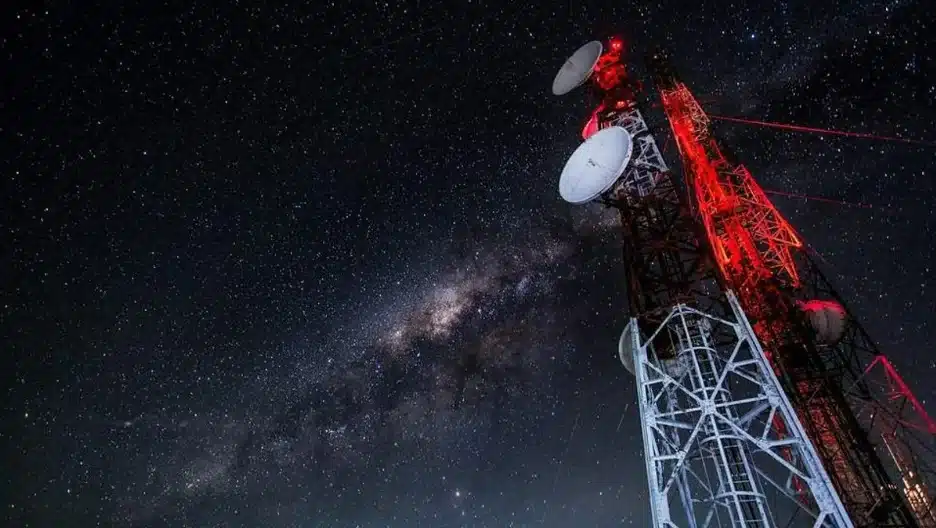
- Airwaves are radio frequencies within the electromagnetic spectrum that can carry information wirelessly for a range of services including telecommunications.
- The government manages and allocates airwaves to companies or sectors for their use.
- The government auctions a fixed amount of spectrum within specified band/s to be utilised by operators for providing communication services to consumers.
Types of spectrum band
- Spectrum can be divided into bands ranging from low frequency to high frequency, which determines their usage and is useful in allocation.
- Low band spectrum
- Less than 1 GHz (600 MHz,700 MHz, 800 MHz, 900 MHz)
- Offers blanket coverage suitable to serve thousands of customers over long distances with fewer towers.
- Ideal for wide and in-building coverage.
- When bundled with high-spectrum bands, it can be used for commercial mobile and broadcasting services.
- The mid-band spectrum
- Ranges from 1 GHz to 6 GHz (1800 MHz, 2100 MHz, and 2300 MHz).
- Provides coverage as well as the capacity to carry more data while traveling significant distances.
- The high band spectrum
- Ranges from 24 GHz to 40 GHz and are also known as the millimetre wave spectrum.
- Ideal for speedy networks over short ranges.
- However, this range is subject to interference from dense objects.
What spectrum do telecom companies require?
- According to the GSM Association, for telecom purposes, spectrum in the 400 MHz to 4 GHz range is the most optimum.
- Operators can provide 2G, 3G, 4G, and 5G services using one frequency band if they have enough spectrum.
- For mobile technology in India:
- 2G services use the 900 MHz and 1800 MHz bands,
- 3G uses 900 MHz and 2100 MHz,
- 4G uses 850 MHz, 1800 MHz, 2300 MHz, and 2500 MHz, and
- 5G uses 3.5MHz and 700 MHz bands.
- The 900 MHz band is a superior commercial ecosystem with better-developed technology standards.
- It is also suitable for offering GSM-based voice calls as well as 4G broadband services.
- After 900 MHz, the band suitable for GSM is 1800 MHz, which is also the core band used globally for LTE (long-term evolution), a 4G mobile communications standard.
- 5G spectrum bands can be clubbed into low, mid and high spectrum buckets.
News Summary
- The Union Cabinet approved an auction of telecom spectrum this year for airwaves amounting to a cumulative reserve price of ₹96,317.65 crore.
- The reserve pricing is the minimum telecom companies will have to pay for acquiring this spectrum.
- This is because, these companies will have to bid with the reserve pricing as the minimum price.
Key highlights
- Bands to be auctioned
- The spectrum will be in the 800, 900, 1,800, 2,100, 2,300, 2,500 and 3,300 megahertz (MHz), as well as in the 26 gigahertz (GHz) bands.
- If sold, the spectrum will be valid for a 20-year period.
- Expiring airwaves of some companies will also be auctioned
- Expiring airwaves that belong to certain companies undergoing insolvency will also be auctioned.
- Approved spectrum requirements of railways
- Spectrum has also been approved for use by the railways for the deployment of Kavach.
- Kavach is the automatic train protection (ATP) system used for preventing accidents in the rail network.
- This 5 MHz band in the 700MHz band will be assigned to multiple regional and urban rail-based transit systems.
- The Indian Railways had sought additional 5 Mhz of paired spectrum, free of cost, in the 700 MHz band in July 2023.
- This was a month after the Balasore incident that left 296 persons dead and nearly 1,200 injured.
- Spectrum has also been approved for use by the railways for the deployment of Kavach.
- Committee formed to decide on the issue of refarming spectrum
- The government has also set up a Cabinet Secretary-chaired committee to decide on the issue of refarming spectrum.
- Spectrum refarming is the process of repurposing radio frequency bands for different uses.
- This allows different generations of cellular networks to operate in the same radio spectrum.
- In other words, it is the process of transitioning a specific radio frequency band from one technology to another.
- The government has also set up a Cabinet Secretary-chaired committee to decide on the issue of refarming spectrum.
Spectrum allocation to railways
- Past precedents
- In the past, the Railways had received spectrum grants, for which they only needed to pay an annual royalty without bidding for the airwaves like telecom operators.
- However, the data transfer capacity was not sufficient to allow trains to continuously upload video footage for safety purposes.
- The video feeds were instead dumped at railway stations with a WiFi connection.
- Demand of spectrum from railways
- The Railways was only granted 5 Mhz of its original demand for 15 MHz in discussions post the Balasore tragedy.
- As a result, Railways had again asked for an additional 5 MHz of paired spectrum in the 700 MHz band.
- Railways wants additional spectrum for implementing several safety features such as:
- the Modern Train Control System,
- Train Collision Avoidance System,
- signal aspect in loco cabs, and
- emergency mobile communications.
- Other advantages that the spectrum allocation could bring, include:
- increased speed,
- augmenting train’s running capacity,
- passenger security,
- CCTV network-like live feed at security control centres,
- video surveillance, video analytics, asset reliability, etc.
- Opposition from Cellular Operators Association of India (COAI)
- COAI had in the past opposed free handouts in the 700 MHz band, from which this spectrum has been set aside for the Railways.
- That band is used for commercial telecom operations around the world, and a significant chunk of it had already been assigned to the Ministry of Defence.
- Further assignment to non-telecom use cases would leave the spectrum availability for technologies like 5G grossly inadequate.
Q1) What is Long-term evolution (LTE)?
Long-term evolution (LTE) is a 4th generation (4G) wireless standard that improves the speed and capacity of cellular networks. It’s based on GSM/EDGE and UMTS/HSPA standards, but uses a different radio interface and core network improvements.
Q2) What is Global System for Mobile Communication (GSM)?
GSM stands for Global System for Mobile Communication. It’s a second-generation telecommunication standard (2G) that describes the protocols for digital cellular networks. GSM is a wireless network that allows mobile devices like phones and tablets to transmit data and voice services.
Source: Nod for spectrum auction at base price of Rs 96,317 crore | The Hindu | The Hindu| Indian Express

 Last updated on Oct, 2026
→ UPSC 2027 Notification will be released on 13 January 2027 at upsconline.nic.in.
→ Check Nobel Prize 2026 Winners List here.
→ Download PIB PRiSM Monthly Magazine 2026 here.
→ Check UPSC Monthly Current Affairs Magazine The Recitals here.
→ Check out the latest UPSC Syllabus here.
→ Download UPSC Model Answers for Mains 2026
→ UPSC Mains Question Paper 2026 is out now for Essay & GS Paper 1, 2, 3 & 4.
→ UPSC Calendar 2027 has been released.
→ Enroll in Vajiram & Ravi’s UPSC Mains Test Series 2027 for structured answer writing practice, expert evaluation, and exam-oriented feedback.
→ Join Vajiram & Ravi’s UPSC Mentorship Program 2027 for personalized guidance, strategy planning, and one-to-one support from experienced mentors.
→ Go through the UPSC Mains Previous Year Papers to enhance your preparation.
→ UPSC has released UPSC Toppers List 2025 with the Civil Services final result on its official website.
→ Also check Best UPSC Coaching in India