Strait of Hormuz Navigation Fees Latest News
- Following a framework agreement between the US and Iran on June 15, 2026, the Strait of Hormuz was reopened to global shipping and the US blockade on Iranian ships lifted.
- After the US and Israel began hostilities against Iran on February 28, 2026, Iran had used the Strait as both a chokepoint and a bargaining chip, even collecting a toll per transit to offset war damages.
- It has now dropped the toll but continues to levy a navigation fee and an environmental protection charge.
- This raises a core legal question: does Iran’s action pass the test of the “right of transit passage” under the 1982 UN Convention on the Law of the Sea (UNCLOS) and customary international law?
Why the Strait Matters
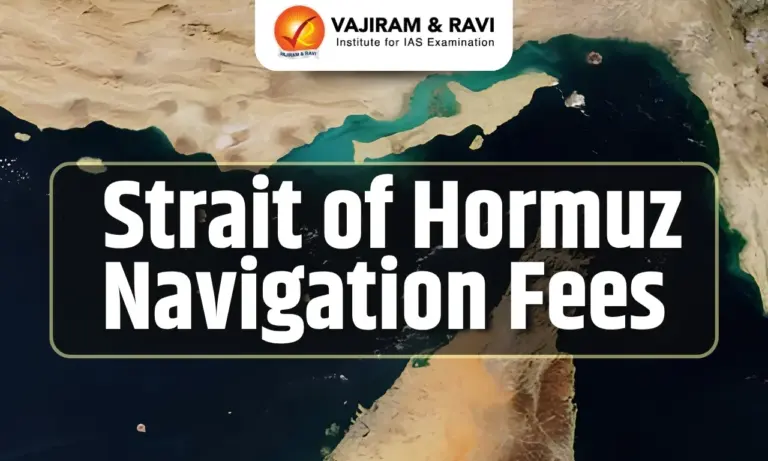
- The Strait of Hormuz is one of the world’s most critical maritime chokepoints — a narrow waterway through which a large share of global oil trade passes.
- Its strategic value is exactly what gives a bordering state like Iran potential leverage, and exactly why international law tries to limit such leverage.


The Legal Principle: Freedom of Navigation
- The heart of the matter lies in UNCLOS Articles 37 to 44, which govern “Straits used for International Navigation.”
- These provide that all ships and aircraft enjoy a “right of transit passage” — the freedom of continuous and swift navigation and overflight through international straits.
- Two phrases are key:
- Transit passage “shall not be impeded.”
- “There shall be no suspension” of transit passage.
- The logic is that when a large portion of global trade depends on a narrow corridor, bordering states should not be able to weaponise it.
- This principle predates UNCLOS. In the Corfu Channel case (UK v. Albania, 1949), the International Court of Justice held that ships enjoy unrestricted passage through a strait used for international navigation during peacetime, so long as transit does not threaten the coastal state’s security.
- By this standard, Iran’s navigation and environmental charges look like an attempt to turn a natural strait into a managed, revenue-generating entry point — administered by Iran with Oman’s support.
International Law’s Silence: The Loopholes Iran Can Use
- Experts believe that the law is not as airtight as it appears, and Iran has several legal openings.
- Territorial waters, not high seas – The Strait lies within the combined territorial seas of Iran and Oman. Here, full high-seas freedom of navigation does not apply. Instead, ships enjoy the “right of innocent passage.”
- The “innocent passage” caveat – Under Article 19 of UNCLOS, innocent passage is subject to the coastal state being satisfied that passage does not prejudice its peace, good order, or security. These grounds are broad enough that Iran could invoke them to deny passage during a tense standoff.
- The flawed canal analogy. Iran might point to the Suez and Panama canals, which charge transit fees. But this analogy might not help Iran: those are artificially engineered waterways built and maintained through sovereign territory and governed by specific treaty regimes — unlike Hormuz, a natural strait governed by UNCLOS.
- The “persistent objector” argument. Iran signed UNCLOS but never ratified it.
- On signing, Iran declared it does not regard the transit-passage regime as customary international law — viewing it instead as a quid pro quo bargain only for treaty parties.
- Under the “persistent objector” doctrine, a state is exempt from an emerging rule of customary international law if it has clearly, consistently and persistently objected to that rule while it was still forming.
- Iran’s domestic law. In 1993, Iran enacted the “Law of Marine Areas of the Islamic Republic of Iran in the Persian Gulf and Oman Sea,” which lets it suspend the passage of foreign ships and requires prior authorisation for warships and vessels carrying harmful substances (for environmental protection).
- Since this latter category can include commercial oil tankers, the inclusion of a navigation and environmental fee in the agreement actually reinforces Iran’s persistent-objector position.
- This claim gains some acceptance under the doctrine of comity of nations — where states voluntarily recognise and respect each other’s laws and customs.
The Bigger Picture: An Economic Weapon
- The distinctive feature of the conflict has been its rapid oscillation between military confrontation and economic warfare, blurring the line between the two.
- Though stretched militarily and economically, Iran demonstrated that it can impose global costs by making ordinary commerce uncertain.
- The smoothness of transit through Hormuz depends partly on Israel’s military moves in Lebanon. Tehran treats the Lebanon conflict as part of the same strategic campaign against it, and sees the Strait as leverage to demand limits on Israeli attacks.
- For an energy-dependent country like India, the episode is a reminder that the security of vital sea lanes rests not only on treaty text but on the geopolitical will of the states that border them.
Source: IE

 Last updated on Oct, 2026
→ UPSC 2027 Notification will be released on 13 January 2027 at upsconline.nic.in.
→ Check Nobel Prize 2026 Winners List here.
→ Download PIB PRiSM Monthly Magazine 2026 here.
→ Check UPSC Monthly Current Affairs Magazine The Recitals here.
→ Check out the latest UPSC Syllabus here.
→ Download UPSC Model Answers for Mains 2026
→ UPSC Mains Question Paper 2026 is out now for Essay & GS Paper 1, 2, 3 & 4.
→ UPSC Calendar 2027 has been released.
→ Enroll in Vajiram & Ravi’s UPSC Mains Test Series 2027 for structured answer writing practice, expert evaluation, and exam-oriented feedback.
→ Join Vajiram & Ravi’s UPSC Mentorship Program 2027 for personalized guidance, strategy planning, and one-to-one support from experienced mentors.
→ Go through the UPSC Mains Previous Year Papers to enhance your preparation.
→ UPSC has released UPSC Toppers List 2025 with the Civil Services final result on its official website.
→ Also check Best UPSC Coaching in India
Strait of Hormuz Navigation Fees FAQs
Q1. Why have Strait of Hormuz Navigation Fees become an international legal issue?+
Q2. How does UNCLOS regulate Strait of Hormuz Navigation Fees?+
Q3. What legal arguments does Iran use to justify Strait of Hormuz Navigation Fees?+
Q4. Why is the Strait of Hormuz strategically important despite the debate over Strait of Hormuz Navigation Fees?+
Q5. What lessons do Strait of Hormuz Navigation Fees hold for India?+
Tags: mains articles Strait of Hormuz Navigation Fees upsc current affairs upsc mains current affairs