About the String Technology
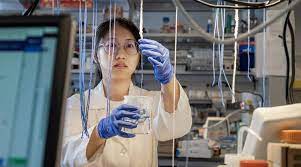
- A set of porous fibres twisted into strings and engineered them to have a water-loving (hydrophilic) core and water-repelling surface.
- When one end is dipped in a salt-water solution, the water travels up the string because of capillary action.
- Then, the water evaporates quickly from the string’s surface. This leaves behind salt ions such as sodium and lithium.
- The water will continue to evaporate like this as the salts become increasingly concentrated, eventually forming sodium chloride and lithium chloride crystals.
- The strings don’t just concentrate the salts. Since lithium and sodium have different physical properties, they crystallise at different locations on the strings.
- Sodium, with its low solubility, crystallises on the lower part, while the highly soluble lithium salts crystallise near the top.
Current method of production
- A large majority of the lithium produced in the world is extracted from “brine reservoirs” located in salt flats.
- Conventional methods of extraction rely on a series of massive evaporation ponds that concentrate lithium from saltwater reservoirs, salt flats of underground aquifers.
- This method of production can require hundreds of square kilometres, and it often takes months or even years to produce lithium that can be used in batteries.
- It is commercially viable in a few locations around the world.
Key facts about Lithium
- It is a soft, silvery-white metal that belongs to the alkali metals group, of the periodic table of the elements.
- Features
- It has the lowest density of all metals.
- It is the lightest of the solid elements.
- It reacts vigorously with water.
- Occurrence:
- It does not occur as a metal in nature but is found combined in small amounts in igneous rocks.
- Major Reserves: Its reserves are majorly concentrated in the lithium triangle in South America – Argentina, Bolivia & Chile, with 50% of the deposits concentrated in these regions.
Q1) What is alkali metal?
The alkali metals are a group of chemical elements located in Group 1 of the periodic table. They are known for their highly reactive nature and are some of the most reactive elements in the periodic table.
Source: New ‘string’ technology could revolutionise lithium production


 Last updated on Oct, 2026
→ UPSC 2027 Notification will be released on 13 January 2027 at upsconline.nic.in.
→ Check Nobel Prize 2026 Winners List here.
→ Download PIB PRiSM Monthly Magazine 2026 here.
→ Check UPSC Monthly Current Affairs Magazine The Recitals here.
→ Check out the latest UPSC Syllabus here.
→ Download UPSC Model Answers for Mains 2026
→ UPSC Mains Question Paper 2026 is out now for Essay & GS Paper 1, 2, 3 & 4.
→ UPSC Calendar 2027 has been released.
→ Enroll in Vajiram & Ravi’s UPSC Mains Test Series 2027 for structured answer writing practice, expert evaluation, and exam-oriented feedback.
→ Join Vajiram & Ravi’s UPSC Mentorship Program 2027 for personalized guidance, strategy planning, and one-to-one support from experienced mentors.
→ Go through the UPSC Mains Previous Year Papers to enhance your preparation.
→ UPSC has released UPSC Toppers List 2025 with the Civil Services final result on its official website.
→ Also check Best UPSC Coaching in India