Stroke Latest News
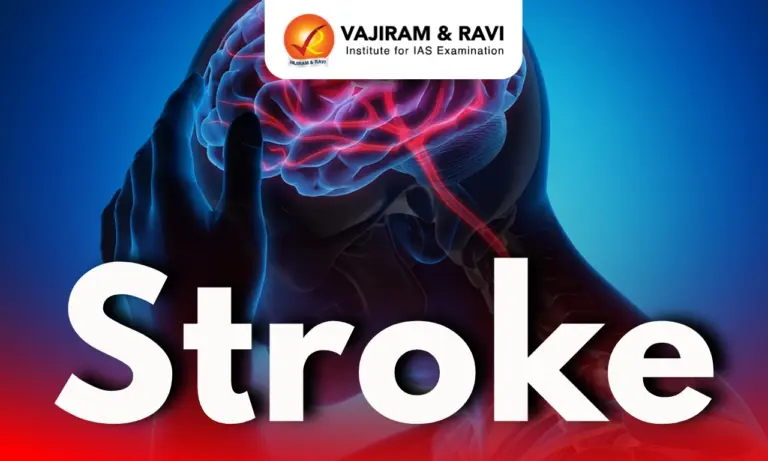
The World Health Assembly (WHA) recently passed the first-ever resolution on strokes, urging member states to recognise the medical condition as a public health priority.
About Stroke
- It is a medical emergency that occurs when blood flow to the brain is interrupted, either due to a blockage or bleeding.
- This lack of blood flow can lead to brain cell death and serious complications.
- A stroke can cause lasting brain damage, long-term disability, or even death.
- The types of strokes are:
- Ischaemic stroke: A blood clot blocks a blood vessel in your brain, leading to loss of blood flow.
- Haemorrhagic stroke: Intracerebral haemorrhage (ICH) by rupture of a blood vessel in the brain leading to bleeding.
- Transient ischaemic attack (TIA): A short period of symptoms similar to those of a stroke, caused by a brief blockage of blood flow to the brain. A TIA usually lasts only a few minutes and doesn’t cause long-term damage.
- Most of the stroke burden is attributable to 10 modifiable risk factors, including high blood pressure, air pollution, smoking, high LDL cholesterol, diet high in sodium, high fasting blood glucose, kidney dysfunction, excess body weight, physical inactivity, and harmful use of alcohol.
- Non‑modifiable risk factors are:
- Age
- A prior stroke
- Pre-existing cardiac conditions (e.g., atrial fibrillation and heart failure) and chronic kidney disease.
- The symptoms of a stroke often happen quickly. They include:
- Sudden numbness or weakness of the face, arm, or leg (especially on one side of the body).
- Sudden confusion, trouble speaking, or understanding speech.
- Sudden trouble seeing in one or both eyes.
- Sudden difficulty walking, dizziness, loss of balance, or coordination.
- Sudden severe headache with no known cause.
- Treatment:
- Treatments for stroke include medicines, surgery, and rehabilitation.
- Prevention of another stroke is also important, since having a stroke increases the risk of getting another one.
- Prevention may include heart-healthy lifestyle changes and medicines.
Source: TH


 Last updated on Oct, 2026
→ UPSC 2027 Notification will be released on 13 January 2027 at upsconline.nic.in.
→ Check Nobel Prize 2026 Winners List here.
→ Download PIB PRiSM Monthly Magazine 2026 here.
→ Check UPSC Monthly Current Affairs Magazine The Recitals here.
→ Check out the latest UPSC Syllabus here.
→ Download UPSC Model Answers for Mains 2026
→ UPSC Mains Question Paper 2026 is out now for Essay & GS Paper 1, 2, 3 & 4.
→ UPSC Calendar 2027 has been released.
→ Enroll in Vajiram & Ravi’s UPSC Mains Test Series 2027 for structured answer writing practice, expert evaluation, and exam-oriented feedback.
→ Join Vajiram & Ravi’s UPSC Mentorship Program 2027 for personalized guidance, strategy planning, and one-to-one support from experienced mentors.
→ Go through the UPSC Mains Previous Year Papers to enhance your preparation.
→ UPSC has released UPSC Toppers List 2025 with the Civil Services final result on its official website.
→ Also check Best UPSC Coaching in India
Stroke FAQs
Q1. What is a stroke?+
Q2. What are the two main causes of a stroke?+
Q3. Why is interrupted blood flow dangerous during a stroke?+
Q4. What is an ischaemic stroke?+
Q5. What is a haemorrhagic stroke?+
Tags: prelims pointers stroke upsc current affairs upsc prelims current affairs